Thank you for visiting SNEWPapers!
Sign up free
Story
January 19, 1914
Newark Evening Star And Newark Advertiser
Newark, Essex County, New Jersey
What is this article about?
A journalist recounts an interview with Dr. Cyrus W. Edson, New York Health Commissioner, who minimized leprosy's contagious risk but highlighted the widespread, taboo venereal disease affecting many, contrasting past prudishness with modern openness exemplified by the play 'Damaged Goods.'
Clipping
OCR Quality
98%
Excellent
Full Text
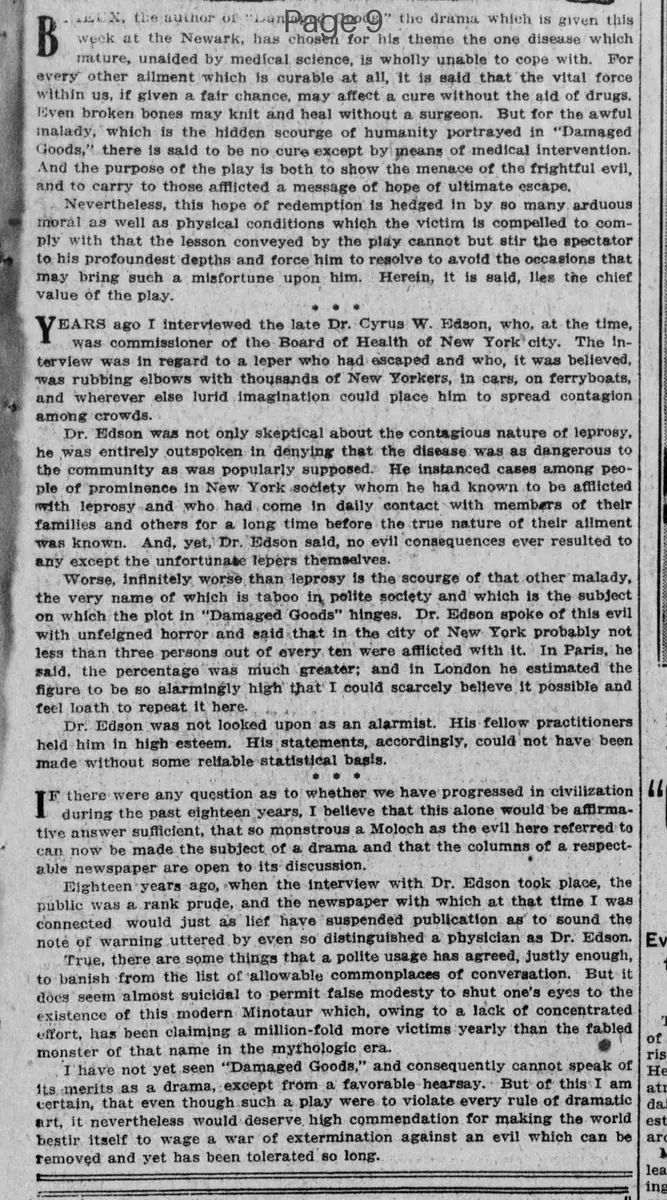
YEARS ago I interviewed the late Dr. Cyrus W. Edson, who, at the time, was commissioner of the Board of Health of New York city. The interview was in regard to a leper who had escaped and who, it was believed, was rubbing elbows with thousands of New Yorkers, in cars, on ferryboats, and wherever else lurid imagination could place him to spread contagion among crowds.
Dr. Edson was not only skeptical about the contagious nature of leprosy. he was entirely outspoken in denying that the disease was as dangerous to the community as was popularly supposed. He instanced cases among people of prominence in New York society whom he had known to be afflicted with leprosy and who had come in daily contact with members of their families and others for a long time before the true nature of their ailment was known. And, yet, Dr. Edson said, no evil consequences ever resulted to any except the unfortunate lepers themselves.
Worse, infinitely worse than leprosy is the scourge of that other malady, the very name of which is taboo in polite society and which is the subject on which the plot in "Damaged Goods" hinges. Dr. Edson spoke of this evil with unfeigned horror and said that in the city of New York probably not less than three persons out of every ten were afflicted with it. In Paris, he said, the percentage was much greater; and in London he estimated the figure to be so alarmingly high that I could scarcely believe it possible and feel loath to repeat it here.
Dr. Edson was not looked upon as an alarmist. His fellow practitioners held him in high esteem. His statements, accordingly, could not have been made without some reliable statistical basis.
If there were any question as to whether we have progressed in civilization during the past eighteen years, I believe that this alone would be affirmative answer sufficient, that so monstrous a Moloch as the evil here referred to can now be made the subject of a drama and that the columns of a respectable newspaper are open to its discussion.
Eighteen years ago, when the interview with Dr. Edson took place, the public was a rank prude, and the newspaper with which at that time I was connected would just as lief have suspended publication as to sound the note of warning uttered by even so distinguished a physician as Dr. Edson.
True, there are some things that a polite usage has agreed, justly enough, to banish from the list of allowable commonplaces of conversation. But it does seem almost suicidal to permit false modesty to shut one's eyes to the existence of this modern Minotaur which, owing to a lack of concentrated effort, has been claiming a million-fold more victims yearly than the fabled monster of that name in the mythologic era.
I have not yet seen "Damaged Goods," and consequently cannot speak of its merits as a drama, except from a favorable hearsay. But of this I am certain, that even though such a play were to violate every rule of dramatic art, it nevertheless would deserve high commendation for making the world bestir itself to wage a war of extermination against an evil which can be removed and yet has been tolerated so long.
Dr. Edson was not only skeptical about the contagious nature of leprosy. he was entirely outspoken in denying that the disease was as dangerous to the community as was popularly supposed. He instanced cases among people of prominence in New York society whom he had known to be afflicted with leprosy and who had come in daily contact with members of their families and others for a long time before the true nature of their ailment was known. And, yet, Dr. Edson said, no evil consequences ever resulted to any except the unfortunate lepers themselves.
Worse, infinitely worse than leprosy is the scourge of that other malady, the very name of which is taboo in polite society and which is the subject on which the plot in "Damaged Goods" hinges. Dr. Edson spoke of this evil with unfeigned horror and said that in the city of New York probably not less than three persons out of every ten were afflicted with it. In Paris, he said, the percentage was much greater; and in London he estimated the figure to be so alarmingly high that I could scarcely believe it possible and feel loath to repeat it here.
Dr. Edson was not looked upon as an alarmist. His fellow practitioners held him in high esteem. His statements, accordingly, could not have been made without some reliable statistical basis.
If there were any question as to whether we have progressed in civilization during the past eighteen years, I believe that this alone would be affirmative answer sufficient, that so monstrous a Moloch as the evil here referred to can now be made the subject of a drama and that the columns of a respectable newspaper are open to its discussion.
Eighteen years ago, when the interview with Dr. Edson took place, the public was a rank prude, and the newspaper with which at that time I was connected would just as lief have suspended publication as to sound the note of warning uttered by even so distinguished a physician as Dr. Edson.
True, there are some things that a polite usage has agreed, justly enough, to banish from the list of allowable commonplaces of conversation. But it does seem almost suicidal to permit false modesty to shut one's eyes to the existence of this modern Minotaur which, owing to a lack of concentrated effort, has been claiming a million-fold more victims yearly than the fabled monster of that name in the mythologic era.
I have not yet seen "Damaged Goods," and consequently cannot speak of its merits as a drama, except from a favorable hearsay. But of this I am certain, that even though such a play were to violate every rule of dramatic art, it nevertheless would deserve high commendation for making the world bestir itself to wage a war of extermination against an evil which can be removed and yet has been tolerated so long.
What sub-type of article is it?
Medical Curiosity
Biography
Historical Event
What themes does it cover?
Moral Virtue
Social Manners
Misfortune
What keywords are associated?
Leprosy
Venereal Disease
Dr. Edson
New York
Damaged Goods
Societal Taboo
What entities or persons were involved?
Dr. Cyrus W. Edson
Where did it happen?
New York City
Story Details
Key Persons
Dr. Cyrus W. Edson
Location
New York City
Event Date
Eighteen Years Ago
Story Details
Journalist interviews Dr. Edson on escaped leper and leprosy's low contagion risk, contrasting it with widespread venereal disease's horror and societal taboo; reflects on progress allowing open discussion via 'Damaged Goods.'