Thank you for visiting SNEWPapers!
Sign up free
Editorial
February 24, 1858
Weekly North Carolina Standard
Raleigh, Wake County, North Carolina
What is this article about?
Editorial quotes Freeman Hunt from Merchant's Magazine arguing against usury laws, claiming they are inexpedient, increase interest rates through evasion, fail to account for market fluctuations, and unjustly restrict trade freedom.
Clipping
OCR Quality
98%
Excellent
Full Text
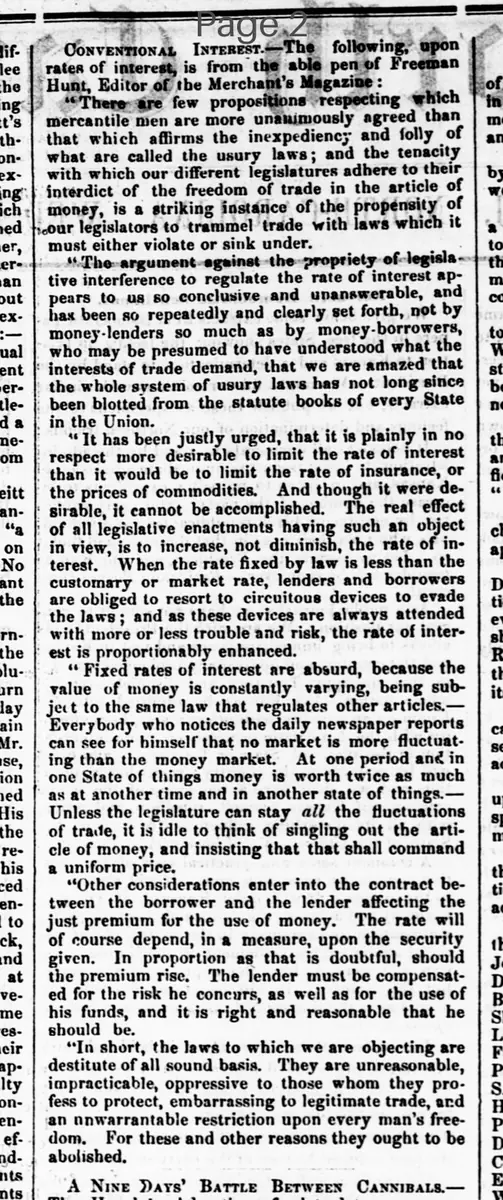
Conventional Interest.
The following, upon rate of interest, is from the able pen of Freeman Hunt, Editor of the Merchant's Magazine:
"There are few propositions respecting which mercantile men are more unanimously agreed than that which affirms the inexpediency and folly of what are called the usury laws; and the tenacity with which our different legislatures adhere to their interdict of the freedom of trade in the article of money, is a striking instance of the propensity of our legislators to trammel trade with laws which it must either violate or sink under.
"The argument against the propriety of legislative interference to regulate the rate of interest appears to us so conclusive and unanswerable, and has been so repeatedly and clearly set forth, not by money-lenders so much as by money-borrowers, who may be presumed to have understood what the interests of trade demand, that we are amazed that the whole system of usury laws has not long since been blotted from the statute books of every State in the Union.
"It has been justly urged, that it is plainly in no respect more desirable to limit the rate of interest than it would be to limit the rate of insurance, or the prices of commodities. And though it were desirable, it cannot be accomplished. The real effect of all legislative enactments having such an object in view, is to increase, not diminish, the rate of interest. When the rate fixed by law is less than the customary or market rate, lenders and borrowers are obliged to resort to circuitous devices to evade the laws; and as these devices are always attended with more or less trouble and risk, the rate of interest is proportionably enhanced.
"Fixed rates of interest are absurd, because the value of money is constantly varying, being subject to the same law that regulates other articles. Everybody who notices the daily newspaper reports can see for himself that no market is more fluctuating than the money market. At one period and in one state of things money is worth twice as much as at another time and in another state of things. Unless the legislature can stay all the fluctuations of trade, it is idle to think of singling out the article of money, and insisting that that shall command a uniform price.
"Other considerations enter into the contract between the borrower and the lender affecting the just premium for the use of money. The rate will of course depend, in a measure, upon the security given. In proportion as that is doubtful, should the premium rise. The lender must be compensated for the risk he incurs, as well as for the use of his funds, and it is right and reasonable that he should be.
"In short, the laws to which we are objecting are destitute of all sound basis. They are unreasonable, impracticable, oppressive to those whom they profess to protect, embarrassing to legitimate trade, and an unwarrantable restriction upon every man's freedom. For these and other reasons they ought to be abolished."
The following, upon rate of interest, is from the able pen of Freeman Hunt, Editor of the Merchant's Magazine:
"There are few propositions respecting which mercantile men are more unanimously agreed than that which affirms the inexpediency and folly of what are called the usury laws; and the tenacity with which our different legislatures adhere to their interdict of the freedom of trade in the article of money, is a striking instance of the propensity of our legislators to trammel trade with laws which it must either violate or sink under.
"The argument against the propriety of legislative interference to regulate the rate of interest appears to us so conclusive and unanswerable, and has been so repeatedly and clearly set forth, not by money-lenders so much as by money-borrowers, who may be presumed to have understood what the interests of trade demand, that we are amazed that the whole system of usury laws has not long since been blotted from the statute books of every State in the Union.
"It has been justly urged, that it is plainly in no respect more desirable to limit the rate of interest than it would be to limit the rate of insurance, or the prices of commodities. And though it were desirable, it cannot be accomplished. The real effect of all legislative enactments having such an object in view, is to increase, not diminish, the rate of interest. When the rate fixed by law is less than the customary or market rate, lenders and borrowers are obliged to resort to circuitous devices to evade the laws; and as these devices are always attended with more or less trouble and risk, the rate of interest is proportionably enhanced.
"Fixed rates of interest are absurd, because the value of money is constantly varying, being subject to the same law that regulates other articles. Everybody who notices the daily newspaper reports can see for himself that no market is more fluctuating than the money market. At one period and in one state of things money is worth twice as much as at another time and in another state of things. Unless the legislature can stay all the fluctuations of trade, it is idle to think of singling out the article of money, and insisting that that shall command a uniform price.
"Other considerations enter into the contract between the borrower and the lender affecting the just premium for the use of money. The rate will of course depend, in a measure, upon the security given. In proportion as that is doubtful, should the premium rise. The lender must be compensated for the risk he incurs, as well as for the use of his funds, and it is right and reasonable that he should be.
"In short, the laws to which we are objecting are destitute of all sound basis. They are unreasonable, impracticable, oppressive to those whom they profess to protect, embarrassing to legitimate trade, and an unwarrantable restriction upon every man's freedom. For these and other reasons they ought to be abolished."
What sub-type of article is it?
Economic Policy
Trade Or Commerce
What keywords are associated?
Usury Laws
Interest Rates
Economic Freedom
Money Market
Legislative Interference
Trade Regulation
What entities or persons were involved?
Freeman Hunt
Legislatures
Mercantile Men
Money Borrowers
Editorial Details
Primary Topic
Opposition To Usury Laws
Stance / Tone
Strongly Against Usury Laws
Key Figures
Freeman Hunt
Legislatures
Mercantile Men
Money Borrowers
Key Arguments
Usury Laws Are Inexpedient And Folly, Agreed Upon By Mercantile Men.
Legislatures Trammel Trade By Restricting Money Trade Freedom.
Legislative Interference In Interest Rates Is Conclusive And Unanswerable.
Limiting Interest Rates Is No More Desirable Than Limiting Insurance Or Commodity Prices.
Such Laws Increase Rather Than Diminish Interest Rates Through Evasion Devices.
Fixed Interest Rates Are Absurd Due To Fluctuating Value Of Money.
Interest Rates Should Account For Security And Risk.
Usury Laws Are Unreasonable, Impracticable, Oppressive, And Restrict Freedom.