Thank you for visiting SNEWPapers!
Sign up free
Literary
August 30, 1844
The Spirit Of Democracy
Woodsfield, Monroe County, Ohio
What is this article about?
Satirical short story about Lt. Redmond, jealous of author Blake's attention from Mary Clinton, challenges him to a duel. Blake chooses pens as weapons for a public debate in the Gazette, forcing Redmond to apologize and retreat, allowing Blake to win Mary's heart.
Clipping
OCR Quality
98%
Excellent
Full Text
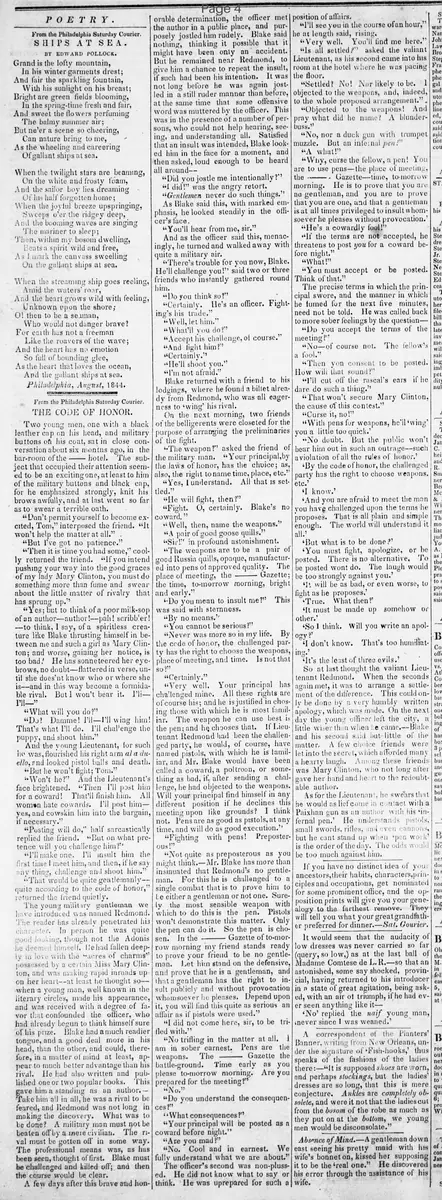
From the Philadelphia Saturday Courier.
THE CODE OF HONOR.
Two young men, one with a black leather cap on his head, and military buttons on his coat, sat in close conversation about six months ago, in the bar-room of the -- hotel. The subject that occupied their attention seemed to be an exciting one, at least to him of the military buttons and black cap, for he emphasized strongly, knit his brows awfully, and at last went so far as to swear a terrible oath.
"Don't permit yourself to become excited, Tom," interposed the friend. "It won't help the matter at all."
"But I've got no patience."
"Then it is time you had some," coolly returned the friend. "If you intend pushing your way into the good graces of my Lady Mary Clinton, you must do something more than fume and swear about the little matter of rivalry that has sprung up."
"Yes; but to think of a poor milk-sop of an author—author!—pah! scribb'er!—to think, I say, of a spiritless creature like Blake thrusting himself in between me and such a girl as Mary Clinton; and worse, gaining her notice, is too bad! He has sonneteered her eye-brows, no doubt—flattered in verse, until she doesn't know who or where she is—and in this way become a formidable rival. But I won't bear it. I'll—I'll—"
"What will you do?"
"Do? Damme! I'll—I'll wing him! That's what I'll do. I'll challenge the puppy, and shoot him."
And the young Lieutenant, for such he was, flourished his right arm al a duello, and looked pistol balls and death.
"But he won't fight, Tom."
"Won't he?" And the Lieutenant's face brightened. "Then I'll post him for a coward! That'll finish him. All women hate cowards. I'll post him—yes, and cowskin him into the bargain, if necessary."
"Posting will do," half sarcastically replied the friend. "But on what pretence will you challenge him?"
"I'll make one, I'll insult him the first time I meet him, and then, if he say anything, challenge and shoot him."
"That would be quite gentlemanly—quite according to the code of honor," returned the friend quietly.
The young military gentleman we have introduced was named Redmond. The reader has already penetrated his character. In person he was quite good looking, though not the Adonis he deemed himself. He had fallen deeply in love with the "acres of charms" possessed by a certain Miss Mary Clinton, and was making rapid inroads upon her heart—at least he thought so—when a young man, well known in the literary circles, made his appearance, and was received with a degree of favor that confounded the officer, who had already begun to think himself sure of his prize. Blake had a much readier tongue, and a good deal more in his head, than the other, and could, therefore, in a matter of mind at least, appear to much better advantage than his rival. He had also written and published one or two popular books. This gave him a standing as an author. Take him all in all, he was a rival to be feared, and Redmond was not long in making the discovery. What was to be done? A military man must not be beaten off by a mere civilian. The rival must be gotten off in some way. The professional means was, as has been seen, thought of first. Blake must be challenged and killed off; and then the course would be clear.
A few days after this brave and honorable determination, the officer met the author in a public place, and purposely jostled him rudely. Blake said nothing, thinking it possible that it might have been only an accident. But he remained near Redmond, to give him a chance to repeat the insult, if such had been his intention. It was not long before he was again jostled in a still ruder manner than before, at the same time that some offensive word was muttered by the officer. This was in the presence of a number of persons, who could not help hearing, seeing, and understanding all. Satisfied that an insult was intended, Blake looked him in the face for a moment, and then asked, loud enough to be heard all around—
"Did you jostle me intentionally?"
"I did!" was the angry retort.
"Gentlemen never do such things"
As Blake said this, with marked emphasis, he looked steadily in the officer's face.
"You'll hear from me, sir."
And as the officer said this, menacingly, he turned and walked away with quite a military air.
"There's trouble for you now, Blake. He'll challenge you!" said two or three friends who instantly gathered round him.
"Do you think so?"
"Certainly. He's an officer. Fighting's his trade."
"Well, let him."
"What'll you do?"
"Accept his challenge, of course."
"And fight him?"
"Certainly."
"He'll shoot you."
"I'm not afraid."
Blake returned with a friend to his lodgings, where he found a billet already from Redmond, who was all eagerness to 'wing' his rival.
On the next morning, two friends of the belligerents were closeted for the purpose of arranging the preliminaries of the fight.
"The weapon?" asked the friend of the military man. "Your principal, by the laws of honor, has the choice; as also, the right to name time, place, etc."
"Yes. I understand. All that is settled."
"He will fight, then?"
"Fight. O, certainly. Blake's no coward."
"Well, then, name the weapons."
"A pair of good goose quills."
"Sir!" in profound astonishment.
"The weapons are to be a pair of good Russia quills, opaque, manufactured into pens of approved quality. The place of meeting, the Gazette; the time, to-morrow morning, bright and early."
"Do you mean to insult me?"
This was said with sternness.
"By no means."
"You cannot be serious?"
"Never was more so in my life. By the code of honor, the challenged party has the right to choose the weapons, place of meeting, and time. Is not that so?"
"Certainly."
"Very well. Your principal has challenged mine. All these rights are of course his; and he is justified in choosing those with which he is most familiar. The weapon he can use best is the pen: and he chooses that. If Lieutenant Redmond had been the challenged party, he would, of course, have named pistols, with which he is familiar, and Mr. Blake would have been called a coward, a poltroon, or something as bad, if, after sending a challenge, he had objected to the weapons. Will your principal find himself in any different position if he declines this meeting upon like grounds? I think not. Pens are as good as pistols, at any time, and will do as good execution."
"Fighting with pens! Preposterous!"
"Not quite as preposterous as you might think. Mr. Blake has more than insinuated that Redmond's no gentleman. For this he is challenged to a single combat that is to prove him to be either a gentleman or not one. Surely the most sensible weapon with which to do this is the pen. Pistols won't demonstrate this matter. Only the pen can do it. So the pen is chosen. In the Gazette of to-morrow morning my friend stands ready to prove your friend to be no gentleman. Let him stand on the defensive, and prove that he is a gentleman, and that a gentleman has the right to insult publicly and without provocation whomsoever he pleases. Depend upon it, you will find this quite as serious an affair as if pistols were used."
"I did not come here, sir, to be trifled with."
"No trifling in the matter at all. I am in sober earnest. Pens are the weapons. The Gazette the battle-ground. Time early as you please to-morrow morning. Are you prepared for the meeting?"
"No."
"Do you understand the consequences?"
"What consequences?"
"Your principal will be posted as a coward before night."
"Are you mad?"
"No. Cool and in earnest. We fully understand what we are about."
The officer's second was non-plussed. He did not know what to say or think. He was unprepared for such a position of affairs.
"I'll see you in the course of an hour," he at length said, rising.
"Very well. You'll find me here."
"Is all settled?" asked the valiant Lieutenant, as his second came into his room at the hotel where he was pacing the floor.
"Settled? No! Nor likely to be. I objected to the weapons, and, indeed, to the whole proposed arrangement."
"Objected to the weapons! And pray what did he name? A blunderbuss?"
"No, nor a duck gun with trumpet muzzle. But an infernal pen!"
"A what!"
"Why, curse the fellow, a pen! You are to use pens—the place of meeting, the Gazette—time, to-morrow morning. He is to prove that you are no gentleman, and you are to prove that you are one, and that a gentleman is at all times privileged to insult whomsoever he pleases without provocation."
"He's a cowardly fool!"
"If the terms are not accepted, he threatens to post you for a coward before night."
"What!"
"You must accept or be posted. Think of that."
The precise terms in which the principal swore, and the manner in which he fumed for the next five minutes, need not be told. He was called back to more sober feelings by the question—
"Do you accept the terms of the meeting?"
"No—of course not. The fellow's a fool."
"Then you consent to be posted. How will that sound?"
"I'll cut off the rascal's ears if he dare do such a thing."
"That won't secure Mary Clinton, the cause of this contest."
"Curse it, no!"
"With pens for weapons, he'll 'wing you a little too quick.'"
No doubt. But the public won't bear him out in such an outrage—such a violation of all the rules of honor. By the code of honor, the challenged party has the right to choose weapons, etc."
"I know."
"And you are afraid to meet the man you have challenged upon the terms he proposes. That is all plain and simple enough. The world will understand it all."
"But what is to be done?"
"You must fight, apologize, or be posted. There is no alternative. To be posted won't do. The laugh would be too strongly against you."
"It will be as bad, or even worse, to fight as he proposes."
True. What then?
"It must be made up somehow or other."
So I think. Will you write an apology?"
"I don't know. That's too humiliating."
"It's the least of three evils."
So at last thought the valiant Lieutenant Redmond. When the seconds again met, it was to arrange a settlement of the difference. This could only be done by a very humbly written apology, which was made. On the next day the young officer left the city, a little wiser than when he came.—Blake and his second said but little of the matter. A few choice friends were let into the secret, which afforded many a hearty laugh. Among these friends was Mary Clinton, who not long after gave her hand and heart to the redoubtable author.
As for the Lieutenant, he swears that he would as lief come in contact with a Paixhan gun as an author with his infernal pen. He understands pistols, small swords, rifles, and even cannons, but he can't stand up when 'pen work' is the order of the day. The odds would be too much against him.
THE CODE OF HONOR.
Two young men, one with a black leather cap on his head, and military buttons on his coat, sat in close conversation about six months ago, in the bar-room of the -- hotel. The subject that occupied their attention seemed to be an exciting one, at least to him of the military buttons and black cap, for he emphasized strongly, knit his brows awfully, and at last went so far as to swear a terrible oath.
"Don't permit yourself to become excited, Tom," interposed the friend. "It won't help the matter at all."
"But I've got no patience."
"Then it is time you had some," coolly returned the friend. "If you intend pushing your way into the good graces of my Lady Mary Clinton, you must do something more than fume and swear about the little matter of rivalry that has sprung up."
"Yes; but to think of a poor milk-sop of an author—author!—pah! scribb'er!—to think, I say, of a spiritless creature like Blake thrusting himself in between me and such a girl as Mary Clinton; and worse, gaining her notice, is too bad! He has sonneteered her eye-brows, no doubt—flattered in verse, until she doesn't know who or where she is—and in this way become a formidable rival. But I won't bear it. I'll—I'll—"
"What will you do?"
"Do? Damme! I'll—I'll wing him! That's what I'll do. I'll challenge the puppy, and shoot him."
And the young Lieutenant, for such he was, flourished his right arm al a duello, and looked pistol balls and death.
"But he won't fight, Tom."
"Won't he?" And the Lieutenant's face brightened. "Then I'll post him for a coward! That'll finish him. All women hate cowards. I'll post him—yes, and cowskin him into the bargain, if necessary."
"Posting will do," half sarcastically replied the friend. "But on what pretence will you challenge him?"
"I'll make one, I'll insult him the first time I meet him, and then, if he say anything, challenge and shoot him."
"That would be quite gentlemanly—quite according to the code of honor," returned the friend quietly.
The young military gentleman we have introduced was named Redmond. The reader has already penetrated his character. In person he was quite good looking, though not the Adonis he deemed himself. He had fallen deeply in love with the "acres of charms" possessed by a certain Miss Mary Clinton, and was making rapid inroads upon her heart—at least he thought so—when a young man, well known in the literary circles, made his appearance, and was received with a degree of favor that confounded the officer, who had already begun to think himself sure of his prize. Blake had a much readier tongue, and a good deal more in his head, than the other, and could, therefore, in a matter of mind at least, appear to much better advantage than his rival. He had also written and published one or two popular books. This gave him a standing as an author. Take him all in all, he was a rival to be feared, and Redmond was not long in making the discovery. What was to be done? A military man must not be beaten off by a mere civilian. The rival must be gotten off in some way. The professional means was, as has been seen, thought of first. Blake must be challenged and killed off; and then the course would be clear.
A few days after this brave and honorable determination, the officer met the author in a public place, and purposely jostled him rudely. Blake said nothing, thinking it possible that it might have been only an accident. But he remained near Redmond, to give him a chance to repeat the insult, if such had been his intention. It was not long before he was again jostled in a still ruder manner than before, at the same time that some offensive word was muttered by the officer. This was in the presence of a number of persons, who could not help hearing, seeing, and understanding all. Satisfied that an insult was intended, Blake looked him in the face for a moment, and then asked, loud enough to be heard all around—
"Did you jostle me intentionally?"
"I did!" was the angry retort.
"Gentlemen never do such things"
As Blake said this, with marked emphasis, he looked steadily in the officer's face.
"You'll hear from me, sir."
And as the officer said this, menacingly, he turned and walked away with quite a military air.
"There's trouble for you now, Blake. He'll challenge you!" said two or three friends who instantly gathered round him.
"Do you think so?"
"Certainly. He's an officer. Fighting's his trade."
"Well, let him."
"What'll you do?"
"Accept his challenge, of course."
"And fight him?"
"Certainly."
"He'll shoot you."
"I'm not afraid."
Blake returned with a friend to his lodgings, where he found a billet already from Redmond, who was all eagerness to 'wing' his rival.
On the next morning, two friends of the belligerents were closeted for the purpose of arranging the preliminaries of the fight.
"The weapon?" asked the friend of the military man. "Your principal, by the laws of honor, has the choice; as also, the right to name time, place, etc."
"Yes. I understand. All that is settled."
"He will fight, then?"
"Fight. O, certainly. Blake's no coward."
"Well, then, name the weapons."
"A pair of good goose quills."
"Sir!" in profound astonishment.
"The weapons are to be a pair of good Russia quills, opaque, manufactured into pens of approved quality. The place of meeting, the Gazette; the time, to-morrow morning, bright and early."
"Do you mean to insult me?"
This was said with sternness.
"By no means."
"You cannot be serious?"
"Never was more so in my life. By the code of honor, the challenged party has the right to choose the weapons, place of meeting, and time. Is not that so?"
"Certainly."
"Very well. Your principal has challenged mine. All these rights are of course his; and he is justified in choosing those with which he is most familiar. The weapon he can use best is the pen: and he chooses that. If Lieutenant Redmond had been the challenged party, he would, of course, have named pistols, with which he is familiar, and Mr. Blake would have been called a coward, a poltroon, or something as bad, if, after sending a challenge, he had objected to the weapons. Will your principal find himself in any different position if he declines this meeting upon like grounds? I think not. Pens are as good as pistols, at any time, and will do as good execution."
"Fighting with pens! Preposterous!"
"Not quite as preposterous as you might think. Mr. Blake has more than insinuated that Redmond's no gentleman. For this he is challenged to a single combat that is to prove him to be either a gentleman or not one. Surely the most sensible weapon with which to do this is the pen. Pistols won't demonstrate this matter. Only the pen can do it. So the pen is chosen. In the Gazette of to-morrow morning my friend stands ready to prove your friend to be no gentleman. Let him stand on the defensive, and prove that he is a gentleman, and that a gentleman has the right to insult publicly and without provocation whomsoever he pleases. Depend upon it, you will find this quite as serious an affair as if pistols were used."
"I did not come here, sir, to be trifled with."
"No trifling in the matter at all. I am in sober earnest. Pens are the weapons. The Gazette the battle-ground. Time early as you please to-morrow morning. Are you prepared for the meeting?"
"No."
"Do you understand the consequences?"
"What consequences?"
"Your principal will be posted as a coward before night."
"Are you mad?"
"No. Cool and in earnest. We fully understand what we are about."
The officer's second was non-plussed. He did not know what to say or think. He was unprepared for such a position of affairs.
"I'll see you in the course of an hour," he at length said, rising.
"Very well. You'll find me here."
"Is all settled?" asked the valiant Lieutenant, as his second came into his room at the hotel where he was pacing the floor.
"Settled? No! Nor likely to be. I objected to the weapons, and, indeed, to the whole proposed arrangement."
"Objected to the weapons! And pray what did he name? A blunderbuss?"
"No, nor a duck gun with trumpet muzzle. But an infernal pen!"
"A what!"
"Why, curse the fellow, a pen! You are to use pens—the place of meeting, the Gazette—time, to-morrow morning. He is to prove that you are no gentleman, and you are to prove that you are one, and that a gentleman is at all times privileged to insult whomsoever he pleases without provocation."
"He's a cowardly fool!"
"If the terms are not accepted, he threatens to post you for a coward before night."
"What!"
"You must accept or be posted. Think of that."
The precise terms in which the principal swore, and the manner in which he fumed for the next five minutes, need not be told. He was called back to more sober feelings by the question—
"Do you accept the terms of the meeting?"
"No—of course not. The fellow's a fool."
"Then you consent to be posted. How will that sound?"
"I'll cut off the rascal's ears if he dare do such a thing."
"That won't secure Mary Clinton, the cause of this contest."
"Curse it, no!"
"With pens for weapons, he'll 'wing you a little too quick.'"
No doubt. But the public won't bear him out in such an outrage—such a violation of all the rules of honor. By the code of honor, the challenged party has the right to choose weapons, etc."
"I know."
"And you are afraid to meet the man you have challenged upon the terms he proposes. That is all plain and simple enough. The world will understand it all."
"But what is to be done?"
"You must fight, apologize, or be posted. There is no alternative. To be posted won't do. The laugh would be too strongly against you."
"It will be as bad, or even worse, to fight as he proposes."
True. What then?
"It must be made up somehow or other."
So I think. Will you write an apology?"
"I don't know. That's too humiliating."
"It's the least of three evils."
So at last thought the valiant Lieutenant Redmond. When the seconds again met, it was to arrange a settlement of the difference. This could only be done by a very humbly written apology, which was made. On the next day the young officer left the city, a little wiser than when he came.—Blake and his second said but little of the matter. A few choice friends were let into the secret, which afforded many a hearty laugh. Among these friends was Mary Clinton, who not long after gave her hand and heart to the redoubtable author.
As for the Lieutenant, he swears that he would as lief come in contact with a Paixhan gun as an author with his infernal pen. He understands pistols, small swords, rifles, and even cannons, but he can't stand up when 'pen work' is the order of the day. The odds would be too much against him.
What sub-type of article is it?
Prose Fiction
Satire
What themes does it cover?
Love Romance
Moral Virtue
Social Manners
What keywords are associated?
Code Of Honor
Duel Satire
Rivalry
Author Vs Officer
Pen Vs Pistol
Literary Details
Title
The Code Of Honor.
Key Lines
"Do? Damme! I'll—I'll Wing Him! That's What I'll Do. I'll Challenge The Puppy, And Shoot Him."
"A Pair Of Good Goose Quills."
"Pens Are As Good As Pistols, At Any Time, And Will Do As Good Execution."
"Fighting With Pens! Preposterous!"
"As For The Lieutenant, He Swears That He Would As Lief Come In Contact With A Paixhan Gun As An Author With His Infernal Pen."