Thank you for visiting SNEWPapers!
Sign up free
Story
November 11, 1870
Public Ledger
Memphis, Shelby County, Tennessee
What is this article about?
Jefferson Davis delivers a speech at the Lee Memorial Convention in Richmond, Virginia, praising General Robert E. Lee's character, leadership, and loyalty during the Civil War, refuting accusations against him, and recounting key incidents from his career.
Clipping
OCR Quality
96%
Excellent
Full Text
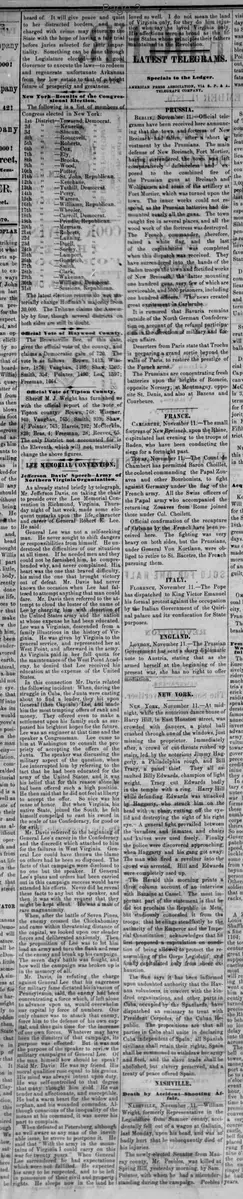
LEE MEMORIAL CONVENTION.
Jefferson Davis' Speech—Army of Northern Virginia Organization.
As already stated briefly by telegraph, Mr. Jefferson Davis, on taking the chair to preside over the Lee Memorial Convention in Richmond, Virginia, Thursday night of last week, made some eloquent remarks upon the life, character and career of General Robert E. Lee. He said:
General Lee was not a self-seeking man. He never sought to shift dangers or responsibilities from himself. He understood the difficulties of our situation at all times. If he needed men and they could not be furnished him, he comprehended why, and never complained. His heart was the one that braved difficulty, his mind the one that brought victory out of defeat. Mr. Davis had never known the occasion when Lee had faltered to attempt anything that man could dare. Mr. Davis then referred to the attempt to cloud the luster of the name of Lee by charging him with desertion of the United States army and the nation at whose expense he had been educated. Lee was a Virginian, descended from a family illustrious in the history of Virginia. He was given by Virginia to the general service, and represented her at West Point, and afterward in the army. As Virginia paid in her full quota for the maintenance of the West Point Academy, he denied that Lee received his education at the expense of the United States.
In this connection Mr. Davis related the following incident: When, during the struggle in Cuba, the Junta were casting about to find a leader, they hit upon General (then Captain) Lee, and made him the most tempting offers of rank and money. They offered even to make a settlement upon his family such as surpassed his brightest hopes for the future. Lee was an engineer at that time and the speaker a Congressman. Lee came to him at Washington to consult the propriety of accepting the offers of the Junta. The speaker was discussing the military aspect of the question, when Lee interrupted him by referring to the fact that he had been educated for the army of the United States, and it was his belief that for this reason alone he had been offered such a high position. He then said that he did not feel at liberty to accept the offer. So nice was his sense of honor. But when Virginia, his native State, joined the South, he felt himself compelled to cast his sword in the scale of the Confederacy, for good or for evil.
Mr. Davis referred to the beginning of General Lee's career in the Confederacy and the discredit which attached to him for the failures in West Virginia. General Lee could have thrown the blame on others had he been so disposed. The facts of that campaign were disclosed to no one but the speaker. If General Lee's plans and orders had been carried out in this campaign success would have attended his efforts. Never did he reveal these facts to any but the speaker, and then it was with the request that they might be kept silent. He was a man of rare magnanimity.
When, after the battle of Seven Pines, the enemy crossed the Chickahominy and came within threatening distance of the capital, we looked upon our slender forces and deliberated anxiously. Then the proposition of Lee was to let him lead an army and turn the flank and rear of the enemy and break up his campaign. The seven days' battle was fought, and how well the campaign was broken up is in the memory of all.
Mr. Davis, in refuting the charge against General Lee that his eagerness for military fame dictated his invasion of Pennsylvania, said, the enemy had been concentrating a force which, if left alone to advance upon us, would overwhelm our capital by force of numbers. Our only chance was to attack that enemy, force him to the defense of his own capital, and thus gain time for the increase of our own forces. Whatever may have been the disasters of that campaign, its purpose was effected. But it was not the purpose of the speaker to review the military campaigns of General Lee. Of the man himself how should he speak? Said Mr. Davis: He was my friend. His moral qualities rose equal to his genius. His mind was always intent upon duty. He was self-controlled to that degree that many thought him cold. He was tender and affectionate, and susceptible. He had a warm heart for the widow and orphan, and his wounded comrades. Although conscious of the inequality of the means at his command, it was never his part to complain.
When defeated at Petersburg, although as well aware as any man of the inevitable issue, he strove to postpone it. He said that "With the army in the mountains of Virginia I could carry on this war for twenty years." When General Lee surrendered he had expectations which were not fulfilled. He expected his army to be respected, and to be left in possession of their civil and property rights. He sleeps now in the land he loved so well, I do not mean the land of Virginia only, for they do him injustice who say he loved Virginia only. His affections were as broad as the fifteen States whose principles their fathers maintained in the Revolution.
Jefferson Davis' Speech—Army of Northern Virginia Organization.
As already stated briefly by telegraph, Mr. Jefferson Davis, on taking the chair to preside over the Lee Memorial Convention in Richmond, Virginia, Thursday night of last week, made some eloquent remarks upon the life, character and career of General Robert E. Lee. He said:
General Lee was not a self-seeking man. He never sought to shift dangers or responsibilities from himself. He understood the difficulties of our situation at all times. If he needed men and they could not be furnished him, he comprehended why, and never complained. His heart was the one that braved difficulty, his mind the one that brought victory out of defeat. Mr. Davis had never known the occasion when Lee had faltered to attempt anything that man could dare. Mr. Davis then referred to the attempt to cloud the luster of the name of Lee by charging him with desertion of the United States army and the nation at whose expense he had been educated. Lee was a Virginian, descended from a family illustrious in the history of Virginia. He was given by Virginia to the general service, and represented her at West Point, and afterward in the army. As Virginia paid in her full quota for the maintenance of the West Point Academy, he denied that Lee received his education at the expense of the United States.
In this connection Mr. Davis related the following incident: When, during the struggle in Cuba, the Junta were casting about to find a leader, they hit upon General (then Captain) Lee, and made him the most tempting offers of rank and money. They offered even to make a settlement upon his family such as surpassed his brightest hopes for the future. Lee was an engineer at that time and the speaker a Congressman. Lee came to him at Washington to consult the propriety of accepting the offers of the Junta. The speaker was discussing the military aspect of the question, when Lee interrupted him by referring to the fact that he had been educated for the army of the United States, and it was his belief that for this reason alone he had been offered such a high position. He then said that he did not feel at liberty to accept the offer. So nice was his sense of honor. But when Virginia, his native State, joined the South, he felt himself compelled to cast his sword in the scale of the Confederacy, for good or for evil.
Mr. Davis referred to the beginning of General Lee's career in the Confederacy and the discredit which attached to him for the failures in West Virginia. General Lee could have thrown the blame on others had he been so disposed. The facts of that campaign were disclosed to no one but the speaker. If General Lee's plans and orders had been carried out in this campaign success would have attended his efforts. Never did he reveal these facts to any but the speaker, and then it was with the request that they might be kept silent. He was a man of rare magnanimity.
When, after the battle of Seven Pines, the enemy crossed the Chickahominy and came within threatening distance of the capital, we looked upon our slender forces and deliberated anxiously. Then the proposition of Lee was to let him lead an army and turn the flank and rear of the enemy and break up his campaign. The seven days' battle was fought, and how well the campaign was broken up is in the memory of all.
Mr. Davis, in refuting the charge against General Lee that his eagerness for military fame dictated his invasion of Pennsylvania, said, the enemy had been concentrating a force which, if left alone to advance upon us, would overwhelm our capital by force of numbers. Our only chance was to attack that enemy, force him to the defense of his own capital, and thus gain time for the increase of our own forces. Whatever may have been the disasters of that campaign, its purpose was effected. But it was not the purpose of the speaker to review the military campaigns of General Lee. Of the man himself how should he speak? Said Mr. Davis: He was my friend. His moral qualities rose equal to his genius. His mind was always intent upon duty. He was self-controlled to that degree that many thought him cold. He was tender and affectionate, and susceptible. He had a warm heart for the widow and orphan, and his wounded comrades. Although conscious of the inequality of the means at his command, it was never his part to complain.
When defeated at Petersburg, although as well aware as any man of the inevitable issue, he strove to postpone it. He said that "With the army in the mountains of Virginia I could carry on this war for twenty years." When General Lee surrendered he had expectations which were not fulfilled. He expected his army to be respected, and to be left in possession of their civil and property rights. He sleeps now in the land he loved so well, I do not mean the land of Virginia only, for they do him injustice who say he loved Virginia only. His affections were as broad as the fifteen States whose principles their fathers maintained in the Revolution.
What sub-type of article is it?
Biography
Historical Event
What themes does it cover?
Bravery Heroism
Moral Virtue
Justice
What keywords are associated?
Jefferson Davis Speech
Robert E Lee
Lee Memorial Convention
Civil War Leadership
Confederate History
Military Honor
What entities or persons were involved?
Jefferson Davis
Robert E. Lee
Where did it happen?
Richmond, Virginia
Story Details
Key Persons
Jefferson Davis
Robert E. Lee
Location
Richmond, Virginia
Event Date
Thursday Night Of Last Week
Story Details
Jefferson Davis eulogizes General Robert E. Lee's life, honor, and military leadership in the Confederacy, refuting charges of desertion and fame-seeking, and recounting incidents like the Cuba offer, West Virginia campaign, Seven Days Battles, and Pennsylvania invasion to highlight Lee's magnanimity and duty.