Thank you for visiting SNEWPapers!
Sign up free
Story
February 5, 1955
The Northwest Times
Seattle, King County, Washington
What is this article about?
Public service explanation of probate process: why administration is required to collect assets, pay debts, and distribute estates for deceased persons, with or without a will, under court supervision to protect creditors and heirs.
Clipping
OCR Quality
98%
Excellent
Full Text
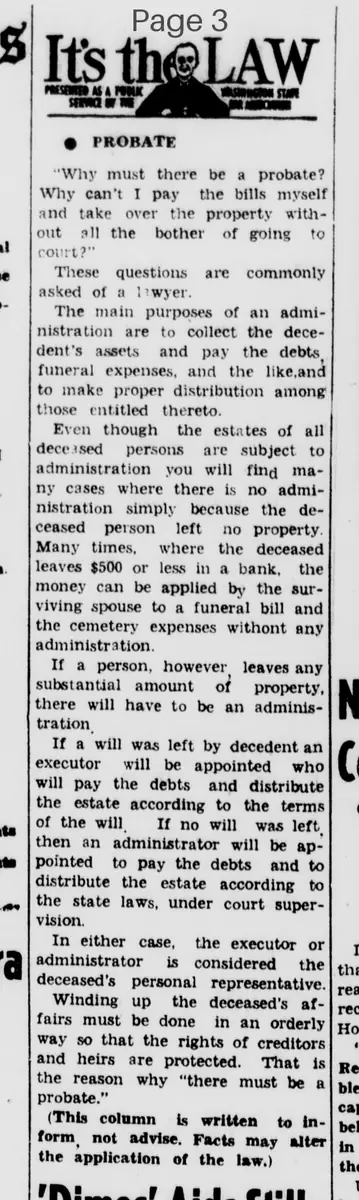
It's the LAW
PRESENTED AS A PUBLIC SERVICE
PROBATE
"Why must there be a probate?
Why can't I pay the bills myself and take over the property without all the bother of going to court?"
These questions are commonly asked of a lawyer.
The main purposes of an administration are to collect the decedent's assets and pay the debts, funeral expenses, and the like, and to make proper distribution among those entitled thereto.
Even though the estates of all deceased persons are subject to administration you will find many cases where there is no administration simply because the deceased person left no property.
Many times, where the deceased leaves $500 or less in a bank, the money can be applied by the surviving spouse to a funeral bill and the cemetery expenses without any administration.
If a person, however, leaves any substantial amount of property there will have to be an administration.
If a will was left by decedent an executor will be appointed who will pay the debts and distribute the estate according to the terms of the will. If no will was left then an administrator will be appointed to pay the debts and to distribute the estate according to the state laws, under court supervision.
In either case, the executor or administrator is considered the deceased's personal representative.
Winding up the deceased's affairs must be done in an orderly way so that the rights of creditors and heirs are protected. That is the reason why "there must be a probate."
(This column is written to inform, not advise. Facts may alter the application of the law.)
PRESENTED AS A PUBLIC SERVICE
PROBATE
"Why must there be a probate?
Why can't I pay the bills myself and take over the property without all the bother of going to court?"
These questions are commonly asked of a lawyer.
The main purposes of an administration are to collect the decedent's assets and pay the debts, funeral expenses, and the like, and to make proper distribution among those entitled thereto.
Even though the estates of all deceased persons are subject to administration you will find many cases where there is no administration simply because the deceased person left no property.
Many times, where the deceased leaves $500 or less in a bank, the money can be applied by the surviving spouse to a funeral bill and the cemetery expenses without any administration.
If a person, however, leaves any substantial amount of property there will have to be an administration.
If a will was left by decedent an executor will be appointed who will pay the debts and distribute the estate according to the terms of the will. If no will was left then an administrator will be appointed to pay the debts and to distribute the estate according to the state laws, under court supervision.
In either case, the executor or administrator is considered the deceased's personal representative.
Winding up the deceased's affairs must be done in an orderly way so that the rights of creditors and heirs are protected. That is the reason why "there must be a probate."
(This column is written to inform, not advise. Facts may alter the application of the law.)
What sub-type of article is it?
Legal Explanation
What keywords are associated?
Probate
Estate Administration
Executor
Administrator
Decedent Assets
Creditors Rights
Story Details
Story Details
Explains purposes of probate administration: collecting assets, paying debts and expenses, distributing to heirs; exceptions for small estates; roles of executor or administrator under will or state law; necessity for orderly protection of rights.