Thank you for visiting SNEWPapers!
Sign up free
Editorial
December 31, 1842
Republican Herald
Providence, Providence County, Rhode Island
What is this article about?
An editorial critiques Section 1, Article 9 of a new constitution, questioning if it restricts civil office eligibility to General Assembly members only, potentially limiting appointments to insiders and perpetuating judges under Article 10, Section 4. It challenges Whig administration motives and seeks clarification from constitutional experts.
Clipping
OCR Quality
98%
Excellent
Full Text
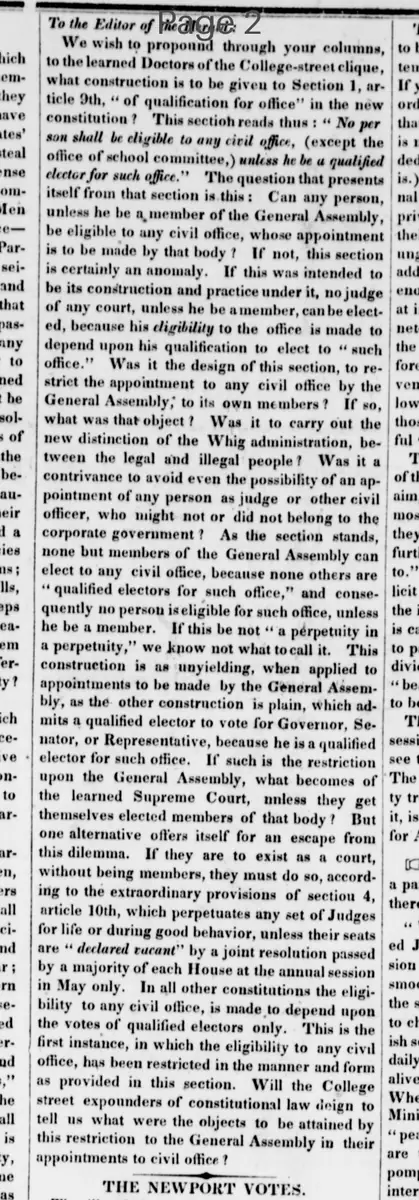
We wish to propound through your columns, to the learned Doctors of the College-street clique, what construction is to be given to Section 1, article 9th, "of qualification for office" in the new constitution?
This section reads thus: "No person shall be eligible to any civil office, (except the office of school committee,) unless he be a qualified elector for such office."
The question that presents itself from that section is this: Can any person, unless he be a member of the General Assembly, be eligible to any civil office, whose appointment is to be made by that body? If not, this section is certainly an anomaly.
If this was intended to be its construction and practice under it, no judge of any court, unless he be a member, can be elected, because his eligibility to the office is made to depend upon his qualification to elect to "such office."
Was it the design of this section, to restrict the appointment to any civil office by the General Assembly; to its own members? If so, what was that object? Was it to carry out the new distinction of the Whig administration, between the legal and illegal people? Was it a contrivance to avoid even the possibility of an appointment of any person as judge or other civil officer, who might not or did not belong to the corporate government?
As the section stands, none but members of the General Assembly can elect to any civil office, because none others are "qualified electors for such office," and consequently no person is eligible for such office, unless he be a member. If this be not "a perpetuity in a perpetuity," we know not what to call it.
This construction is as unyielding, when applied to appointments to be made by the General Assembly, as the other construction is plain, which admits a qualified elector to vote for Governor, Senator, or Representative, because he is a qualified elector for such office.
If such is the restriction upon the General Assembly, what becomes of the learned Supreme Court, unless they get themselves elected members of that body?
But one alternative offers itself for an escape from this dilemma. If they are to exist as a court, without being members, they must do so, according to the extraordinary provisions of section 4, article 10th, which perpetuates any set of Judges for life or during good behavior, unless their seats are "declared vacant" by a joint resolution passed by a majority of each House at the annual session in May only.
In all other constitutions the eligibility to any civil office, is made to depend upon the votes of qualified electors only. This is the first instance, in which the eligibility to any civil office, has been restricted in the manner and form as provided in this section.
Will the College street expounders of constitutional law deign to tell us what were the objects to be attained by this restriction to the General Assembly in their appointments to civil office?
This section reads thus: "No person shall be eligible to any civil office, (except the office of school committee,) unless he be a qualified elector for such office."
The question that presents itself from that section is this: Can any person, unless he be a member of the General Assembly, be eligible to any civil office, whose appointment is to be made by that body? If not, this section is certainly an anomaly.
If this was intended to be its construction and practice under it, no judge of any court, unless he be a member, can be elected, because his eligibility to the office is made to depend upon his qualification to elect to "such office."
Was it the design of this section, to restrict the appointment to any civil office by the General Assembly; to its own members? If so, what was that object? Was it to carry out the new distinction of the Whig administration, between the legal and illegal people? Was it a contrivance to avoid even the possibility of an appointment of any person as judge or other civil officer, who might not or did not belong to the corporate government?
As the section stands, none but members of the General Assembly can elect to any civil office, because none others are "qualified electors for such office," and consequently no person is eligible for such office, unless he be a member. If this be not "a perpetuity in a perpetuity," we know not what to call it.
This construction is as unyielding, when applied to appointments to be made by the General Assembly, as the other construction is plain, which admits a qualified elector to vote for Governor, Senator, or Representative, because he is a qualified elector for such office.
If such is the restriction upon the General Assembly, what becomes of the learned Supreme Court, unless they get themselves elected members of that body?
But one alternative offers itself for an escape from this dilemma. If they are to exist as a court, without being members, they must do so, according to the extraordinary provisions of section 4, article 10th, which perpetuates any set of Judges for life or during good behavior, unless their seats are "declared vacant" by a joint resolution passed by a majority of each House at the annual session in May only.
In all other constitutions the eligibility to any civil office, is made to depend upon the votes of qualified electors only. This is the first instance, in which the eligibility to any civil office, has been restricted in the manner and form as provided in this section.
Will the College street expounders of constitutional law deign to tell us what were the objects to be attained by this restriction to the General Assembly in their appointments to civil office?
What sub-type of article is it?
Constitutional
Legal Reform
Partisan Politics
What keywords are associated?
Constitution
Eligibility
Civil Office
General Assembly
Judges
Whig Administration
Qualified Elector
What entities or persons were involved?
General Assembly
Supreme Court
College Street Clique
Whig Administration
Editorial Details
Primary Topic
Interpretation Of Section 1 Article 9 On Civil Office Eligibility
Stance / Tone
Critical And Questioning Of Constitutional Anomaly
Key Figures
General Assembly
Supreme Court
College Street Clique
Whig Administration
Key Arguments
Section Restricts Eligibility To Members Of General Assembly For Offices Appointed By It
This Creates An Anomaly Preventing Non Members From Being Judges Or Civil Officers
Possibly Intended To Favor Insiders And Exclude 'Illegal People'
Judges Perpetuated Under Section 4 Article 10 Unless Declared Vacant
Unique Restriction Compared To Other Constitutions