Thank you for visiting SNEWPapers!
Sign up free
Editorial
August 11, 1792
National Gazette
Philadelphia, Philadelphia County, Pennsylvania
What is this article about?
An editorial argues against constitutional disqualifications of religious ministers from holding civil offices, emphasizing separation of church and state, equality of citizens, and refuting arguments for exclusion. Dated Philadelphia, August 8.
Clipping
OCR Quality
95%
Excellent
Full Text
The question relating to a constitutional exclusion of the ministers of religion from civil offices is a very serious one, as it affects a respectable and very venerable order of citizens, and still more important as it involves certain fundamental principles of government.
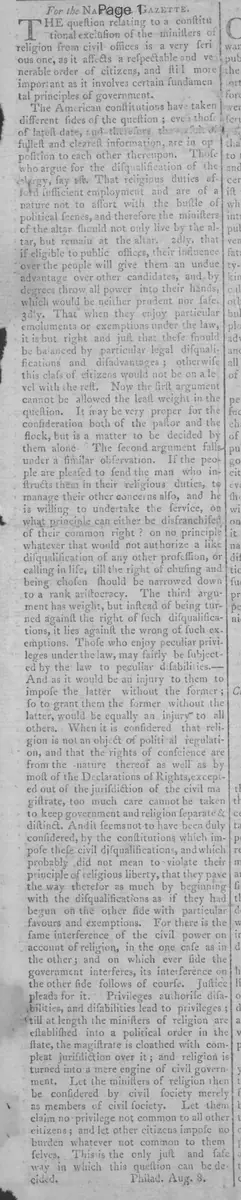
The American constitutions have taken different sides of the question; even those of latest date, and therefore those fullest and clearest information, are in opposition to each other thereupon. Those who argue for the disqualification of the clergy, say 1st. That religious duties afford sufficient employment and are of a nature not to sort with the bustle of political scenes, and therefore the ministers of the altar should not only live by the altar, but remain at the altar. 2dly. that if eligible to public offices, their influence over the people will give them an undue advantage over other candidates, and by degrees throw all power into their hands, which would be neither prudent nor safe. 3dly. That when they enjoy particular emoluments or exemptions under the law, it is but right and just that these should be balanced by particular legal disqualifications and disadvantages; otherwise this class of citizens would not be on a level with the rest. Now the first argument cannot be allowed the least weight in the question. It may be very proper for the consideration both of the pastor and the flock, but is a matter to be decided by them alone. The second argument falls under a similar observation. If the people are pleased to send the man who instructs them in their religious duties, to manage their other concerns also, and he is willing to undertake the service, on what principle can either be disfranchised of their common right? on no principle whatever that would not authorize a like disqualification of any other profession, or calling in life, till the right of choosing and being chosen should be narrowed down to a rank aristocracy. The third argument has weight, but instead of being turned against the right of such disqualifications, it lies against the wrong of such exemptions. Those who enjoy peculiar privileges under the law, may fairly be subjected by the law to peculiar disabilities.— And as it would be an injury to them to impose the latter without the former; so to grant them the former without the latter, would be equally an injury to all others. When it is considered that religion is not an object of political regulation, and that the rights of conscience are from the nature thereof as well as by most of the Declarations of Rights, excepted out of the jurisdiction of the civil magistrate, too much care cannot be taken to keep government and religion separate & distinct. And it seems not to have been duly considered, by the constitutions which impose these civil disqualifications, and which probably did not mean to violate their principle of religious liberty, that they pave the way therefor as much by beginning with the disqualifications as if they had begun on the other side with particular favours and exemptions. For there is the same interference of the civil power on account of religion, in the one case as in the other; and on whichever side the government interferes, its interference on the other side follows of course. Justice pleads for it. Privileges authorize disabilities, and disabilities lead to privileges till at length the ministers of religion are established into a political order in the state, the magistrate is clothed with complete jurisdiction over it; and religion is turned into a mere engine of civil government. Let the ministers of religion therefore be considered by civil society merely as members of civil society. Let them claim no privilege not common to all other citizens; and let other citizens impose no burden whatever not common to themselves. This is the only just and safe way in which this question can be decided.
Philad. Aug. 8.
The American constitutions have taken different sides of the question; even those of latest date, and therefore those fullest and clearest information, are in opposition to each other thereupon. Those who argue for the disqualification of the clergy, say 1st. That religious duties afford sufficient employment and are of a nature not to sort with the bustle of political scenes, and therefore the ministers of the altar should not only live by the altar, but remain at the altar. 2dly. that if eligible to public offices, their influence over the people will give them an undue advantage over other candidates, and by degrees throw all power into their hands, which would be neither prudent nor safe. 3dly. That when they enjoy particular emoluments or exemptions under the law, it is but right and just that these should be balanced by particular legal disqualifications and disadvantages; otherwise this class of citizens would not be on a level with the rest. Now the first argument cannot be allowed the least weight in the question. It may be very proper for the consideration both of the pastor and the flock, but is a matter to be decided by them alone. The second argument falls under a similar observation. If the people are pleased to send the man who instructs them in their religious duties, to manage their other concerns also, and he is willing to undertake the service, on what principle can either be disfranchised of their common right? on no principle whatever that would not authorize a like disqualification of any other profession, or calling in life, till the right of choosing and being chosen should be narrowed down to a rank aristocracy. The third argument has weight, but instead of being turned against the right of such disqualifications, it lies against the wrong of such exemptions. Those who enjoy peculiar privileges under the law, may fairly be subjected by the law to peculiar disabilities.— And as it would be an injury to them to impose the latter without the former; so to grant them the former without the latter, would be equally an injury to all others. When it is considered that religion is not an object of political regulation, and that the rights of conscience are from the nature thereof as well as by most of the Declarations of Rights, excepted out of the jurisdiction of the civil magistrate, too much care cannot be taken to keep government and religion separate & distinct. And it seems not to have been duly considered, by the constitutions which impose these civil disqualifications, and which probably did not mean to violate their principle of religious liberty, that they pave the way therefor as much by beginning with the disqualifications as if they had begun on the other side with particular favours and exemptions. For there is the same interference of the civil power on account of religion, in the one case as in the other; and on whichever side the government interferes, its interference on the other side follows of course. Justice pleads for it. Privileges authorize disabilities, and disabilities lead to privileges till at length the ministers of religion are established into a political order in the state, the magistrate is clothed with complete jurisdiction over it; and religion is turned into a mere engine of civil government. Let the ministers of religion therefore be considered by civil society merely as members of civil society. Let them claim no privilege not common to all other citizens; and let other citizens impose no burden whatever not common to themselves. This is the only just and safe way in which this question can be decided.
Philad. Aug. 8.
What sub-type of article is it?
Constitutional
Moral Or Religious
What keywords are associated?
Clergy Disqualification
Separation Church State
Religious Liberty
Civil Offices
Constitutional Principles
American Constitutions
What entities or persons were involved?
Ministers Of Religion
Clergy
American Constitutions
Editorial Details
Primary Topic
Constitutional Exclusion Of Ministers From Civil Offices
Stance / Tone
Against Disqualification Of Clergy, Advocating Separation Of Church And State
Key Figures
Ministers Of Religion
Clergy
American Constitutions
Key Arguments
Religious Duties Should Not Disqualify Clergy From Civil Offices; Decision Belongs To Pastor And Flock.
Clergy Influence Does Not Justify Exclusion; People Should Choose Freely Without Narrowing Rights To Aristocracy.
Exemptions For Clergy Should Be Balanced By Disabilities, But Disqualifications Interfere With Religious Liberty.
Government And Religion Must Remain Separate To Avoid Civil Interference In Religion.
Treat Ministers As Ordinary Citizens With No Special Privileges Or Burdens.