Thank you for visiting SNEWPapers!
Sign up free
The Daily Spy
Worcester, Worcester County, Massachusetts
What is this article about?
A traveler describes visiting a wealthy Jewish home in Jerusalem, Palestine, encountering a noble Hebrew host and his daughters, discussing Jewish faith, resistance to proselytizing, community size around 4,000, poverty, and Turkish oppression.
Clipping
OCR Quality
Full Text
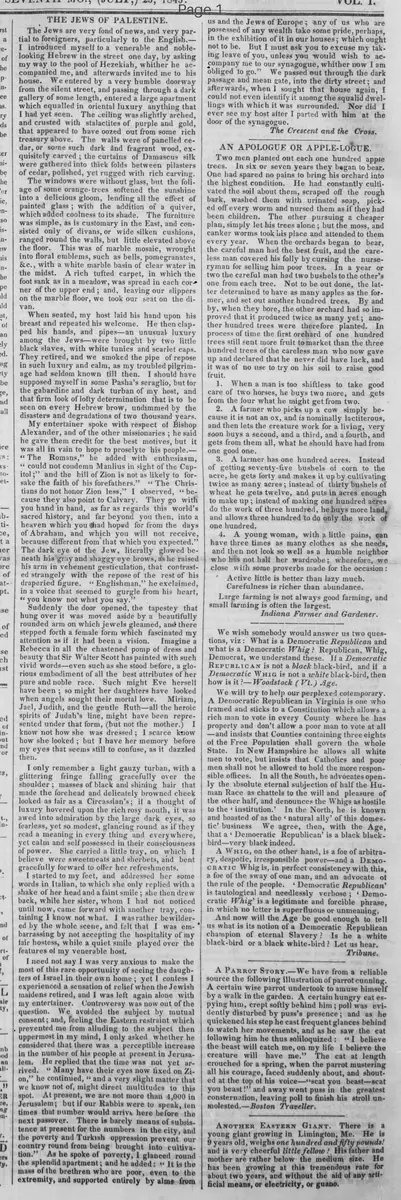
The Jews are very fond of news, and very partial to foreigners, particularly to the English.—
I introduced myself to a venerable and noble-looking Hebrew in the street one day, by asking my way to the pool of Hezekiah, whither he accompanied me, and afterwards invited me to his house. We entered by a very humble doorway from the silent street, and passing through a dark gallery of some length, entered a large apartment which equalled in oriental luxury anything that I had yet seen. The ceiling was slightly arched, and crusted with stalactites of purple and gold, that appeared to have oozed out from some rich treasury above. The walls were of panelled cedar, or some such dark and fragrant wood, exquisitely carved; the curtains of Damascus silk were gathered into thick folds between pilasters of cedar, polished, yet rugged with rich carving. The windows were without glass, but the foliage of some orange-trees softened the sunshine into a delicious gloom, lending all the effect of painted glass; with the addition of a quiver, which added coolness to its shade. The furniture was simple, as is customary in the East, and consisted only of divans, or wide silken cushions, ranged round the walls, but little elevated above the floor. This was of marble mosaic, wrought into floral emblems, such as bells, pomegranates, &c., with a white marble basin of clear water in the midst. A rich tufted carpet, in which the foot sank as in a meadow, was spread in each corner of the upper end; and, leaving our slippers on the marble floor, we took our seat on the divan.
When seated, my host laid his hand upon his breast and repeated his welcome. He then clapped his hands, and pipes—an unusual luxury among the Jews—were brought by two little black slaves, with white tunics and scarlet caps. They retired, and we smoked the pipe of repose in such luxury and calm, as my troubled pilgrimage had seldom known till then. I should have supposed myself in some Pasha's seraglio, but for the gabardine and dark turban of my host, and that firm look of lofty determination that is to be seen on every Hebrew brow, undimmed by the disasters and degradations of two thousand years.
My entertainer spoke with respect of Bishop Alexander, and of the other missionaries; he said he gave them credit for the best motives, but it was all in vain to hope to proselyte his people.— "The Romans," he added with enthusiasm, "could not condemn Manlius in sight of the Capitols;" and the hill of Zion is not as likely to forsake the faith of his forefathers." "The Christians do not honor Zion less," I observed," because they also point to Calvary. They go with you hand in hand, as far as regards this world's sacred history, and far beyond you then, into a heaven which you had hoped for from the days of Abraham, and which you will not receive, because different from that which you expected."
The dark eye of the Jew, literally glowed beneath his gray and shaggy eye brows, as he raised his arm in vehement gesticulation, that contrasted strangely with the repose of the rest of his draped figure. "Englishman," he exclaimed, in a voice that seemed to gurgle from his heart, "you know not what you say."
Suddenly the door opened, the tapestry that hung over it was moved aside by a beautifully rounded arm on which jewels gleamed, and there stepped forth a female form which fascinated my attention as if it had been a vision. Imagine a Rebecca in all the chastened pomp of dress and beauty that Sir Walter Scott has painted with such vivid words—even such as she stood before, a glorious embodiment of all the best attributes of her pure and noble race. Such might Eve herself have been; so might her daughters have looked when angels sought their mortal love. Miriam, Jael, Judith, and the gentle Ruth—all the heroic spirits of Judah's line, might have been represented under that form, (but not the mother.) I know not how she was dressed; I scarce know how she looked: but I have her memory before my eyes that seems still to confuse, as it dazzled then.
I only remember a light gauzy turban, with a glittering fringe falling gracefully over the shoulder; masses of black and shining hair that made the forehead and delicately browned cheek looked as fair as a Circassian's; if a thought of luxury hovered upon the rich rosy mouth, it was awed into admiration by the large dark eyes, so fearless, yet so modest, glancing round as if they read a meaning in every thing and everywhere, yet calm and self possessed in their consciousness of power. She carried a little tray, on which I believe were sweetmeats and sherbets, and bent gracefully forward to offer her refreshments.
I started to my feet, and addressed her some words in Italian, to which she only replied with a shake of her head and a faint smile; she then drew back, while her sister, whom I had not noticed until now, came forward with another tray, containing I know not what. I was rather bewildered by the whole scene, and felt that I was embarrassing by not accepting the hospitality of my fair hostess, while a quiet smile played over the features of my venerable host.
I need not say I was very anxious to make the most of this rare opportunity of seeing the daughters of Israel in their own home; yet I confess I experienced a sensation of relief when the Jewish maidens retired, and I was left again alone with my entertainer. Controversy was now out of the question. We avoided the subject by mutual consent; and, feeling the Eastern restraint which prevented me from alluding to the subject then uppermost in my mind, I only asked whether he considered that there was a perceptible increase in the number of his people at present in Jerusalem. He replied that the time was not yet arrived. "Many have their eyes now fixed on Zion," he continued, "and a very slight matter that we know not of, might direct multitudes to this spot. At present, we are not more than 4,000 in Jerusalem; but if our Rabbis were to speak, ten times that number would arrive here before the next passover. There is barely means of subsistence at present for the numbers in the city, and the poverty and Turkish oppression prevent our country round from being brought into cultivation." As he spoke of poverty, I glanced round the splendid apartment; and he added: "It is the mass of the brethren who are poor, even to the extremity, and supported entirely by alms from us and the Jews of Europe; any of us who are possessed of any wealth take some pride, perhaps, in the exhibition of it in our houses; which ought not to be. But I must ask you to excuse my taking leave of you, unless you would wish to accompany me to our synagogue, whither now I am obliged to go." We passed out through the dark passage and mean gate, into the dirty street; and afterwards, when I sought that house again, I could not even identify it among the squalid dwellings with which it was surrounded. Nor did I ever see my host after I parted with him at the door of the synagogue.
The Crescent and the Cross.
What sub-type of article is it?
What keywords are associated?
What entities or persons were involved?
Where did it happen?
Foreign News Details
Primary Location
Jerusalem, Palestine
Key Persons
Outcome
jewish community in jerusalem numbers about 4,000, supported by alms; potential for rapid increase if called by rabbis; hindered by poverty and turkish oppression.
Event Details
An English traveler meets a venerable Jewish man in Jerusalem, visits his luxurious home, smokes pipes with him, discusses missionaries and Jewish faith's steadfastness to Zion, meets his daughters who serve refreshments, learns about the community's size, poverty, reliance on European alms, and hopes for return to Zion; accompanies host to synagogue.