Thank you for visiting SNEWPapers!
Sign up free
Gazette Of The United States, & Philadelphia Daily Advertiser
Philadelphia, Philadelphia County, Pennsylvania
What is this article about?
Associate Justice James Iredell delivers a charge to the Grand Jury in Richmond, Virginia, on May 22, 1797, urging caution in discussing public measures, emphasizing duty and justice over policy, republican submission to majority decisions, obedience to laws, and vigilance to preserve national union amid potential dangers.
Clipping
OCR Quality
Full Text
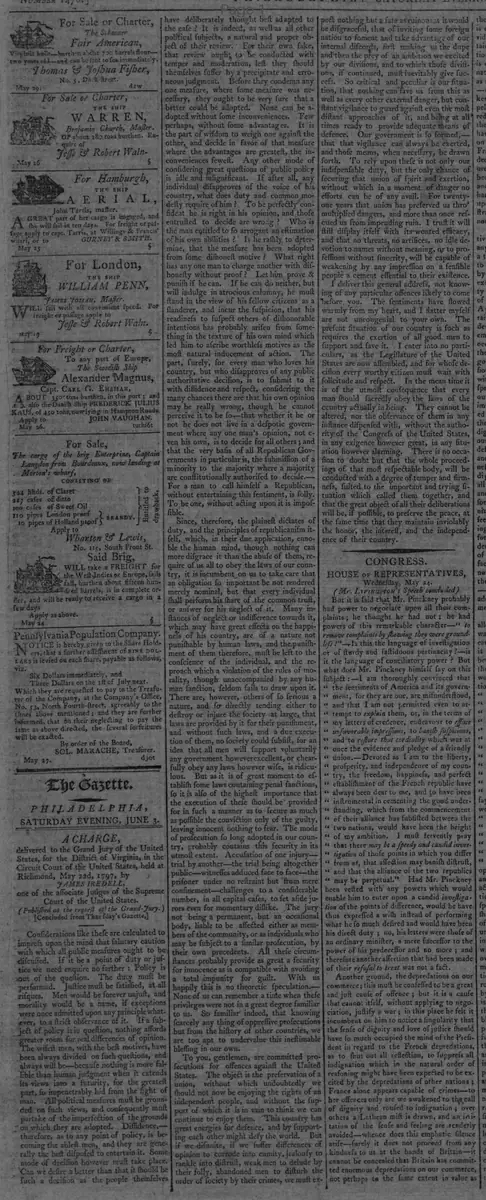
delivered to the Grand Jury of the United
States, for the District of Virginia, in the
Circuit Court of the United States, held at
Richmond, May 22d, 1797, by
JAMES IREDELL,
one of the associate Judges of the Supreme
Court of the United States.
(Published at the request of the Grand-Jury.)
[Concluded from Thursday's Gazette.]
Considerations like these are calculated to
impress upon the mind that salutary caution
with which all public measures ought to be
discussed. If it be a point of duty or justice
we need enquire no farther: Policy is
out of the question. The duty must be
performed. Justice must be satisfied, at all
risks. Men would be forever unjust, and
morality would be a name, if exceptions
were once admitted upon any principle whatever,
to a strict observance of it. If a subject
of policy is in question, nothing affords
greater room for real differences of opinion.
The wisest men, with the best motives, have
been always divided on such questions, and
always will be—because nothing is more fallible
than human judgment when it extends
its views into a futurity, for the greatest
part, so impenetrably hid from the sight of
man. All political measures must be grounded
on such views, and consequently must
partake of the imperfection of the grounds
on which they are adopted. Diffidence,
therefore, as to any point of policy, is becoming
the ablest men, and they are generally the best
disposed to entertain it. Some
mode of decision however must take place.
Can we desire a better than that it should be
such a decision as the people themselves
have deliberately thought best adapted to
the case? It is indeed, as well as all other
political subjects, a natural and proper object
of their review. For their own sake,
that review ought to be conducted with
temper and moderation, lest they themselves suffer
by a precipitate and erroneous judgment.
Before they condemn any
one measure, where some measure was necessary,
they ought to be very sure that a
better could be adopted. None can be adopted
without some inconveniences. Few
perhaps, without some advantages. It is
the part of wisdom to weigh one against the
other, and decide in favor of that measure
where the advantages are greatest, the inconveniences
fewest. Any other mode of
considering great questions of public policy
is idle and insignificant. If after all, any
individual disapproves of the voice of his
country, what does duty and common modesty
require of him? To be perfectly confident
he is right in his opinion, and those
entrusted to decide are wrong? Who is
the man entitled to so arrogant an estimation
of his own abilities? Is he rashly to determine,
that the measure has been adopted
from some dishonest motive? What right
has any one man to charge another with dishonesty
without proof? Let him prove it
and punish if he can. If he can do neither, but
will indulge in atrocious calumny, he must
stand in the view of his fellow citizens as a
slanderer, and incur the suspicion, that his
readiness to suspect others of dishonorable
intentions has probably arisen from something
in the texture of his own mind which
led him to ascribe worthless motives as the
most natural inducement of action. The
part, surely, for every man who loves his
country, but who disapproves of any public
authoritative decision, is to submit to it
with diffidence and respect, considering the
many chances there are that his own opinion
may be really wrong, though he cannot
perceive it to be so—that whether it be or
not he does not live in a despotic government
where any one man's opinion, not even
his own, is to decide for all others; and
that the very basis of all Republican Governments
in particular is, the submission of a
minority to the majority where a majority
are constitutionally authorized to decide.
For a man to call himself a Republican,
without entertaining this sentiment, is folly.
To be one, without acting upon it is impossible.
Since, therefore, the plainest dictates of
duty, and the principles of republicanism itself,
which, in their due application, ennoble
the human mind, though nothing can
more disgrace it than the abuse of them, require
of us all to obey the laws of our country,
it is incumbent on us to take care that
an obligation so important be not rendered
merely nominal, but that every individual
shall perform his share of the common trust,
or answer for his neglect of it. Many instances
of neglect or indifference towards it,
which may have great effects on the happiness
of his country, are of a nature not
punishable by human laws, and the punishment
of them therefore, must be left to the
conscience of the individual, and the reproach
which a violation of the rules of morality,
though unaccompanied by any human sanction,
seldom fails to draw upon it.
There are, however, others of so serious a
nature, and so directly tending either to
destroy or injure the society at large, that
laws are provided by it for their punishment,
and without such laws, and a due execution
of them, no society could subsist, for an
idea that all men will support voluntarily
any government however excellent, or cheerfully
obey any laws however wise, is ridiculous.
But as it is of great moment to establish
some laws containing penal sanctions,
so it is also of the highest importance that
the execution of these should be provided
for in such a manner as to secure as much
as possible the conviction only of the guilty,
leaving innocence nothing to fear. The mode
of prosecution so long adopted in our country,
probably contains this security in its
utmost extent. Accusation by one jury—
trial by another—the trial being altogether
public—witnesses adduced face to face—the
prisoner under no restraint but from mere
confinement—challenges to a considerable
number, in all capital cases, to set aside jurors
even for momentary dislike. The jury
not being a permanent, but an occasional
body, liable to be affected either as members
of the community, or as individuals who
may be subject to a similar prosecution, by
their own precedents. All these circumstances
probably provide as great a security
for innocence as is compatible with avoiding
a total impunity for guilt. With us
happily this is no theoretic speculation.—
None of us can remember a time when these
privileges were not in a great degree familiar
to us. So familiar indeed, that knowing
scarcely any thing of oppressive prosecutions
but from the history of other countries, we
are too apt to undervalue this inestimable
blessing in our own.
To you, gentlemen, are committed prosecutions
for offences against the United
States. The object is the preservation of a
union, without which undoubtedly we
should not now be enjoying the rights of an
independent people, and without the support
of which it is in vain to think we can
continue to enjoy them. This country has
great energies for defence, and by supporting
each other might defy the world. But
if we disunite, if we suffer differences of
opinion to corrode into enmity, jealousy to
rankle into distrust, weak men to delude by
their folly, abandoned men to disturb the
order of society by their crimes, we must expect
nothing but a fate as ruinous as it would
be disgraceful, that of inviting some foreign
nation to foment and take advantage of our
internal discords, first making us the dupe
and then the prey of an ambition we excited
by our divisions, and to which those divisions,
if continued, must inevitably give success.
So critical and peculiar is our situation,
that nothing can save us from this as
well as every other external danger, but constant
vigilance to guard against even the most
distant approaches of it, and being at all
times ready to provide adequate means of
defence. Our government is so formed,—
that that vigilance can always be exerted,
and those means, when necessary, be drawn
forth. To rely upon these is not only our
indispensable duty, but the only chance of
securing that union of spirit and exertion,
without which in a moment of danger no
efforts can be of any avail. For twenty-
one years that union has preserved us thro
multiplied dangers, and more than once rescued
us from impending ruin. I trust it will
still display itself with its wonted efficacy,
and that no threats, no artifices, no idle devotion
to names without meaning, or to professions
without sincerity, will be capable of
weakening by any impression on a sensible
people a cement essential to their existence.
I deliver this general address, not knowing
of any particular offences likely to come
before you. The sentiments have flowed
warmly from my heart, and I flatter myself
are not uncongenial to your own. The
present situation of our country is such as
requires the exertion of all good men to
support and save it. I enter into no particulars,
as the Legislature of the United
States are now assembled, and for whose decision
every worthy citizen must wait with
solicitude and respect. In the mean time it
is of the utmost consequence that every
man should sacredly obey the laws of the
country actually in being. They cannot be
altered, nor the observance of them in any
instance dispensed with, without the authority
of the Congress of the United States,
in any exigence however great, in any situation
however alarming. There is no occasion
to doubt but that the whole proceedings
of that most respectable body, will be
conducted with a degree of temper and firmness,
suited to the important and trying situation
which called them together, and
that the great object of all their deliberations
will be, if possible, to preserve the peace, at
the same time that they maintain inviolably
the honor, the interest, and the independence
of their country.
What sub-type of article is it?
What themes does it cover?
What keywords are associated?
What entities or persons were involved?
Where did it happen?
Story Details
Key Persons
Location
Richmond, District Of Virginia
Event Date
May 22d, 1797
Story Details
James Iredell delivers a charge to the Grand Jury emphasizing the primacy of duty and justice in public measures, the fallibility of policy judgments, the republican principle of minority submission to majority, the moral obligation to obey laws, the safeguards in the judicial process, and the critical need for national union and vigilance against internal divisions and external threats.