Thank you for visiting SNEWPapers!
Sign up free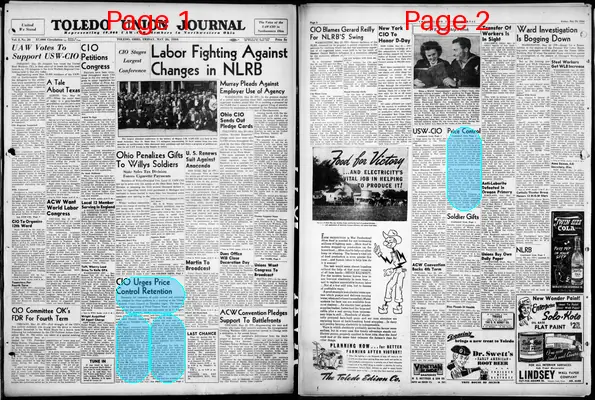
Toledo Union Journal
Toledo, Lucas County, Ohio
What is this article about?
At a CIO meeting in Toledo marking Price Control Week, speakers H.C. Bogart, Jack Lane, and Ollie Pecord urge retention of price controls and rationing to curb inflation during WWII, citing lower cost increases than in WWI and calling for worker protections via petitions to Congress.
Merged-components note: Merged across pages due to explicit continuation ('See PRICE CONTROL, Page 2'). Narrative on labor support for price control.
Clippings
1 of 2
OCR Quality
Full Text
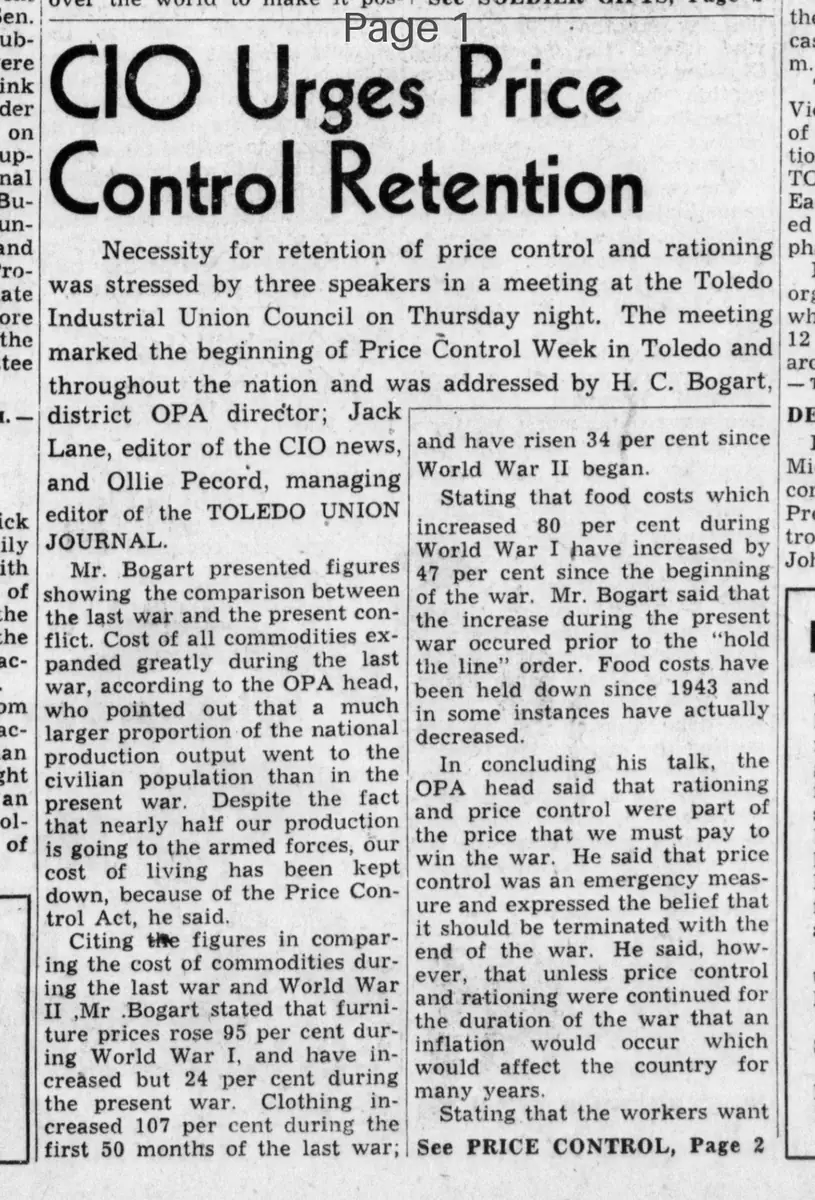
Necessity for retention of price control and rationing was stressed by three speakers in a meeting at the Toledo Industrial Union Council on Thursday night. The meeting marked the beginning of Price Control Week in Toledo and throughout the nation and was addressed by H. C. Bogart, district OPA director; Jack Lane, editor of the CIO news and Ollie Pecord, managing editor of the TOLEDO UNION JOURNAL.
Mr. Bogart presented figures showing the comparison between the last war and the present conflict. Cost of all commodities expanded greatly during the last war, according to the OPA head, who pointed out that a much larger proportion of the national production output went to the civilian population than in the present war. Despite the fact that nearly half our production is going to the armed forces, our cost of living has been kept down, because of the Price Control Act, he said.
Citing the figures in comparing the cost of commodities during the last war and World War II Mr. Bogart stated that furniture prices rose 95 per cent during World War I, and have increased but 24 per cent during the present war. Clothing increased 107 per cent during the first 50 months of the last war; and have risen 34 per cent since World War II began.
Stating that food costs which increased 80 per cent during World War I have increased by 47 per cent since the beginning of the war, Mr. Bogart said that the increase during the present war occurred prior to the "hold the line" order. Food costs have been held down since 1943 and in some instances have actually decreased.
In concluding his talk, the OPA head said that rationing and price control were part of the price that we must pay to win the war. He said that price control was an emergency measure and expressed the belief that it should be terminated with the end of the war. He said, however, that unless price control and rationing were continued for the duration of the war that an inflation would occur which would affect the country for many years.
Stating that the workers want price control continued.
Ollie Pecord advocated the continuance of the Price Control Act and said that it should be given from 20 to 30 million dollars for enforcement. He pointed out the inequalities which exist because of the little steel formula and predicted that unless an adequate price control act was provided by Congress that there would be serious inflation resulting in hardship for the workers.
Mr. Lane stressed the necessity for adjusting wages upward, and spoke of the low paid workers whose incomes were not elevated before the War Labor Board's use of the little steel formula. He urged that the Price Control Act be re-enacted to protect the low paid workers who even now are receiving sub-standard wages.
Petitions asking Congress to continue the Price Control Act and not to place crippling amendments in it have been prepared by the Toledo Industrial Union Council and will be passed out for signing in all CIO shops.
What sub-type of article is it?
What themes does it cover?
What keywords are associated?
What entities or persons were involved?
Where did it happen?
Story Details
Key Persons
Location
Toledo Industrial Union Council, Toledo
Event Date
Thursday Night, During World War Ii
Story Details
Three speakers at a CIO meeting in Toledo stress the need to retain price controls and rationing to prevent inflation, comparing cost increases in WWI and WWII, and advocate for funding enforcement and wage adjustments to protect workers.