Thank you for visiting SNEWPapers!
Sign up free
Letter to Editor
January 29, 1858
The Daily Manchester American
Manchester, Hillsboro County, New Hampshire
What is this article about?
Report on a celebration of Robert Burns' birthday in Weare, New Hampshire, at Clinton Grove High School. Features speeches by Moses A. Cartland, William H. Gove, F. A. Moore, and Moses T. Brown, praising Burns' poetry, life, and democratic spirit, with musical performances and toasts.
Clipping
OCR Quality
98%
Excellent
Full Text
For the American.
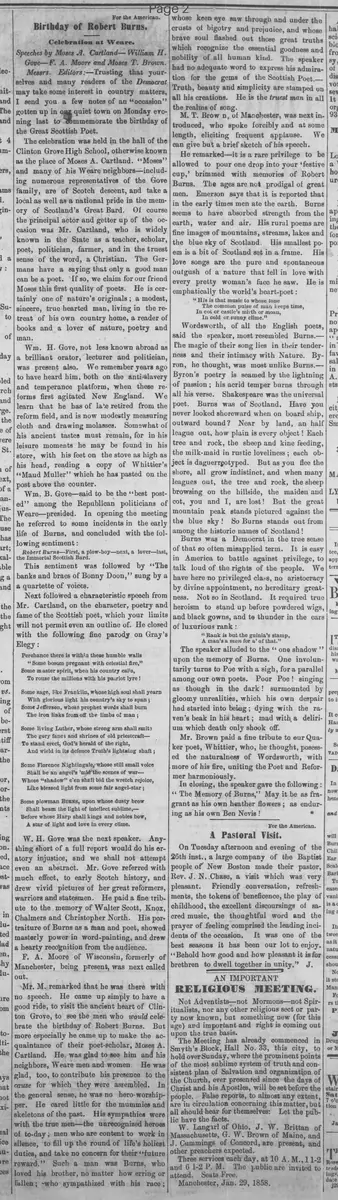
Birthday of Robert Burns.
Celebration at Weare:
Speeches by Moses A. Cartland—William H. Gove—F. A. Moore and Moses T. Brown.
Messrs. Editors:—Trusting that yourselves and many readers of the Democrat may take some interest in country matters, I send you a few notes of an "occasion" gotten up in our quiet town on Monday evening last to commemorate the birthday of the Great Scottish Poet.
The celebration was held in the hall of the Clinton Grove High School, otherwise known as the place of Moses A. Cartland. "Moses" and many of his Weare neighbors—including numerous representatives of the Gove family, are of Scotch descent, and take a local as well as a national pride in the memory of Scotland's Great Bard. Of course the principal actor and getter up of the occasion was Mr. Cartland, who is widely known in the State as a teacher, scholar, poet, politician, farmer, and in the truest sense of the word, a Christian. The Germans have a saying that only a good man can be a poet. If so, we claim for our friend Moses this first quality of poets. He is certainly one of nature's originals; a modest, sincere, true hearted man, living in the retreat of his own country home, a reader of books and a lover of nature, poetry and man.
Wm. H. Gove, not less known abroad as a brilliant orator, lecturer and politician, was present also. We remember years ago to have heard him, both on the anti slavery and temperance platform, when these reforms first agitated New England. We learn that he has of late retired from the reform field, and is now modestly measuring cloth and drawing molasses. Somewhat of his ancient tastes must remain, for in his leisure moments he may be found in his store, with his feet on the stove as high as his head, reading a copy of Whittier's "Maud Muller" which he has pasted on the post above the counter.
Wm. B. Gove—said to be the "best posted" among the Republican politicians of Weare presided. In opening the meeting he referred to some incidents in the early life of Burns, and concluded with the following sentiment:
Robert Burns—First, a plow-boy—next, a lover—last, the Immortal Scottish Bard.
This sentiment was followed by "The banks and braes of Bonny Doon," sung by a quartette of voices.
Next followed a characteristic speech from Mr. Cartland, on the character, poetry and fame of the Scottish poet, which your limits will not permit even an outline of. He closed with the following fine parody on Gray's Elegy:
Perchance there is within these humble walls
"Some bosom pregnant with celestial fire,"
Some master spirit, when his country calls,
To rouse the millions with his patriot lyre!
Some sage, like Franklin, whose high soul shall yearn
With glorious light his country's sky to span;
Some Jefferson, whose prophet words shall burn
The iron links from off the limbs of man;
Some living Luther, whose strong arm shall smite
The gory fanes and shrines of old priestcraft—
To stand erect, God's herald of the right,
And wield in its defence Truth's lightning shaft;
Some Florence Nightingale, whose still small voice
Shall be an angel's 'mid the scenes of war—
Whose "shadow" e'en shall bid the wretch rejoice.
Like blessed light from some fair angel-star;
Some plowman Burns, upon whose dusty brow
Shall beam the light of intellect sublime,—
Before whose Harp shall kings and nobles bow.
A star of light and love in every clime.
W. H. Gove was the next speaker. Anything short of a full report would do his oratory injustice, and we shall not attempt even an abstract. Mr. Gove referred with much effect, to early Scotch history, and drew vivid pictures of her great reformers, warriors and statesmen. He paid a fine tribute to the memory of Walter Scott, Knox, Chalmers and Christopher North. His portraiture of Burns as a man and poet, showed masterly power in word-painting, and drew a hearty recognition from the audience.
F. A. Moore of Wisconsin, formerly of Manchester, being present, was next called out.
Mr. M. remarked that he was there with no speech. He came up simply to have a good ride, to visit the ancient heart of Clinton Grove, to see the men who would celebrate the birthday of Robert Burns. But more especially he came up to make the acquaintance of their poet-scholar, Moses A. Cartland. He was glad to see him and his neighbors, Weare men and women. He was glad, too, to contribute his presence to the cause for which they were assembled. In the general sense, he was no hero-worshipper. He cared little for the mummies and skeletons of the past. His sympathies were with the true men—the unrecognized heroes of to-day; men who are content to work in silence, to fill up the round of life's holiest duties, and take no concern for their "future reward." Such a man was Burns, who loved his brother, no matter how erring or fallen; who sympathized with his race;
whose keen eye saw through and under the crusts of bigotry and prejudice, and whose brave soul flashed out those great truths which recognize the essential goodness and nobility of all human kind. The speaker had no adequate word to express his admiration for the gems of the Scottish Poet.— Truth, beauty and simplicity are stamped on all his creations. He is the truest man in all the realms of song.
M. T. Brown, of Manchester, was next introduced, who spoke forcibly and at some length, eliciting frequent applause. We can give but a brief sketch of his speech.
He remarked—it is a rare privilege to be allowed to pour one drop into your 'festive cup,' brimmed with memories of Robert Burns. The ages are not prodigal of great men. Emerson says that it is reported that in the early times men ate the earth. Burns seems to have absorbed strength from the earth, water and air. His rural poems are fine images of mountains, streams, lakes and the blue sky of Scotland. His smallest poem is a bit of Scotland set in a frame. His love songs are the pure and spontaneous outgush of a nature that fell in love with every pretty woman's face he saw. He is emphatically the world's heart-poet:
"His is that music to whose tone
The common pulse of man keeps time,
In cot or castle's mirth or moan,
In cold or sunny clime."
Wordsworth, of all the English poets, said the speaker, most resembled Burns.— The magic of their song lies in their tenderness and their intimacy with Nature. Byron, he thought, was most unlike Burns.— Byron's poetry is seamed by the lightning of passion; his acrid temper burns through all his verse. Shakespeare was the universal poet. Burns was of Scotland. Have you never looked shoreward when on board ship, outward bound? Near by land, an half league out, how plain is every object! Each tree and rock, the sheep and kine feeding, the milk-maid in rustic loveliness; each object is daguerreotyped. But as you flee the shore, all grow indistinct, and when many leagues out, the tree and rock, the sheep browsing on the hillside, the maiden and cot, you and I, are lost! But the great mountain peak stands pictured against the blue sky! So Burns stands out from among the historic names of Scotland!
Burns was a Democrat in the true sense of that so often misapplied term. It is easy in America to battle against privilege, to talk loud of the rights of the people. We have here no privileged class, no aristocracy by divine appointment, no hereditary greatness. Not so in Scotland. It required true heroism to stand up before powdered wigs, and black gowns, and to thunder in the ears of luxurious rank:
"Rank is but the guinea's stamp.
A man's a man for a' that."
The speaker alluded to the "one shadow" upon the memory of Burns. One involuntarily turns to Poe with a sigh, for a parallel among our own poets. Poor Poe! singing as though in the dark! surmounted by gloomy unrealities, which his own despair had started into being; dying with the raven's beak in his heart; mad with a delirium which death only shook off.
Mr. Brown paid a fine tribute to our Quaker poet, Whittier, who, he thought, possessed the naturalness of Wordsworth, with more of his fire, uniting the Poet and Reformer harmoniously.
In closing, the speaker gave the following:
"The Memory of Burns," May it be as fragrant as his own heather flowers; as enduring as his own Ben Nevis!
Birthday of Robert Burns.
Celebration at Weare:
Speeches by Moses A. Cartland—William H. Gove—F. A. Moore and Moses T. Brown.
Messrs. Editors:—Trusting that yourselves and many readers of the Democrat may take some interest in country matters, I send you a few notes of an "occasion" gotten up in our quiet town on Monday evening last to commemorate the birthday of the Great Scottish Poet.
The celebration was held in the hall of the Clinton Grove High School, otherwise known as the place of Moses A. Cartland. "Moses" and many of his Weare neighbors—including numerous representatives of the Gove family, are of Scotch descent, and take a local as well as a national pride in the memory of Scotland's Great Bard. Of course the principal actor and getter up of the occasion was Mr. Cartland, who is widely known in the State as a teacher, scholar, poet, politician, farmer, and in the truest sense of the word, a Christian. The Germans have a saying that only a good man can be a poet. If so, we claim for our friend Moses this first quality of poets. He is certainly one of nature's originals; a modest, sincere, true hearted man, living in the retreat of his own country home, a reader of books and a lover of nature, poetry and man.
Wm. H. Gove, not less known abroad as a brilliant orator, lecturer and politician, was present also. We remember years ago to have heard him, both on the anti slavery and temperance platform, when these reforms first agitated New England. We learn that he has of late retired from the reform field, and is now modestly measuring cloth and drawing molasses. Somewhat of his ancient tastes must remain, for in his leisure moments he may be found in his store, with his feet on the stove as high as his head, reading a copy of Whittier's "Maud Muller" which he has pasted on the post above the counter.
Wm. B. Gove—said to be the "best posted" among the Republican politicians of Weare presided. In opening the meeting he referred to some incidents in the early life of Burns, and concluded with the following sentiment:
Robert Burns—First, a plow-boy—next, a lover—last, the Immortal Scottish Bard.
This sentiment was followed by "The banks and braes of Bonny Doon," sung by a quartette of voices.
Next followed a characteristic speech from Mr. Cartland, on the character, poetry and fame of the Scottish poet, which your limits will not permit even an outline of. He closed with the following fine parody on Gray's Elegy:
Perchance there is within these humble walls
"Some bosom pregnant with celestial fire,"
Some master spirit, when his country calls,
To rouse the millions with his patriot lyre!
Some sage, like Franklin, whose high soul shall yearn
With glorious light his country's sky to span;
Some Jefferson, whose prophet words shall burn
The iron links from off the limbs of man;
Some living Luther, whose strong arm shall smite
The gory fanes and shrines of old priestcraft—
To stand erect, God's herald of the right,
And wield in its defence Truth's lightning shaft;
Some Florence Nightingale, whose still small voice
Shall be an angel's 'mid the scenes of war—
Whose "shadow" e'en shall bid the wretch rejoice.
Like blessed light from some fair angel-star;
Some plowman Burns, upon whose dusty brow
Shall beam the light of intellect sublime,—
Before whose Harp shall kings and nobles bow.
A star of light and love in every clime.
W. H. Gove was the next speaker. Anything short of a full report would do his oratory injustice, and we shall not attempt even an abstract. Mr. Gove referred with much effect, to early Scotch history, and drew vivid pictures of her great reformers, warriors and statesmen. He paid a fine tribute to the memory of Walter Scott, Knox, Chalmers and Christopher North. His portraiture of Burns as a man and poet, showed masterly power in word-painting, and drew a hearty recognition from the audience.
F. A. Moore of Wisconsin, formerly of Manchester, being present, was next called out.
Mr. M. remarked that he was there with no speech. He came up simply to have a good ride, to visit the ancient heart of Clinton Grove, to see the men who would celebrate the birthday of Robert Burns. But more especially he came up to make the acquaintance of their poet-scholar, Moses A. Cartland. He was glad to see him and his neighbors, Weare men and women. He was glad, too, to contribute his presence to the cause for which they were assembled. In the general sense, he was no hero-worshipper. He cared little for the mummies and skeletons of the past. His sympathies were with the true men—the unrecognized heroes of to-day; men who are content to work in silence, to fill up the round of life's holiest duties, and take no concern for their "future reward." Such a man was Burns, who loved his brother, no matter how erring or fallen; who sympathized with his race;
whose keen eye saw through and under the crusts of bigotry and prejudice, and whose brave soul flashed out those great truths which recognize the essential goodness and nobility of all human kind. The speaker had no adequate word to express his admiration for the gems of the Scottish Poet.— Truth, beauty and simplicity are stamped on all his creations. He is the truest man in all the realms of song.
M. T. Brown, of Manchester, was next introduced, who spoke forcibly and at some length, eliciting frequent applause. We can give but a brief sketch of his speech.
He remarked—it is a rare privilege to be allowed to pour one drop into your 'festive cup,' brimmed with memories of Robert Burns. The ages are not prodigal of great men. Emerson says that it is reported that in the early times men ate the earth. Burns seems to have absorbed strength from the earth, water and air. His rural poems are fine images of mountains, streams, lakes and the blue sky of Scotland. His smallest poem is a bit of Scotland set in a frame. His love songs are the pure and spontaneous outgush of a nature that fell in love with every pretty woman's face he saw. He is emphatically the world's heart-poet:
"His is that music to whose tone
The common pulse of man keeps time,
In cot or castle's mirth or moan,
In cold or sunny clime."
Wordsworth, of all the English poets, said the speaker, most resembled Burns.— The magic of their song lies in their tenderness and their intimacy with Nature. Byron, he thought, was most unlike Burns.— Byron's poetry is seamed by the lightning of passion; his acrid temper burns through all his verse. Shakespeare was the universal poet. Burns was of Scotland. Have you never looked shoreward when on board ship, outward bound? Near by land, an half league out, how plain is every object! Each tree and rock, the sheep and kine feeding, the milk-maid in rustic loveliness; each object is daguerreotyped. But as you flee the shore, all grow indistinct, and when many leagues out, the tree and rock, the sheep browsing on the hillside, the maiden and cot, you and I, are lost! But the great mountain peak stands pictured against the blue sky! So Burns stands out from among the historic names of Scotland!
Burns was a Democrat in the true sense of that so often misapplied term. It is easy in America to battle against privilege, to talk loud of the rights of the people. We have here no privileged class, no aristocracy by divine appointment, no hereditary greatness. Not so in Scotland. It required true heroism to stand up before powdered wigs, and black gowns, and to thunder in the ears of luxurious rank:
"Rank is but the guinea's stamp.
A man's a man for a' that."
The speaker alluded to the "one shadow" upon the memory of Burns. One involuntarily turns to Poe with a sigh, for a parallel among our own poets. Poor Poe! singing as though in the dark! surmounted by gloomy unrealities, which his own despair had started into being; dying with the raven's beak in his heart; mad with a delirium which death only shook off.
Mr. Brown paid a fine tribute to our Quaker poet, Whittier, who, he thought, possessed the naturalness of Wordsworth, with more of his fire, uniting the Poet and Reformer harmoniously.
In closing, the speaker gave the following:
"The Memory of Burns," May it be as fragrant as his own heather flowers; as enduring as his own Ben Nevis!
What sub-type of article is it?
Informative
Reflective
Historical
What themes does it cover?
Politics
Morality
Social Issues
What keywords are associated?
Robert Burns
Birthday Celebration
Weare New Hampshire
Scottish Poetry
Anti Slavery Reform
Temperance
Democratic Ideals
What entities or persons were involved?
Messrs. Editors
Letter to Editor Details
Recipient
Messrs. Editors
Main Argument
describes a local celebration honoring robert burns' birthday, featuring speeches that praise his poetry, democratic ideals, and connection to reform movements.
Notable Details
Parody Of Gray's Elegy By Cartland
Tribute To Burns As A Democrat Challenging Privilege
Comparisons To Wordsworth, Byron, Shakespeare, Poe, And Whittier
Sentiment: Robert Burns—First, A Plow Boy—Next, A Lover—Last, The Immortal Scottish Bard.
Quote From Burns: 'Rank Is But The Guinea's Stamp. A Man's A Man For A' That.'