Thank you for visiting SNEWPapers!
Sign up free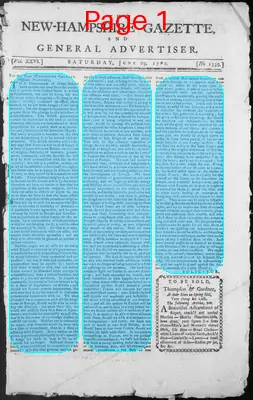
Letter to Editor
June 29, 1782
The New Hampshire Gazette And General Advertiser
Portsmouth, Exeter, Rockingham County, New Hampshire
What is this article about?
A letter arguing against reconciling with Britain on terms of dependence, emphasizing the benefits of independence and alliance with France during the Revolutionary War. It warns of the consequences of betraying allies and urges continued resistance until full independence is recognized.
Clipping
OCR Quality
95%
Excellent
Full Text
For the New-Hampshire Gazette.
Messieurs PRINTERs,
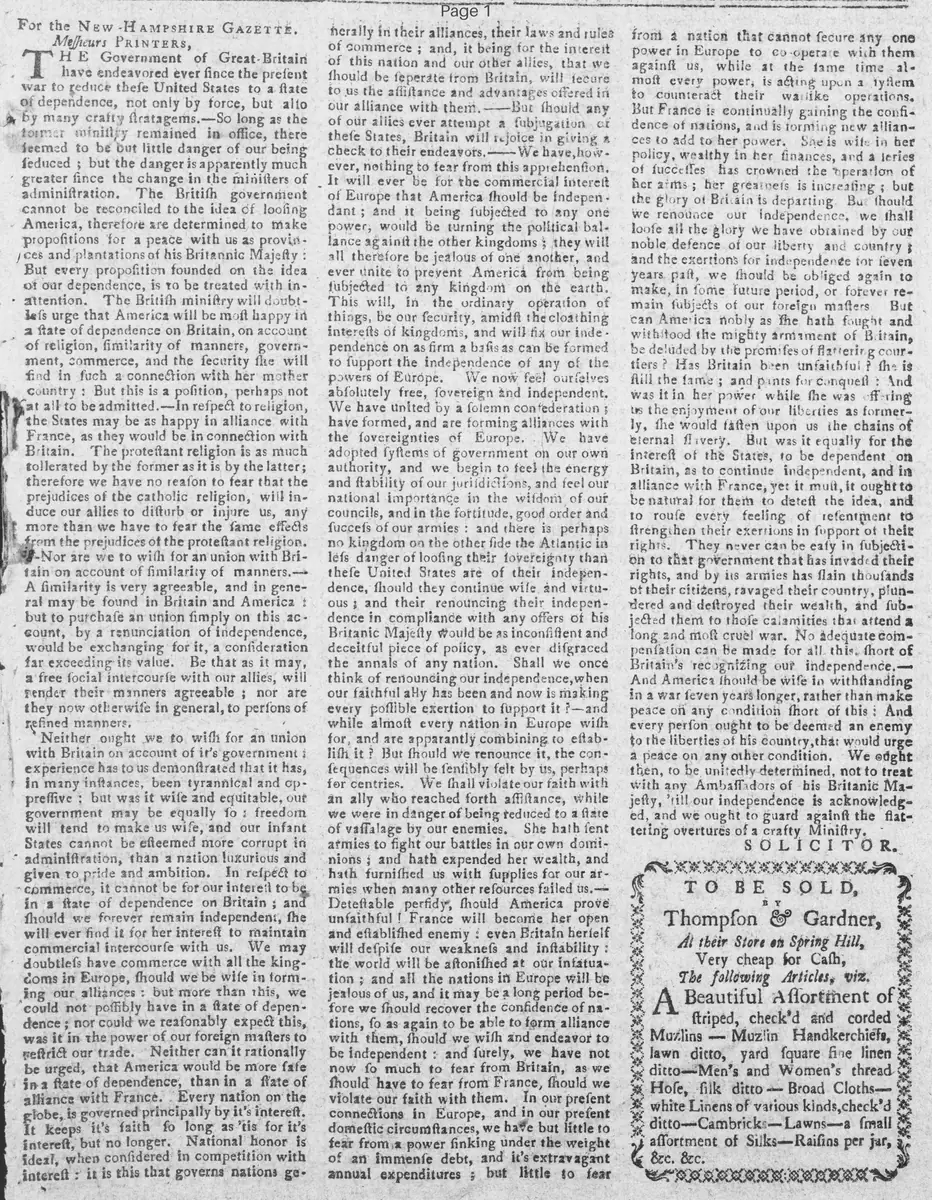
THE Government of Great-Britain have endeavored ever since the present war to reduce these United States to a state of dependence, not only by force, but also by many crafty stratagems. So long as the former ministry remained in office, there seemed to be but little danger of our being reduced; but the danger is apparently much greater since the change in the ministers of administration. The British government cannot be reconciled to the idea of losing America, therefore are determined to make propositions for a peace with us as provinces and plantations of his Britannic Majesty: But every proposition founded on the idea of our dependence, is to be treated with indignation. The British ministry will doubtless urge that America will be most happy in a state of dependence on Britain, on account of religion, similarity of manners, government, commerce, and the security she will find in such a connection with her mother country: But this is a position, perhaps not at all to be admitted. In respect to religion, the States may be as happy in alliance with France, as they would be in connection with Britain. The protestant religion is as much tolerated by the former as it is by the latter: therefore we have no reason to fear that the prejudices of the catholic religion, will induce our allies to disturb or injure us, any more than we have to fear the same effects from the prejudices of the protestant religion.
Nor are we to wish for an union with Britain on account of similarity of manners. A similarity is very agreeable, and in general may be found in Britain and America: but to purchase an union simply on this account, by a renunciation of independence, would be exchanging for it, a consideration far exceeding its value. Be that as it may, a free social intercourse with our allies, will render their manners agreeable; nor are they now otherwise in general, to persons of refined manners.
Neither ought we to wish for an union with Britain on account of its government: experience has to us demonstrated that it has, in many instances, been tyrannical and oppressive: but was it wise and equitable, our government may be equally so: freedom will tend to make us wise, and our infant States cannot be esteemed more corrupt in administration, than a nation luxurious and given to pride and ambition. In respect to commerce, it cannot be for our interest to be in a state of dependence on Britain: and should we forever remain independent, she will ever find it for her interest to maintain commercial intercourse with us. We may doubtless have commerce with all the kingdoms in Europe, should we be wise in forming our alliances: but more than this, we could not possibly have in a state of dependence; nor could we reasonably expect this, was it in the power of our foreign masters to restrict our trade. Neither can it rationally be urged, that America would be more safe in a state of dependence, than in a state of alliance with France. Every nation on the globe, is governed principally by its interest. It keeps its faith so long as it is for its interest, but no longer. National honor is ideal, when considered in competition with interest: it is this that governs nations generally in their alliances, their laws and rules of commerce: and, it being for the interest of this nation and our other allies, that we should be separate from Britain, will secure to us the assistance and advantages offered in our alliance with them.
But should any of our allies ever attempt the subjugation of these States, Britain will rejoice in giving a check to their endeavors. We have, however, nothing to fear from this apprehension. It will ever be for the commercial interest of Europe that America should be independent; and it being subjected to any one power, would be turning the political balance against the other kingdoms; they will all therefore be jealous of one another, and ever unite to prevent America from being subjected to any kingdom on the earth. This will, in the ordinary operation of things, be our security, amidst the clashing interests of kingdoms, and will fix our independence on as firm a basis as can be formed to support the independence of any of the powers of Europe. We now feel ourselves absolutely free, sovereign and independent. We have united by a solemn confederation; have formed, and are forming alliances with the sovereignties of Europe. We have adopted systems of government on our own authority, and we begin to feel the energy and stability of our jurisdictions, and feel our national importance in the wisdom of our councils, and in the fortitude, good order and success of our armies: and there is perhaps no kingdom on the other side the Atlantic in less danger of losing their sovereignty than these United States are of their independence, should they continue wise and virtuous: and their renouncing their independence in compliance with any offers of his Britannic Majesty would be as inconsistent and deceitful piece of policy, as ever disgraced the annals of any nation. Shall we once think of renouncing our independence, when our faithful ally has been and now is making every possible exertion to support it? and while almost every nation in Europe wish for, and are apparently combining to establish it? But should we renounce it, the consequences will be sensibly felt by us, perhaps for centuries. We shall violate our faith with an ally who reached forth assistance, while we were in danger of being reduced to a state of vassalage by our enemies. She hath sent armies to fight our battles in our own dominions; and hath expended her wealth, and hath furnished us with supplies for our armies when many other resources failed us. Detestable perfidy, should America prove unfaithful! France will become her open and established enemy: even Britain herself will despise our weakness and instability: the world will be astonished at our infatuation: and all the nations in Europe will be jealous of us, and it may be a long period before we should recover the confidence of nations, so as again to be able to form alliance with them, should we wish and endeavor to be independent: and surely, we have not now so much to fear from Britain, as we should have to fear from France, should we violate our faith with them. In our present connections in Europe, and in our present domestic circumstances, we have but little to fear from a power sinking under the weight of an immense debt, and its extravagant annual expenditures; but little to fear from a nation that cannot secure any one power in Europe to co-operate with them against us, while at the same time almost every power, is acting upon a system to counteract their warlike operations. But France is continually gaining the confidence of nations, and is forming new alliances to add to her power. She is wise in her policy, wealthy in her finances, and a series of successes has crowned the operation of her arms: her greatness is increasing: but the glory of Britain is departing. But should we renounce our independence, we shall lose all the glory we have obtained by our noble defence of our liberty and country and the exertions for independence for seven years past, we should be obliged again to make, in some future period, or forever remain subjects of our foreign masters. But can America, nobly as she hath fought and withstood the mighty armament of Britain, be deluded by the promises of flattering courtiers? Has Britain been unfaithful? she is still the same: and pants for conquest: And was it in her power while she was sparing us the enjoyment of our liberties as formerly, she would fasten upon us the chains of eternal slavery. But was it equally for the interest of the States, to be dependent on Britain, as to continue independent, and in alliance with France, yet it must, it ought to be natural for them to detest the idea, and to rouse every feeling of resentment to strengthen their exertions in support of their rights. They never can be easy in subjection to that government that has invaded their rights, and by its armies has slain thousands of their citizens, ravaged their country, plundered and destroyed their wealth, and subjected them to those calamities that attend a long and most cruel war. No adequate compensation can be made for all this, short of Britain's recognizing our independence. And America should be wise in withstanding in a war even years longer, rather than make peace on any condition short of this: And every person ought to be deemed an enemy to the liberties of his country, that would urge a peace on any other condition. We ought then, to be unitedly determined, not to treat with any Ambassadors of his Britannic Majesty, 'till our independence is acknowledged, and we ought to guard against the flattering overtures of a crafty Ministry.
SOLICITOR.
Messieurs PRINTERs,
THE Government of Great-Britain have endeavored ever since the present war to reduce these United States to a state of dependence, not only by force, but also by many crafty stratagems. So long as the former ministry remained in office, there seemed to be but little danger of our being reduced; but the danger is apparently much greater since the change in the ministers of administration. The British government cannot be reconciled to the idea of losing America, therefore are determined to make propositions for a peace with us as provinces and plantations of his Britannic Majesty: But every proposition founded on the idea of our dependence, is to be treated with indignation. The British ministry will doubtless urge that America will be most happy in a state of dependence on Britain, on account of religion, similarity of manners, government, commerce, and the security she will find in such a connection with her mother country: But this is a position, perhaps not at all to be admitted. In respect to religion, the States may be as happy in alliance with France, as they would be in connection with Britain. The protestant religion is as much tolerated by the former as it is by the latter: therefore we have no reason to fear that the prejudices of the catholic religion, will induce our allies to disturb or injure us, any more than we have to fear the same effects from the prejudices of the protestant religion.
Nor are we to wish for an union with Britain on account of similarity of manners. A similarity is very agreeable, and in general may be found in Britain and America: but to purchase an union simply on this account, by a renunciation of independence, would be exchanging for it, a consideration far exceeding its value. Be that as it may, a free social intercourse with our allies, will render their manners agreeable; nor are they now otherwise in general, to persons of refined manners.
Neither ought we to wish for an union with Britain on account of its government: experience has to us demonstrated that it has, in many instances, been tyrannical and oppressive: but was it wise and equitable, our government may be equally so: freedom will tend to make us wise, and our infant States cannot be esteemed more corrupt in administration, than a nation luxurious and given to pride and ambition. In respect to commerce, it cannot be for our interest to be in a state of dependence on Britain: and should we forever remain independent, she will ever find it for her interest to maintain commercial intercourse with us. We may doubtless have commerce with all the kingdoms in Europe, should we be wise in forming our alliances: but more than this, we could not possibly have in a state of dependence; nor could we reasonably expect this, was it in the power of our foreign masters to restrict our trade. Neither can it rationally be urged, that America would be more safe in a state of dependence, than in a state of alliance with France. Every nation on the globe, is governed principally by its interest. It keeps its faith so long as it is for its interest, but no longer. National honor is ideal, when considered in competition with interest: it is this that governs nations generally in their alliances, their laws and rules of commerce: and, it being for the interest of this nation and our other allies, that we should be separate from Britain, will secure to us the assistance and advantages offered in our alliance with them.
But should any of our allies ever attempt the subjugation of these States, Britain will rejoice in giving a check to their endeavors. We have, however, nothing to fear from this apprehension. It will ever be for the commercial interest of Europe that America should be independent; and it being subjected to any one power, would be turning the political balance against the other kingdoms; they will all therefore be jealous of one another, and ever unite to prevent America from being subjected to any kingdom on the earth. This will, in the ordinary operation of things, be our security, amidst the clashing interests of kingdoms, and will fix our independence on as firm a basis as can be formed to support the independence of any of the powers of Europe. We now feel ourselves absolutely free, sovereign and independent. We have united by a solemn confederation; have formed, and are forming alliances with the sovereignties of Europe. We have adopted systems of government on our own authority, and we begin to feel the energy and stability of our jurisdictions, and feel our national importance in the wisdom of our councils, and in the fortitude, good order and success of our armies: and there is perhaps no kingdom on the other side the Atlantic in less danger of losing their sovereignty than these United States are of their independence, should they continue wise and virtuous: and their renouncing their independence in compliance with any offers of his Britannic Majesty would be as inconsistent and deceitful piece of policy, as ever disgraced the annals of any nation. Shall we once think of renouncing our independence, when our faithful ally has been and now is making every possible exertion to support it? and while almost every nation in Europe wish for, and are apparently combining to establish it? But should we renounce it, the consequences will be sensibly felt by us, perhaps for centuries. We shall violate our faith with an ally who reached forth assistance, while we were in danger of being reduced to a state of vassalage by our enemies. She hath sent armies to fight our battles in our own dominions; and hath expended her wealth, and hath furnished us with supplies for our armies when many other resources failed us. Detestable perfidy, should America prove unfaithful! France will become her open and established enemy: even Britain herself will despise our weakness and instability: the world will be astonished at our infatuation: and all the nations in Europe will be jealous of us, and it may be a long period before we should recover the confidence of nations, so as again to be able to form alliance with them, should we wish and endeavor to be independent: and surely, we have not now so much to fear from Britain, as we should have to fear from France, should we violate our faith with them. In our present connections in Europe, and in our present domestic circumstances, we have but little to fear from a power sinking under the weight of an immense debt, and its extravagant annual expenditures; but little to fear from a nation that cannot secure any one power in Europe to co-operate with them against us, while at the same time almost every power, is acting upon a system to counteract their warlike operations. But France is continually gaining the confidence of nations, and is forming new alliances to add to her power. She is wise in her policy, wealthy in her finances, and a series of successes has crowned the operation of her arms: her greatness is increasing: but the glory of Britain is departing. But should we renounce our independence, we shall lose all the glory we have obtained by our noble defence of our liberty and country and the exertions for independence for seven years past, we should be obliged again to make, in some future period, or forever remain subjects of our foreign masters. But can America, nobly as she hath fought and withstood the mighty armament of Britain, be deluded by the promises of flattering courtiers? Has Britain been unfaithful? she is still the same: and pants for conquest: And was it in her power while she was sparing us the enjoyment of our liberties as formerly, she would fasten upon us the chains of eternal slavery. But was it equally for the interest of the States, to be dependent on Britain, as to continue independent, and in alliance with France, yet it must, it ought to be natural for them to detest the idea, and to rouse every feeling of resentment to strengthen their exertions in support of their rights. They never can be easy in subjection to that government that has invaded their rights, and by its armies has slain thousands of their citizens, ravaged their country, plundered and destroyed their wealth, and subjected them to those calamities that attend a long and most cruel war. No adequate compensation can be made for all this, short of Britain's recognizing our independence. And America should be wise in withstanding in a war even years longer, rather than make peace on any condition short of this: And every person ought to be deemed an enemy to the liberties of his country, that would urge a peace on any other condition. We ought then, to be unitedly determined, not to treat with any Ambassadors of his Britannic Majesty, 'till our independence is acknowledged, and we ought to guard against the flattering overtures of a crafty Ministry.
SOLICITOR.
What sub-type of article is it?
Persuasive
Political
What themes does it cover?
Constitutional Rights
Politics
Military War
What keywords are associated?
American Independence
British Dependence
Alliance With France
Revolutionary War
Peace Propositions
National Interest
Political Alliances
What entities or persons were involved?
Solicitor.
Messieurs Printers
Letter to Editor Details
Author
Solicitor.
Recipient
Messieurs Printers
Main Argument
the united states must reject any british peace proposals that imply dependence and instead maintain full independence and their alliance with france, as dependence would betray allies, undermine security, and forfeit hard-won liberty after years of war.
Notable Details
References To British Stratagems And Ministerial Changes
Comparison Of Alliances With Britain Vs. France On Religion, Manners, Government, Commerce, And Security
Emphasis On National Interest Governing International Relations
Warning Against Perfidy Toward France And Loss Of European Confidence