Thank you for visiting SNEWPapers!
Sign up free
The Liberator
Boston, Suffolk County, Massachusetts
What is this article about?
Anti-slavery meeting in Boston's Marlboro' Chapel on Monday evening last, attended by abolitionists, legislators, and citizens, to critique Massachusetts legislative reports on D.C. slavery, foreign slave trade, and color-based laws. Resolutions unanimously passed urging abolition and repeal of discriminatory statutes.
Clipping
OCR Quality
Full Text
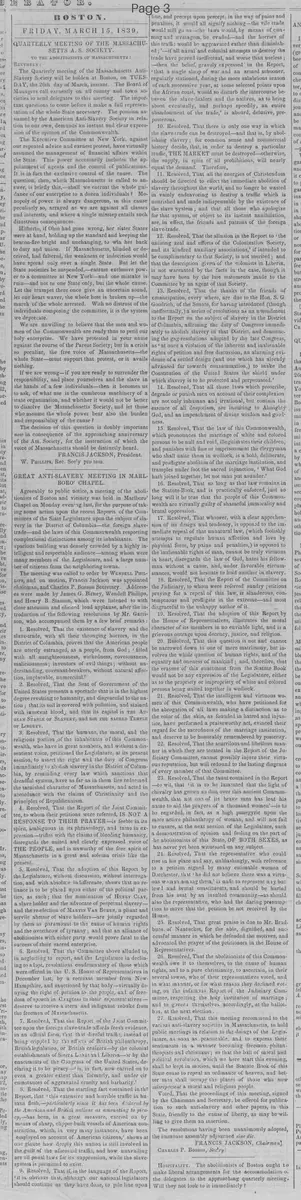
Agreeably to public notice, a meeting of the abolitionists of Boston and vicinity was held in Marlboro' Chapel on Monday evening last, for the purpose of taking some action upon the recent Reports of the Committees of the State Legislature upon the subject of slavery in the District of Columbia—the foreign slave trade—and the laws of this Commonwealth respecting complexional distinctions among its inhabitants. The spacious building was densely crowded by a highly intelligent and respectable audience—among whom were many members of the Legislature, and a large number of citizens from the neighboring towns.
The meeting was called to order by Wendell PHILLIPS, and on motion, Francis Jackson was appointed chairman, and Charles P. Bosson Secretary. Addresses were made by James G. Birney, Wendell Phillips, and Henry B. Stanton, which were listened to with close attention and elicited loud applause, after the introduction of the following resolutions by Mr. Garrison, who accompanied them by a few brief remarks:
1. Resolved, That the existence of slavery and the slave-trade, with all their thronging horrors, in the District of Columbia, proves that the American people are utterly estranged, as a people, from God; filled with all unrighteousness, wickedness, covetousness, maliciousness; inventors of evil things; without understanding, covenant-breakers, without natural affection, implacable, unmerciful.'
2. Resolved, 'That the Seat of Government of the United States presents a spectacle that is in the highest degree revolting to humanity, and disgraceful to the nation ; that its soil is covered with pollution, and stained with innocent blood; and that its capitol is THE AUGEAN STABLE OF SLAVERY, AND NOT THE SACRED TEMPLE OF LIBERTY.'
3. Resolved, That the humane, the moral, and the religious portion of the inhabitants of this Commonwealth, who have in great numbers, and without a dissenting voice. petitioned the Legislature, at its present session, to assert the right and the duty of Congress immediately to abolish slavery in the District of Columbia, by rescinding every law which sanctions that dreadful system, have as far as in them lies redeemed the tarnished character of Massachusetts, and acted in accordance with the claims of Christianity and the principles of Republicanism.
4. Resolved, That the Report of the Joint Committee, to whom their petitions were referred, IS NOT A RESPONSE TO THEIR PRAYER—is feeble in its spirit, ambiguous in its phraseology, and tame in expression—trifles with the claims of bleeding humanity, disregards the united and clearly expressed voice of THE PEOPLE, and is unworthy of the free spirit of Massachusetts in a great and solemn crisis like the present.
5. Resolved, That the adoption of this Report by the Legislature, without discussion, without interrogation, and with absolute indifference, shows that no reliance is to be placed upon either of the political parties, as such; that the nomination of Henry CLAY, a slave holder and the advocate of perpetual slavery— and the re-election of MARTIN VAN BUREN, a pliant and servile abettor of slave holders—are jointly regarded by them as paramount to the cause of human rights and the overthrow of tyranny; and that an alliance of abolitionists with either party would prove fatal to the success of their sacred enterprise.
6. Resolved, That the Committee above alluded to, in neglecting to report, and the Legislature in declining to adopt, resolutions condemnatory of those which were offered in the U. S. House of Representatives in December last. by a recreant member from New. Hampshire, and sanctioned by that body—virtually denying the right of petition to the people, and of freedom of speech in Congress to their representatives- deserve to receive a stern and indignant rebuke from the freemen of Massachusetts.
7. Resolved. That the Report of the Joint Committee upon the foreign slave-trade affords fresh evidence. in an official form, that this direful traffic, instead of being crippled by the efforts of British philanthropy, British legislation, or British cruizers—by the colonial establishments of Sierra Leone and Liberia—or by the enactments of the Congress of the United States, declaring it to be piracy—'is, in fact, now carried on to even a greater extent than formerly, and under circumstances of aggravated cruelty and barbarity.'
8. Resolved. That the startling fact contained in the Report, that 'this extensive and horrible traffic in human flesh,—particularly since it has been declared by the American and British nations as amounting to piracy,—has been, in a great measure, carried on by means of sharp, clipper-built vessels of American construction, which, in very many instances, have been employed on account of American citizens,' shows at one glance how deeply this nation is still involved in the guilt of the aforesaid traffic, and how unavailing are all penal laws for its suppression, while the slave system is permitted to exist.
9. Resolved, That if, in the language of the Report 'it is obvious that, although our national legislators should continue as they have done, to pile line upon line, and precept upon precept, in the way of pains and penalties, it would all signify nothing—the vile trade would still go on—the laws would, by means of cunning and stratagem, be evaded—and the horrors of this traffic would be aggravated rather than diminished; '—if all naval and colonial attempts to destroy the trade have proved ineffectual, and worse than useless: —then the belief, gravely expressed in the Report, 'that a single sloop of war and an armed schooner, regularly stationed, during the more salubrious season of each successive year, at some selected points upon the African coast, would so disturb the intercourse between the slave-dealers and the natives, as to bring about eventually, and perhaps speedily, an entire abandonment of the trade,' is absurd, delusive, preposterous.
10. Resolved, That there is only one way in which the slave-trade can be destroyed—and that is. by abolishing slavery; for common sense and commercial history decide, that, in order to destroy a particular traffic. THE MARKET must be destroyed—otherwise the supply, in spite of all prohibitions, will nearly equal the demand. Therefore.
11. Resolved, That all the energies of Christendom should-be directed to effect the immediate abolition of slavery throughout the world, and no longer be wasted in vainly endeavoring to destroy a traffic which is nourished and made indispensable by the existence of the slave system; and that all those who apologize for that system, or object to its instant annihilation are, in effect, the friends and patrons of the foreign slave-trade.
12. Resolved, That the allusion in the Report to · the untiring zeal and efforts of the Colonization Society, and its kindred auxiliary associations,' if intended to be complimentary to that Society, is not merited; and that the description given of the colonists in Liberia, is not warranted by the facts in the case, though it may have been by the late statements made to the Committee by an agent of that Society.
13. Resolved, That the thanks of the friends of emancipation. every where. are due to the Hon. S. G Goodrich, of the Senate, for having introduced (though ineffectually.) a series of resolutions as an amendment to the Report on the subject of slavery in the District of Columbia, affirming the duty of Congress immediately to abolish slavery in that District, and denouncing the gag-resolutions adopted by the late Congress as 'at once a violation of the inherent and inalienable rights of petition and free discussion, an alarming evidence of a settled design (and one which has already advanced far towards consummation,) to make the Constitution of the United States the shield under which slavery is to be protected and perpetuated.'
14. Resolved. That all those laws which proscribe degrade or punish men on account of their complexion are not only inhuman and irrational, but contain the essence of all despotism, are insulting to Almighty God, and an impeachment of divine wisdom and goodness.
15. Resolved, That the law of this Commonwealth, which pronounces the marriage of white and colored persons to be null and void, illegitimates their children, and punishes with fine or imprisonment the clergyman who shall unite them in wedlock, is a bold, deliberate and profligate abolition of the marriage institution, and tramples under foot the sacred injunction, ' What God hath joined together, let not man put asunder.'
16. Resolved, That so long as that law remains in the Statute-Book, and is practically enforced, just so long will it be true that the people of this Commonwealth are virtually guilty of shameful immorality and brutal oppression.
17. Resolved, That whoever. with a clear apprehension of its design and tendency, is opposed to the immediate repeal of that unnatural law, (which foolishly attempts to regulate human affection and love by physical force, by pains and penalties,) is opposed to the inalienable rights of man, cannot be truly virtuous in heart, disregards the law of God, hates his fellow. man without a cause, and, under favorable circumstances, would not hesitate to hold another in slavery.
18. Resolved, That the Report of the Committee on the Judiciary, to whom were referred sundry petitions praying for a repeal of this law, is slanderous, contemptuous and profligate in the extreme—and most disgraceful to the unhappy author of it.
19. Resolved, That the adoption of this Report by the House of Representatives, illustrates the moral character of its members in no enviable light, and is a grievous outrage upon decency, justice, and religion.
20. Resolved, That this question is not and cannot be narrowed down to one of mere matrimony, but involves the whole question of human rights, and of the equality and oneness of mankind ; and, therefore, that the erasure of this enactment from the Statute Book would not be any expression of the Legislature, either as to the propriety or impropriety of white and colored persons being united together in wedlock.
21. Resolved, That the intelligent and virtuous women of this Commonwealth, who have petitioned for the abrogation of all laws making a distinction as to the color of the skin, as founded in hatred and injustice, have performed a praiseworthy act, evinced their regard for the sacredness of the marriage institution, and deserve to be honorably remembered by posterity.
22. Resolved, That the scurrilous and libellous manner in which they are treated in the Report of the Judiciary Committee, cannot possibly injure their virtuous reputation, but will redound to the lasting disgrace of every member of that Committee.
23. Resolved. That the taunt contained in the Report —to wit, that it is to be lamented that the light of chivalry has grown so dim over this ancient Commonwealth. that not one of its brave men has lent his name to aid the prayers of a thousand women'—is to be regarded, in fact, as a high panegyric upon the more active philanthropy of woman, and will not fail to ensure, at the next session of the Legislature, such a demonstration of opinion and feeling on the part of the abolitionists of this State, OF BOTH SEXES, as has never yet been witnessed on any subject.
24. Resolved, That the representative who could rise in his place and say, unblushingly, with reference to a petition signed by many estimable women of Dorchester. that 'he did not believe there was a virtuous woman among them,' is unfit to represent any but low and brutal constituents, and should be hurled from his seat by an insulted community—as should also the representative, who had the daring presumption to move that the petition be not received by the House.
25. Resolved, That great praise is due to Mr. Bradbury, of Nantucket, for the able, dignified, and successful manner in which he defended the motives, and advocated the prayer of the petitioners in the House of Representatives.
26. Resolved, That the abolitionists of this Commonwealth owe it to themselves, to the cause of human rights, and to a pure christianity, to ascertain, in their several towns, who of their representatives voted, and in what manner, or for what reason they declined voting, on the infamous Report of the Judiciary Committee, respecting the holy institution of marriage; and to govern themselves accordingly, at the ballot-box, at the next election.
27. Resolved. That this meeting recommend to the various anti-slavery societies in Massachusetts, to hold public meetings in relation to the doings of the Legislature, as soon as practicable, and to express their sentiments in a manner becoming freemen, philanthropists and christians; so that the ball of moral and political revolution, which we here start this evening, shall be kept in motion, until the Statute Book of this State cease to repeal an ordinance of heaven, and better men shall occupy the places of those who now misrepresent a moral and religious people.
Voted, That the proceedings of this meeting, signed by the Chairman and Secretary, be offered for publication to such anti-slavery and other papers, in this State, friendly to the cause of liberty, as may be willing to give them an insertion.
The resolutions having been unanimously adopted the immense assembly adjourned sine die.
FRANCIS JACKSON, Chairman
CHARLES P. BOSSON, Sec'ry
What sub-type of article is it?
What keywords are associated?
What entities or persons were involved?
Where did it happen?
Domestic News Details
Primary Location
Boston
Event Date
Monday Evening Last
Key Persons
Outcome
resolutions unanimously adopted; meeting adjourned sine die; proceedings to be published in anti-slavery papers.
Event Details
Abolitionists of Boston and vicinity held a densely crowded meeting in Marlboro' Chapel to discuss recent State Legislature committee reports on slavery in the District of Columbia, the foreign slave trade, and Massachusetts laws on complexional distinctions. Wendell Phillips called the meeting to order; Francis Jackson was chairman, Charles P. Bosson secretary. Addresses by James G. Birney, Wendell Phillips, and Henry B. Stanton. Garrison introduced 27 resolutions criticizing the reports, calling for immediate abolition of slavery, repeal of discriminatory laws, and condemning political parties and specific legislators; all resolutions unanimously adopted.