Thank you for visiting SNEWPapers!
Sign up free
Letter to Editor
February 27, 1828
Literary Cadet And Rhode Island Statesman
Providence, Providence County, Rhode Island
What is this article about?
An article praises Bishop Hobart's letter to New York City's mayor, declining to have clergy publicly mourn Governor De Witt Clinton's death in churches, to avoid mixing religion with politics and prevent church-state union, emphasizing separation's importance for liberty and justice.
Clipping
OCR Quality
98%
Excellent
Full Text
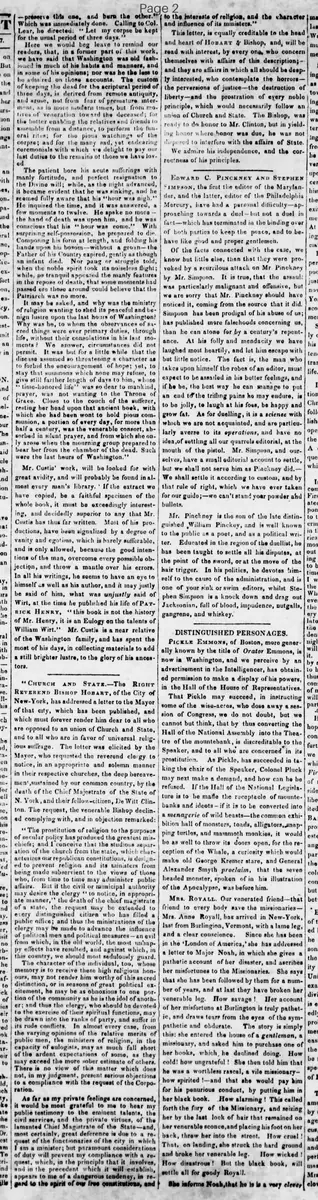
CHURCH AND STATE.-THE RIGHT Reverend Bishop HOBART, of the City of New-York, has addressed a letter to the Mayor of that city, which has been published, and which must forever render him dear to all who are opposed to an union of Church and State, and to all who are in favor of universal religious suffrage. The letter was elicited by the Mayor, who requested the reverend clergy to notice, in an appropriate and solemn manner in their respective churches, the deep bereavement, sustained by our common country, by the death of the Chief Magistrate of the State of N. York, and their fellow-citizen, De Witt Clinton. The request, the venerable Bishop declined complying with, and in objection remarked: "The prostitution of religion to the purposes of secular policy has produced the greatest mischiefs; and I conceive that the studious separation of the church from the state, which characterizes our republican constitutions, is designed to prevent religion and its ministers from being made subservient to the views of those who, from time to time may administer public affairs. But if the civil or municipal authority may desire the clergy "to notice, in appropriate manner," the death of the chief magistrate of a state, the request may be extended to every distinguished citizen who has filled a public office; and thus the ministrations of the clergy may be made to advance the influence of political men and political measures—an evil from which, in the old world, the most unhappy effects have resulted, and against which, in this country, we should most sedulously guard. The character of the individual, too, whose memory is to receive these high religious honours, may not render him worthy of this sacred distinction, or in seasons of great political excitement, he may be as obnoxious to one portion of the community as he is the idol of another; and thus the clergy, who should be devoted to the exercise of their spiritual functions, may be drawn into the ranks of party, and suffer in its rude conflicts. In almost every case, from the varying opinions of the relative merits of public men, the ministers of religion, in the capacity of eulogists, may as much fall short of the ardent expectations of some, as they may exceed the more sober estimate of others. There is no view of this matter which does not, in my judgment, present serious objections to a compliance with the request of the Corporation. As far as my private feelings are concerned, it would be most grateful to me to hear my public testimony to the eminent talents, the civil services, and the private virtues, of the lamented Chief Magistrate of the State—and, most certainly, great deference is due to a request of the functionaries of the city in which I am a minister; but paramount considerations of duty will prevent my compliance with a request, which, in the principle that it involves, and in the precedent which it will establish, appears to me of a dangerous tendency, in regard to the spirit of our free constitutions, and to the interests of religion, and the character and influence of its ministers."
This letter, is equally creditable to the head and heart of Hobart the Bishop, and, will be read with interest, by every one, who concerns themselves with affairs of this description; and they are affairs in which all should be deeply interested, who contemplate the horrors—the perversions of justice—the destruction of liberty—and the prostration of every noble principle, which would necessarily follow an union of Church and State. The Bishop, was ready to do honor to Mr. Clinton, but in yielding honor where honor was due, he was not disposed to interfere with the affairs of State. We admire his independence, and the correctness of his principles.
This letter, is equally creditable to the head and heart of Hobart the Bishop, and, will be read with interest, by every one, who concerns themselves with affairs of this description; and they are affairs in which all should be deeply interested, who contemplate the horrors—the perversions of justice—the destruction of liberty—and the prostration of every noble principle, which would necessarily follow an union of Church and State. The Bishop, was ready to do honor to Mr. Clinton, but in yielding honor where honor was due, he was not disposed to interfere with the affairs of State. We admire his independence, and the correctness of his principles.
What sub-type of article is it?
Persuasive
Political
Religious
What themes does it cover?
Religion
Politics
Constitutional Rights
What keywords are associated?
Church State Separation
Bishop Hobart
De Witt Clinton
Religious Independence
Political Interference
Universal Religious Suffrage
Letter to Editor Details
Main Argument
bishop hobart's refusal to comply with the mayor's request for clergy to eulogize de witt clinton in churches upholds the separation of church and state, preventing religion from being used for political purposes and safeguarding religious independence.
Notable Details
Quotes Bishop Hobart's Objections To Mixing Religion And Secular Policy
References Republican Constitutions' Separation Of Church And State
Warns Of Evils From Church State Union In The Old World
Praises Clinton's Talents And Virtues But Prioritizes Principle