Thank you for visiting SNEWPapers!
Sign up free
Editorial
July 22, 1809
Alexandria Daily Gazette, Commercial & Political
Alexandria, Virginia
What is this article about?
Editorial from Boston Repertory praises John Adams' 'Discourses on Davila' for profound insights into human nature and politics, quoting extracts on ambition, disappointment, and envy in public service. Notes slight qualification on Adams' preference for strong executive over more republican views of Hamilton and Ames.
Clipping
OCR Quality
98%
Excellent
Full Text
From the BOSTON REPERTORY.
MAN AS HE IS.
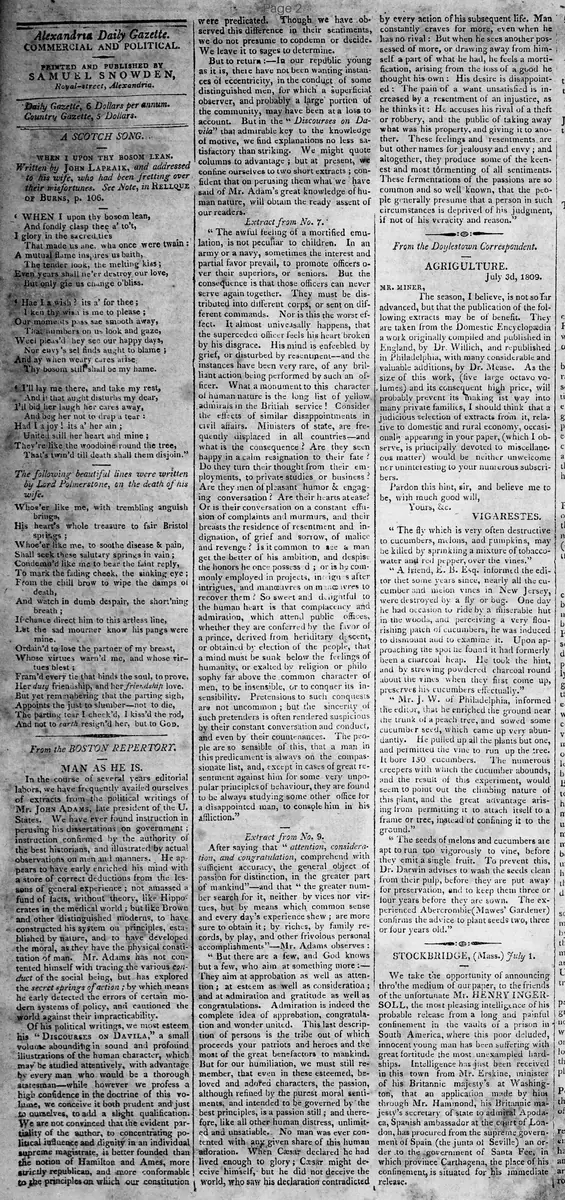
In the course of several years editorial labors, we have frequently availed ourselves of extracts from the political writings of Mr. John Adams, late president of the United States. We have ever found instruction in perusing his dissertations on government; instruction confirmed by the authority of the best historians, and illustrated by actual observations on men and manners. He appears to have early enriched his mind with a store of correct deductions from the lessons of general experience; not amassed a fund of facts, without theory, like Hippocrates in the medical world; but like Brown and other distinguished moderns, to have constructed his system on principles, established by nature, and to have developed the moral, as they have the physical constitution of man. Mr. Adams has not contented himself with tracing the various conduct of the social being, but has explored the secret springs of action; by which means he early detected the errors of certain modern systems of policy, and cautioned the world against their impracticability.
Of his political writings, we most esteem his "Discourses on Davila," a small volume abounding in sound and profound illustrations of the human character, which may be studied attentively, with advantage by every man who would be a thorough statesman--while however we profess a high confidence in the doctrine of this volume, we conceive it both prudent and just to ourselves, to add a slight qualification.
We are not convinced that the evident partiality of the author, to concentrating political influence and dignity in an individual supreme magistrate, is better founded than the notion of Hamilton and Ames, more strictly republican, and more conformable to the principles on which our constitution were predicated. Though we have observed this difference in their sentiments, we do not presume to condemn or decide. We leave it to sages to determine.
But to return:--In our republic young as it is, there have not been wanting instances of eccentricity, in the conduct of some distinguished men, for which a superficial observer, and probably a large portion of the community, may have been at a loss to account. But in the "Discourses on Davila" that admirable key to the knowledge of motive, we find explanations no less satisfactory than striking. We might quote columns to advantage; but at present, we confine ourselves to two short extracts; confident that on perusing them what we have said of Mr. Adams's great knowledge of human nature, will obtain the ready assent of our readers.
Extract from No. 7.
"The awful feeling of a mortified emulation, is not peculiar to children. In an army or a navy, sometimes the interest and partial favor prevail, to promote officers over their superiors, or seniors. But the consequence is that those officers can never serve again together. They must be distributed into different corps, or sent on different commands. Nor is this the worst effect. It almost universally happens, that the superceded officer feels his heart broken by his disgrace. His mind is enfeebled by grief, or disturbed by resentment--and the instances have been very rare, of any brilliant action being performed by such an officer. What a monument to this character of human nature is the long list of yellow admirals in the British service! Consider the effects of similar disappointments in civil affairs. Ministers of state, are frequently displaced in all countries--and what is the consequence? Are they seen happy in a calm resignation to their fate? Do they turn their thought from their employments, to private studies or business? Are they men of pleasant humor & engaging conversation? Are their hearts at ease? Or is their conversation on a constant effusion of complaints and murmurs, and their breasts the residence of resentment and indignation, of grief and sorrow, of malice and revenge? Is it common to see a man get the better of his ambition, and despise the honors he once possessed; or is he commonly employed in projects, intrigues after intrigues, and manoeuvres on manoeuvres to recover them? So sweet and delightful to the human heart is that complacency and admiration, which attend public offices, whether they are conferred by the favor of a prince, derived from hereditary descent, or obtained by election of the people, that a mind must be sunk below the feelings of humanity, or exalted by religion or philosophy far above the common character of men, to be insensible, or to conquer its sensibility. Pretensions to such conquests are not uncommon; but the sincerity of such pretenders is often rendered suspicious by their constant conversation and conduct, and even by their countenances. The people are so sensible of this, that a man in this predicament is always on the compassionate list, and, except in cases of great resentment against him for some very unpopular principles or behaviour, they are found to be always studying some other office for a disappointed man, to console him in his affliction."
Extract from No. 9.
After saying that "attention, consideration, and congratulation, comprehend with sufficient accuracy, the general object of passion for distinction, in the greater part of mankind" -and that "the greater number search for it, neither by vices nor virtues, but by means which common sense and every day's experience shew, are more sure to obtain it; by riches, by family records, by play, and other frivolous personal accomplishments"--Mr. Adams observes:
"But there are a few, and God knows but a few, who aim at something more:--They aim at approbation as well as attention; at esteem as well as consideration; and at admiration and gratitude as well as congratulations. Admiration is indeed the complete idea of approbation, congratulation and wonder united. This last description of persons is the tribe out of which proceeds your patriots and heroes and the most of the great benefactors to mankind. But for our humiliation, we must still remember, that even in these esteemed, beloved and adored characters, the passion, although refined by the purest moral sentiments, and intended to be governed by the best principles, is a passion still; and therefore, like all other human desires, unlimited and insatiable. No man was ever contented with any given share of this human adoration. When Caesar declared he had lived enough to glory; Caesar might deceive himself,- but he did not deceive the world, who saw his declaration contradicted by every action of his subsequent life. Man constantly craves for more, even when he has no rival: But when he sees another possessed of more, or drawing away from himself a part of what he had, he feels a mortification, arising from the loss of a good he thought his own: His desire is disappointed: The pain of a want unsatisfied is increased by a resentment of an injustice, as he thinks it: He accuses his rival of a theft or robbery, and the public of taking away what was his property, and giving it to another. These feelings and resentments are but other names for jealousy and envy; and altogether, they produce some of the keenest and most tormenting of all sentiments. These fermentations of the passions are so common and so well known, that the people generally presume that a person in such circumstances is deprived of his judgment, if not of his veracity and reason."
MAN AS HE IS.
In the course of several years editorial labors, we have frequently availed ourselves of extracts from the political writings of Mr. John Adams, late president of the United States. We have ever found instruction in perusing his dissertations on government; instruction confirmed by the authority of the best historians, and illustrated by actual observations on men and manners. He appears to have early enriched his mind with a store of correct deductions from the lessons of general experience; not amassed a fund of facts, without theory, like Hippocrates in the medical world; but like Brown and other distinguished moderns, to have constructed his system on principles, established by nature, and to have developed the moral, as they have the physical constitution of man. Mr. Adams has not contented himself with tracing the various conduct of the social being, but has explored the secret springs of action; by which means he early detected the errors of certain modern systems of policy, and cautioned the world against their impracticability.
Of his political writings, we most esteem his "Discourses on Davila," a small volume abounding in sound and profound illustrations of the human character, which may be studied attentively, with advantage by every man who would be a thorough statesman--while however we profess a high confidence in the doctrine of this volume, we conceive it both prudent and just to ourselves, to add a slight qualification.
We are not convinced that the evident partiality of the author, to concentrating political influence and dignity in an individual supreme magistrate, is better founded than the notion of Hamilton and Ames, more strictly republican, and more conformable to the principles on which our constitution were predicated. Though we have observed this difference in their sentiments, we do not presume to condemn or decide. We leave it to sages to determine.
But to return:--In our republic young as it is, there have not been wanting instances of eccentricity, in the conduct of some distinguished men, for which a superficial observer, and probably a large portion of the community, may have been at a loss to account. But in the "Discourses on Davila" that admirable key to the knowledge of motive, we find explanations no less satisfactory than striking. We might quote columns to advantage; but at present, we confine ourselves to two short extracts; confident that on perusing them what we have said of Mr. Adams's great knowledge of human nature, will obtain the ready assent of our readers.
Extract from No. 7.
"The awful feeling of a mortified emulation, is not peculiar to children. In an army or a navy, sometimes the interest and partial favor prevail, to promote officers over their superiors, or seniors. But the consequence is that those officers can never serve again together. They must be distributed into different corps, or sent on different commands. Nor is this the worst effect. It almost universally happens, that the superceded officer feels his heart broken by his disgrace. His mind is enfeebled by grief, or disturbed by resentment--and the instances have been very rare, of any brilliant action being performed by such an officer. What a monument to this character of human nature is the long list of yellow admirals in the British service! Consider the effects of similar disappointments in civil affairs. Ministers of state, are frequently displaced in all countries--and what is the consequence? Are they seen happy in a calm resignation to their fate? Do they turn their thought from their employments, to private studies or business? Are they men of pleasant humor & engaging conversation? Are their hearts at ease? Or is their conversation on a constant effusion of complaints and murmurs, and their breasts the residence of resentment and indignation, of grief and sorrow, of malice and revenge? Is it common to see a man get the better of his ambition, and despise the honors he once possessed; or is he commonly employed in projects, intrigues after intrigues, and manoeuvres on manoeuvres to recover them? So sweet and delightful to the human heart is that complacency and admiration, which attend public offices, whether they are conferred by the favor of a prince, derived from hereditary descent, or obtained by election of the people, that a mind must be sunk below the feelings of humanity, or exalted by religion or philosophy far above the common character of men, to be insensible, or to conquer its sensibility. Pretensions to such conquests are not uncommon; but the sincerity of such pretenders is often rendered suspicious by their constant conversation and conduct, and even by their countenances. The people are so sensible of this, that a man in this predicament is always on the compassionate list, and, except in cases of great resentment against him for some very unpopular principles or behaviour, they are found to be always studying some other office for a disappointed man, to console him in his affliction."
Extract from No. 9.
After saying that "attention, consideration, and congratulation, comprehend with sufficient accuracy, the general object of passion for distinction, in the greater part of mankind" -and that "the greater number search for it, neither by vices nor virtues, but by means which common sense and every day's experience shew, are more sure to obtain it; by riches, by family records, by play, and other frivolous personal accomplishments"--Mr. Adams observes:
"But there are a few, and God knows but a few, who aim at something more:--They aim at approbation as well as attention; at esteem as well as consideration; and at admiration and gratitude as well as congratulations. Admiration is indeed the complete idea of approbation, congratulation and wonder united. This last description of persons is the tribe out of which proceeds your patriots and heroes and the most of the great benefactors to mankind. But for our humiliation, we must still remember, that even in these esteemed, beloved and adored characters, the passion, although refined by the purest moral sentiments, and intended to be governed by the best principles, is a passion still; and therefore, like all other human desires, unlimited and insatiable. No man was ever contented with any given share of this human adoration. When Caesar declared he had lived enough to glory; Caesar might deceive himself,- but he did not deceive the world, who saw his declaration contradicted by every action of his subsequent life. Man constantly craves for more, even when he has no rival: But when he sees another possessed of more, or drawing away from himself a part of what he had, he feels a mortification, arising from the loss of a good he thought his own: His desire is disappointed: The pain of a want unsatisfied is increased by a resentment of an injustice, as he thinks it: He accuses his rival of a theft or robbery, and the public of taking away what was his property, and giving it to another. These feelings and resentments are but other names for jealousy and envy; and altogether, they produce some of the keenest and most tormenting of all sentiments. These fermentations of the passions are so common and so well known, that the people generally presume that a person in such circumstances is deprived of his judgment, if not of his veracity and reason."
What sub-type of article is it?
Constitutional
Moral Or Religious
What keywords are associated?
John Adams
Discourses On Davila
Human Nature
Political Philosophy
Ambition
Envy
Public Office
Republican Principles
What entities or persons were involved?
John Adams
Alexander Hamilton
Fisher Ames
Editorial Details
Primary Topic
Praise And Analysis Of John Adams' Discourses On Davila On Human Nature In Politics
Stance / Tone
Admiring With Slight Qualification On Executive Power
Key Figures
John Adams
Alexander Hamilton
Fisher Ames
Key Arguments
Adams' Writings Provide Profound Insights Into Human Nature And Political Systems
Discourses On Davila Illustrates Secret Springs Of Human Action And Errors In Modern Policies
Qualification: Adams' Preference For Strong Supreme Magistrate Less Republican Than Hamilton And Ames' Views
Mortified Emulation In Military And Civil Life Leads To Resentment And Impaired Performance
Public Offices Bring Complacency And Admiration Essential To Human Heart
Passion For Distinction Drives Most People Through Common Means Like Riches
True Patriots Seek Approbation And Esteem But Remain Insatiable In Their Passions
Jealousy And Envy Arise From Perceived Loss Of Admiration, Affecting Judgment