Thank you for visiting SNEWPapers!
Sign up free
Story
November 30, 1839
The Madisonian
Washington, District Of Columbia
What is this article about?
Article from Salem Gazette urges Congress to compensate US citizens for French spoliations on American commerce before 1800, which the government acknowledged and used to relieve treaty obligations with France, leaving sufferers unremunerated despite national benefits.
Clipping
OCR Quality
95%
Excellent
Full Text
From the Salem Gazette.
THE OLD CLAIMS ON FRANCE.
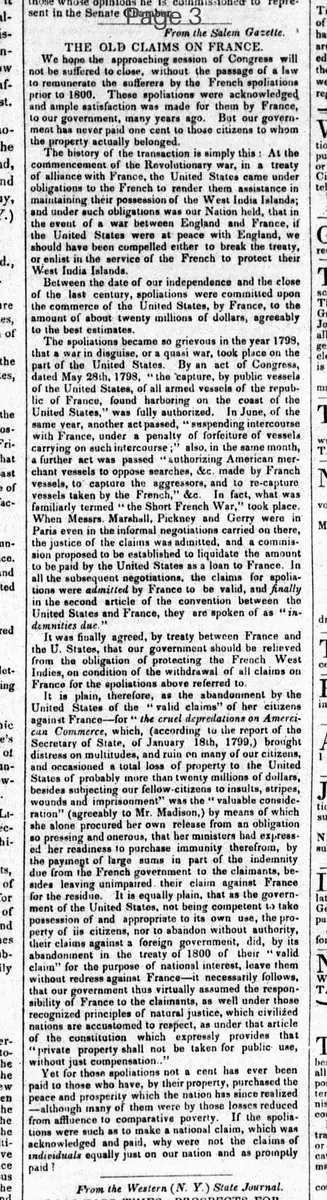
We hope the approaching session of Congress will not be suffered to close, without the passage of a law to remunerate the sufferers by the French spoliations prior to 1800. These spoliations were acknowledged and ample satisfaction was made for them by France, to our government, many years ago. But our government has never paid one cent to those citizens to whom the property actually belonged.
The history of the transaction is simply this: At the commencement of the Revolutionary war, in a treaty of alliance with France, the United States came under obligations to the French to render them assistance in maintaining their possession of the West India Islands; and under such obligations was our Nation held, that in the event of a war between England and France, if the United States were at peace with England, we should have been compelled either to break the treaty, or enlist in the service of the French to protect their West India Islands.
Between the date of our independence and the close of the last century, spoliations were committed upon the commerce of the United States, by France, to the amount of about twenty millions of dollars, agreeably to the best estimates.
The spoliations became so grievous in the year 1798, that a war in disguise, or a quasi war, took place on the part of the United States. By an act of Congress, dated May 28th, 1798, "the capture, by public vessels of the United States, of all armed vessels of the republic of France, found harboring on the coast of the United States," was fully authorized. In June, of the same year, another act passed, "suspending intercourse with France, under a penalty of forfeiture of vessels carrying on such intercourse;" also, in the same month, a further act was passed authorizing American merchant vessels to oppose searches, &c. made by French vessels, to capture the aggressors, and to re-capture vessels taken by the French," &c. In fact, what was familiarly termed "the Short French War," took place.
When Messrs. Marshall, Pinckney and Gerry were in Paris even in the informal negotiations carried on there, the justice of the claims was admitted, and a commission proposed to be established to liquidate the amount to be paid by the United States as a loan to France. In all the subsequent negotiations, the claims for spoliations were admitted by France to be valid, and finally in the second article of the convention between the United States and France, they are spoken of as "indemnities due."
It was finally agreed, by treaty between France and the U. States, that our government should be relieved from the obligation of protecting the French West Indies, on condition of the withdrawal of all claims on France for the spoliations above referred to.
It is plain, therefore, as the abandonment by the United States of the "valid claims" of her citizens against France--or "the cruel depredations on American Commerce, which, (according to the report of the Secretary of State, of January 18th, 1799, brought distress on multitudes, and ruin on many of our citizens, and occasioned a total loss of property to the United States of probably more than twenty millions of dollars besides subjecting our fellow-citizens to insults, stripes, wounds and imprisonment" was the "valuable consideration" (agreeably to Mr. Madison,) by means of which she alone procured her own release from an obligation so pressing and onerous, that her ministers had expressed her readiness to purchase immunity therefrom, by the payment of large sums in part of the indemnity due from the French government to the claimants, besides leaving unimpaired, their claim against France for the residue. It is equally plain, that as the government of the United States, not being competent to take possession of and appropriate to its own use, the property of its citizens, nor to abandon without authority, their claims against a foreign government, did, by its abandonment in the treaty of 1800 of their "valid claim" for the purpose of national interest, leave them without redress against France-it necessarily follows, that our government thus virtually assumed the responsibility of France to the claimants, as well under those recognized principles of natural justice, which civilized nations are accustomed to respect, as under that article of the constitution which expressly provides that "private property shall not be taken for public use, without just compensation."
Yet of those spoliations not a cent has ever been paid to those who have, by their property, purchased the peace and prosperity which the nation has since realized--although many of them were by those losses reduced from affluence to comparative poverty. If the spoliations were such as to make a national claim, which was acknowledged and paid, why were not the claims of individuals equally just on our nation and as promptly paid?
THE OLD CLAIMS ON FRANCE.
We hope the approaching session of Congress will not be suffered to close, without the passage of a law to remunerate the sufferers by the French spoliations prior to 1800. These spoliations were acknowledged and ample satisfaction was made for them by France, to our government, many years ago. But our government has never paid one cent to those citizens to whom the property actually belonged.
The history of the transaction is simply this: At the commencement of the Revolutionary war, in a treaty of alliance with France, the United States came under obligations to the French to render them assistance in maintaining their possession of the West India Islands; and under such obligations was our Nation held, that in the event of a war between England and France, if the United States were at peace with England, we should have been compelled either to break the treaty, or enlist in the service of the French to protect their West India Islands.
Between the date of our independence and the close of the last century, spoliations were committed upon the commerce of the United States, by France, to the amount of about twenty millions of dollars, agreeably to the best estimates.
The spoliations became so grievous in the year 1798, that a war in disguise, or a quasi war, took place on the part of the United States. By an act of Congress, dated May 28th, 1798, "the capture, by public vessels of the United States, of all armed vessels of the republic of France, found harboring on the coast of the United States," was fully authorized. In June, of the same year, another act passed, "suspending intercourse with France, under a penalty of forfeiture of vessels carrying on such intercourse;" also, in the same month, a further act was passed authorizing American merchant vessels to oppose searches, &c. made by French vessels, to capture the aggressors, and to re-capture vessels taken by the French," &c. In fact, what was familiarly termed "the Short French War," took place.
When Messrs. Marshall, Pinckney and Gerry were in Paris even in the informal negotiations carried on there, the justice of the claims was admitted, and a commission proposed to be established to liquidate the amount to be paid by the United States as a loan to France. In all the subsequent negotiations, the claims for spoliations were admitted by France to be valid, and finally in the second article of the convention between the United States and France, they are spoken of as "indemnities due."
It was finally agreed, by treaty between France and the U. States, that our government should be relieved from the obligation of protecting the French West Indies, on condition of the withdrawal of all claims on France for the spoliations above referred to.
It is plain, therefore, as the abandonment by the United States of the "valid claims" of her citizens against France--or "the cruel depredations on American Commerce, which, (according to the report of the Secretary of State, of January 18th, 1799, brought distress on multitudes, and ruin on many of our citizens, and occasioned a total loss of property to the United States of probably more than twenty millions of dollars besides subjecting our fellow-citizens to insults, stripes, wounds and imprisonment" was the "valuable consideration" (agreeably to Mr. Madison,) by means of which she alone procured her own release from an obligation so pressing and onerous, that her ministers had expressed her readiness to purchase immunity therefrom, by the payment of large sums in part of the indemnity due from the French government to the claimants, besides leaving unimpaired, their claim against France for the residue. It is equally plain, that as the government of the United States, not being competent to take possession of and appropriate to its own use, the property of its citizens, nor to abandon without authority, their claims against a foreign government, did, by its abandonment in the treaty of 1800 of their "valid claim" for the purpose of national interest, leave them without redress against France-it necessarily follows, that our government thus virtually assumed the responsibility of France to the claimants, as well under those recognized principles of natural justice, which civilized nations are accustomed to respect, as under that article of the constitution which expressly provides that "private property shall not be taken for public use, without just compensation."
Yet of those spoliations not a cent has ever been paid to those who have, by their property, purchased the peace and prosperity which the nation has since realized--although many of them were by those losses reduced from affluence to comparative poverty. If the spoliations were such as to make a national claim, which was acknowledged and paid, why were not the claims of individuals equally just on our nation and as promptly paid?
What sub-type of article is it?
Historical Event
What themes does it cover?
Justice
Misfortune
What keywords are associated?
French Spoliations
Congress Remuneration
Treaty 1800
Quasi War
West India Islands
American Commerce
What entities or persons were involved?
Messrs. Marshall, Pinckney And Gerry
Mr. Madison
Where did it happen?
United States, France, West India Islands
Story Details
Key Persons
Messrs. Marshall, Pinckney And Gerry
Mr. Madison
Location
United States, France, West India Islands
Event Date
Prior To 1800
Story Details
The US government received payment from France for spoliations on American commerce before 1800 but failed to compensate the affected citizens, using the claims to relieve treaty obligations for protecting French West Indies; article calls for Congress to remunerate the sufferers.