Thank you for visiting SNEWPapers!
Sign up free
The Virginia Gazette
Richmond, Williamsburg, Richmond County, Virginia
What is this article about?
A letter from Nansemond, Virginia, dated November 10, 1771, recounts a conversation between two brothers in North Carolina debating the emission of paper money by the Assembly to pay debts from the Regulator expedition. One brother supports it for personal gain, while the other opposes it as unjust, proposing public bonds instead to uphold honesty and public faith.
Clipping
OCR Quality
Full Text
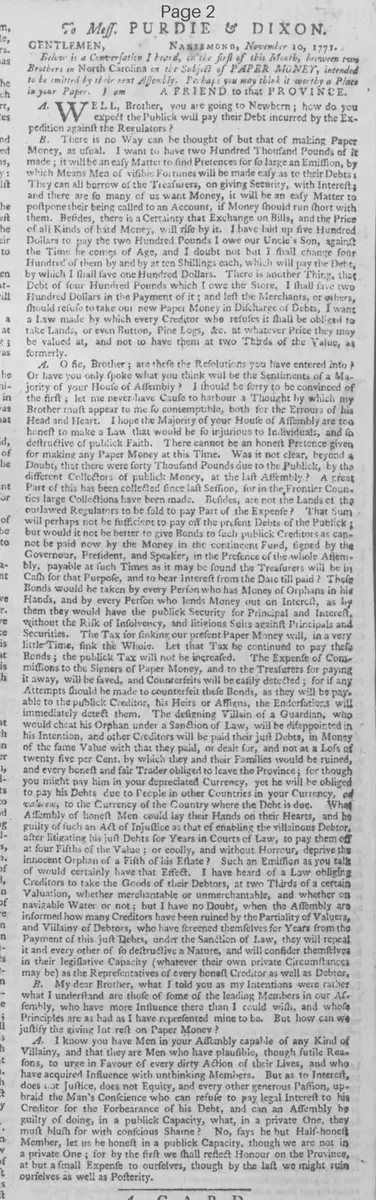
NANSAMOND, November 10, 1771.
Below is a Conversation I heard, on the first of this Month, between two Brothers in North Carolina on the Subject of PAPER MONEY, intended to be emitted by their next Assembly. Perhaps you may think it worthy a Place in your Paper. I am
A FRIEND to that PROVINCE.
A.
Well, Brother, you are going to Newbern; how do you expect the Publick will pay their Debt incurred by the Expedition against the Regulators?
B.
There is no Way can be thought of but that of making Paper Money, as usual. I want to have two Hundred Thousand Pounds of it made; it will be an easy Matter to find Pretences for so large an Emission, by which Means Men of visible Fortunes will be made easy as to their Debts; They can all borrow of the Treasurers, on giving Security, with Interest; and there are so many of us want Money, it will be an easy Matter to postpone their being called to an Account, if Money should run short with them. Besides, there is a Certainty that Exchange on Bills, and the Price of all Kinds of hard Money, will rise by it. I have laid up five Hundred Dollars to pay the two Hundred Pounds I owe our Uncle's Son, against the Time he comes of Age, and I doubt not but I shall change four Hundred of them by and by at ten Shillings each, which will pay the Debt, by which I shall save one Hundred Dollars. There is another Thing, that Debt of four Hundred Pounds which I owe the Store, I shall save two Hundred Dollars in the Payment of it; and lest the Merchants, or others, should refuse to take our new Paper Money in Discharge of Debts, I want a Law made by which every Creditor who refuses it shall be obliged to take Lands, or even Button, Pine Logs, &c. at whatever Price they may be valued at, and not to have them at two Thirds of the Value, as formerly.
A.
O fie, Brother; are these the Resolutions you have entered into? Or have you only spoke what you think will be the Sentiments of a Majority of your House of Assembly? I should be sorry to be convinced of the first; let me never have Cause to harbour a Thought by which my Brother must appear to me so contemptible, both for the Errors of his Head and Heart. I hope the Majority of your House of Assembly are too honest to make a Law that would be so injurious to Individuals, and so destructive of publick Faith. There cannot be an honest Pretence given for making any Paper Money at this Time. Was it not clear, beyond a Doubt, that there were forty Thousand Pounds due to the Publick, by the different Collectors of publick Money, at the last Assembly? A great Part of this has been collected since last Session, for in the Frontier Counties large Collections have been made. Besides, are not the Lands of those outlawed Regulators to be sold to pay Part of the Expense? That Sum will perhaps not be sufficient to pay off the present Debts of the Publick; but would it not be better to give Bonds to such publick Creditors as cannot be paid now by the Money in the contingent Fund, signed by the Governour, President, and Speaker, in the Presence of the whole Assembly, payable at such Times as it may be found the Treasurers will be in Cash for that Purpose, and to bear Interest from the Date till paid? These Bonds would be taken by every Person who has Money of Orphans in his Hands, and by every Person who lends Money out on Interest, as by them they would have the publick Security for Principal and Interest, without the Risk of Insolvency, and litigious Suits against Principals and Securities. The Tax for sinking our present Paper Money will, in a very little Time, sink the Whole. Let that Tax be continued to pay these Bonds; the publick Tax will not be increased. The Expense of Commissions to the Signers of Paper Money, and to the Treasurers for paying it away, will be saved, and Counterfeits will be easily detected; for if any Attempts should be made to counterfeit these Bonds, as they will be payable to the publick Creditor, his Heirs or Assigns, the Endorsations will immediately detect them. The designing Villain of a Guardian, who would cheat his Orphan under a Sanction of Law, will be disappointed in his Intention, and other Creditors will be paid their just Debts, in Money of the same Value with that they paid, or dealt for, and not at a Loss of twenty five per Cent. by which they and their Families would be ruined, and every honest and fair Trader obliged to leave the Province; for though you might pay him in your depreciated Currency, yet he will be obliged to pay his Debts due to People in other Countries in your Currency, equal in Value to the Currency of the Country where the Debt is due. What Assembly of honest Men could lay their Hands on their Hearts, and be guilty of such an Act of Injustice as that of enabling the villainous Debtor, after litigating his just Debts for Years in Courts of Law, to pay them off at four Fifths of the Value; or coolly, and without Horror, deprive the innocent Orphan of a Fifth of his Estate? Such an Emission as you talk of would certainly have that Effect. I have heard of a Law obliging Creditors to take the Goods of their Debtors, at two Thirds of a certain Valuation, whether merchantable or unmerchantable, and whether on navigable Water or not; but I have no Doubt, when the Assembly are informed how many Creditors have been ruined by the Partiality of Valuers, and Villainy of Debtors, who have screened themselves for Years from the Payment of their just Debts, under the Sanction of Law, they will repeal it and every other of so destructive a Nature, and will consider themselves in their legislative Capacity (whatever their own private Circumstances may be) as the Representatives of every honest Creditor as well as Debtor.
B.
My dear Brother, what I told you as my Intentions were rather what I understand are those of some of the leading Members in our Assembly, who have more Influence there than I could wish, and whose Principles are as bad as I have represented mine to be. But how can we justify the giving Interest on Paper Money?
A.
I know you have Men in your Assembly capable of any Kind of Villainy, and that they are Men who have plausible, though futile Reasons, to urge in Favour of every dirty Action of their Lives, and who have acquired Influence with unthinking Members. But as to Interest, does not Justice, does not Equity, and every other generous Passion, upbraid the Man's Conscience who can refuse to pay legal Interest to his Creditor for the Forbearance of his Debt, and can an Assembly be guilty of doing, in a publick Capacity, what, in a private One, they must blush for with conscious Shame? No, says he but Half-honest Member, let us be honest in a publick Capacity, though we are not in a private One; for by the first we shall reflect Honour on the Province, at but a small Expense to ourselves, though by the last we might ruin ourselves as well as Posterity.
What sub-type of article is it?
What themes does it cover?
What keywords are associated?
What entities or persons were involved?
Letter to Editor Details
Author
A Friend To That Province.
Recipient
Gentlemen,
Main Argument
the letter opposes the emission of new paper money by the north carolina assembly to pay public debts from the regulator expedition, arguing it would depreciate currency, harm creditors, and violate public faith; instead, it proposes issuing interest-bearing public bonds secured by taxes to ensure justice and honesty.
Notable Details