Thank you for visiting SNEWPapers!
Sign up free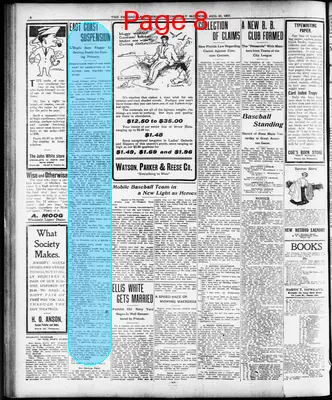
Story
August 21, 1907
The Pensacola Journal
Pensacola, Escambia County, Florida
What is this article about?
Claude L'Engle analyzes the East Coast Railway's suspension of extension work and shop construction, disputing claims of financial harm from legislation using 1906 earnings figures, and suggests it's a political tactic to influence upcoming primaries for electing officials favorable to the railroad.
Clipping

OCR Quality
98%
Excellent
Full Text
EAST COAST SUSPENSION
L'Engle Says Flagler Is Getting Ready for Coming Primary.
ROAD'S CLAIM THAT IT HAS BEEN HURT BY LEGISLATION IS ANALYZED AND FIGURES ARE GIVEN.
Claude L'Engle, whose Tallahassee Sun shines refulgently with every issue, has "spotted" what he thinks is the reason for suspension of work on the East Coast extension. In the last issue of the Sun, Mr. L'Engle says:
Sunshine Through a Fog.
In an authorized interview given to a representative of one of the papers which the East Coast Railway owns, Mr. Parrott, general manager of what is known as the East Coast System of Railroads and Hotels, announces that a general arrest of development plans has been decided on.
In another article appearing a day or two later in the same paper, the St. Augustine Record, the public is informed that work on the East Coast shops will stop.
Mr. Parrott says retrenchment is necessary on account of the increased cost of labor and materials, and the increased cost of operation due to the necessity to provide separate accommodations in stations for whites and negroes, loss and damage acts, etc., required by the new state and interstate law, and the expense of litigation made necessary to protect revenues.
The St. Augustine Record, managed by Mr. Parrott, says that the announcement of the suspension of work was a severe blow to business and that the cause of the suspension of work is to be found in the acts of legislatures "whose sole aim and cry was the placing of more taxes on the railroads, and the disposition toward decreasing their earning capacity by trying to put in force rate reduction."
Oh! very well gentlemen, put it up that way if you like. What do you own some papers and control others for but to make them put up prize packages for the public.
According to the sworn statement made to the railroad commission, the net earnings of the East Coast Railway for the year 1906 were $703,505.58.
In that same sworn statement the East Coast reports an aggregate of stocks and bonds outstanding of $14,259,000.
The net earnings of $703,505.58 reported last year was five per cent. interest on the entire stock and bond issue--and some more to be exact just $650.58 more.
The figures will look better still if we look at them again. Suppose we do.
We will then see that that same sworn statement reported only 500 miles of track.
As the East Coast is a jam-up road we must be liberal with our estimate of the cost of building and equipping it.
Let us therefore put it at $20,000 a mile.
Five hundred miles would figure exactly $10,000,000.
The net earnings would then be a little over seven per cent. on the amount invested.
This gets better.
Now, let us be fair to ourselves and put the cost of building and equipping the East Coast somewhere near right say $15,000 a mile.
Five hundred miles would then figure $7,500,000.
The net earnings last year of $703,505.58 would show might nigh ten per cent. on the money actually invested -or to be exact again-nine and a half per cent. plus.
This looks good to me.
So good in fact that I am looking around for another reason for Mr. Parrott's suspension of work order besides the one given out, which if I remember correctly, was necessity for retrenchment because the aim of the legislatures was to put more taxes on the railroads, and the disposition to decrease their earning capacity by trying to reduce rates.
No legislature except the Florida legislature cuts any ice with the East Coast.
If the last one aimed to put more taxes on railroads, its aim was poor, powerfully poor.
It put on a meagre little tax of $10 a mile which will decrease the net earnings exactly $5,000.
If the last legislature tried to force rate reduction, it didn't try hard enough, for it reduced them nary a red.
My guess on Mr. Parrott's suspension of extension and stop work in shop orders, is primary time is coming.
The East Coast wants to elect a senator, a governor and a couple of trustees.
It is trying to force the men to vote for its men by cutting off the supply of money that goes to feed the wives and children of voters who look to the East Coast for work to earn it.
This is my guess.
Maybe its wrong,
But let someone else try to beat it.
L'Engle Says Flagler Is Getting Ready for Coming Primary.
ROAD'S CLAIM THAT IT HAS BEEN HURT BY LEGISLATION IS ANALYZED AND FIGURES ARE GIVEN.
Claude L'Engle, whose Tallahassee Sun shines refulgently with every issue, has "spotted" what he thinks is the reason for suspension of work on the East Coast extension. In the last issue of the Sun, Mr. L'Engle says:
Sunshine Through a Fog.
In an authorized interview given to a representative of one of the papers which the East Coast Railway owns, Mr. Parrott, general manager of what is known as the East Coast System of Railroads and Hotels, announces that a general arrest of development plans has been decided on.
In another article appearing a day or two later in the same paper, the St. Augustine Record, the public is informed that work on the East Coast shops will stop.
Mr. Parrott says retrenchment is necessary on account of the increased cost of labor and materials, and the increased cost of operation due to the necessity to provide separate accommodations in stations for whites and negroes, loss and damage acts, etc., required by the new state and interstate law, and the expense of litigation made necessary to protect revenues.
The St. Augustine Record, managed by Mr. Parrott, says that the announcement of the suspension of work was a severe blow to business and that the cause of the suspension of work is to be found in the acts of legislatures "whose sole aim and cry was the placing of more taxes on the railroads, and the disposition toward decreasing their earning capacity by trying to put in force rate reduction."
Oh! very well gentlemen, put it up that way if you like. What do you own some papers and control others for but to make them put up prize packages for the public.
According to the sworn statement made to the railroad commission, the net earnings of the East Coast Railway for the year 1906 were $703,505.58.
In that same sworn statement the East Coast reports an aggregate of stocks and bonds outstanding of $14,259,000.
The net earnings of $703,505.58 reported last year was five per cent. interest on the entire stock and bond issue--and some more to be exact just $650.58 more.
The figures will look better still if we look at them again. Suppose we do.
We will then see that that same sworn statement reported only 500 miles of track.
As the East Coast is a jam-up road we must be liberal with our estimate of the cost of building and equipping it.
Let us therefore put it at $20,000 a mile.
Five hundred miles would figure exactly $10,000,000.
The net earnings would then be a little over seven per cent. on the amount invested.
This gets better.
Now, let us be fair to ourselves and put the cost of building and equipping the East Coast somewhere near right say $15,000 a mile.
Five hundred miles would then figure $7,500,000.
The net earnings last year of $703,505.58 would show might nigh ten per cent. on the money actually invested -or to be exact again-nine and a half per cent. plus.
This looks good to me.
So good in fact that I am looking around for another reason for Mr. Parrott's suspension of work order besides the one given out, which if I remember correctly, was necessity for retrenchment because the aim of the legislatures was to put more taxes on the railroads, and the disposition to decrease their earning capacity by trying to reduce rates.
No legislature except the Florida legislature cuts any ice with the East Coast.
If the last one aimed to put more taxes on railroads, its aim was poor, powerfully poor.
It put on a meagre little tax of $10 a mile which will decrease the net earnings exactly $5,000.
If the last legislature tried to force rate reduction, it didn't try hard enough, for it reduced them nary a red.
My guess on Mr. Parrott's suspension of extension and stop work in shop orders, is primary time is coming.
The East Coast wants to elect a senator, a governor and a couple of trustees.
It is trying to force the men to vote for its men by cutting off the supply of money that goes to feed the wives and children of voters who look to the East Coast for work to earn it.
This is my guess.
Maybe its wrong,
But let someone else try to beat it.
What sub-type of article is it?
Deception Fraud
Historical Event
What themes does it cover?
Deception
Justice
What keywords are associated?
East Coast Railway
Work Suspension
Political Primary
Flagler
L'engle
Legislation Impact
Net Earnings
What entities or persons were involved?
Claude L'engle
Mr. Parrott
Flagler
Where did it happen?
East Coast, Florida
Story Details
Key Persons
Claude L'engle
Mr. Parrott
Flagler
Location
East Coast, Florida
Event Date
1906
Story Details
Claude L'Engle disputes the East Coast Railway's claim that recent legislation necessitates suspension of extension work and shop construction, citing strong 1906 net earnings of over 7-10% return on investment, and posits it's a ploy to influence voters in upcoming primaries by withholding jobs.