Thank you for visiting SNEWPapers!
Sign up free
Literary
November 21, 1861
Memphis Daily Appeal
Memphis, Shelby County, Tennessee
What is this article about?
Short story of Dutch painter Peter Van Slingelandt, who spends two years meticulously painting the portrait of a rich widow, Bertha, falling deeply in love with her. His friend Max encourages him, and the widow ultimately proposes marriage as 'payment' for the portrait.
Clipping
OCR Quality
65%
Fair
Full Text
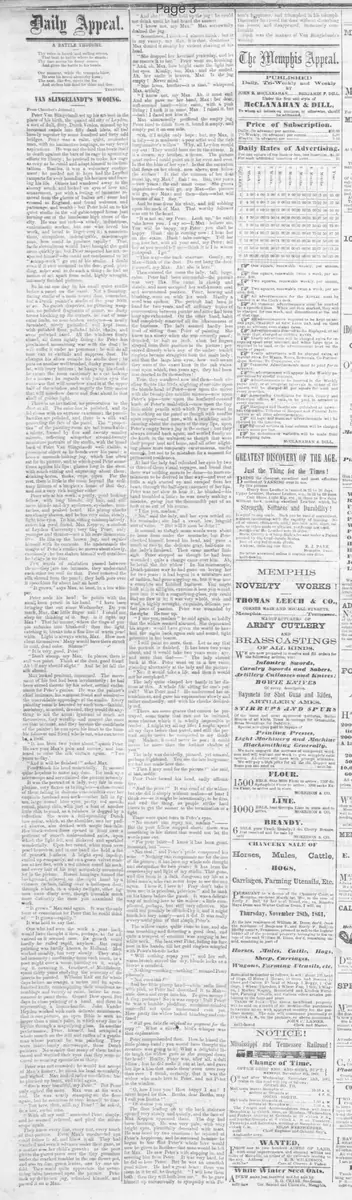
VAN SLINGELANDT'S WOOING.
From (Chamber's Journal)
Peter Van Slingelandt put on his art-frock in the place of his birth, the quaint old city of Leyden—
the wit of dull, dirty, Dutch Venice, wrapped up by inconsequent canals into gray dank mists, all dimly
wrought by some hundred and forty odd bridges. Peter was calm, quiet, content man, with no locomotive longings, no very ardent aspirations. He was not the bird that beats itself to death against the bars of its cage in agonizing strife for liberty: he preferred to make his cage as cozy as he could and sleep himself to its limitations. Being kind, it was a voluntary confine-
ment; he needed not to have had the Leyden ramparts for ever bounding his horizon and framing his life. Others had wandered away to the sunny south, and looked on eyes of love and wonderment, yet with a feeling of immense re-
moval from the glories of Italian art; some had crossed to England, and found welcome, and patronage, and wealth: but Peter stuck to his quiet studio in the old gable-ended house just turning one of those handsome high stream of the city. He was not rich—he steadily, industrious, hard-working man, but one who loved his work, and loved to linger over it: a conscientious, scrupulous, indefatigable, microscopic man, how could he prosper rapidly! The
fine cleverness would have brought the ear more quickly in: but Peter suspected his art to speak for itself—he could not condescend to be "show-work" go out of his senses. I doubt even if it ever occurred to the dear, good, plodding, poor soul to do such a thing: he had no notion of art apart from solid, highly wrought, intensely finished picture.
So he sat one day in his small quiet studio before a panel on the easel. Not a flaunting flaring studio of a more recent day, remember, but a Dutch painter's studio of the year 1660 or so. No garish draperies, no glittering weapons, no polished fragments of armor, no dusty torsos blocking up the corners, no casts of muscular limbs, no broken antiques—a neatly furnished, nicely garnished, well kept room, with polished floors, polished table, chairs, and even polished easel. All the windows firmly closed, all doors tightly fitting: for Peter has proclaimed unremitting war with the dust; he will suffer it under no pretenses; he will do all man can to exclude and suppress dust. He changes his shoes outside his studio door; he puts on another well brushed, dusky green doublet, with ivory buttons: he hangs up his cloak: he enters the room cautiously as a cat looking for a mouse; he regards with jealous eyes the sunbeam that will somehow slant in at the upper half of the window, and angrily the little motes that will somehow dance and float about in that shaft of golden light.
There is no invitation, no provocation to the dust at all. The color-box is polished, and its lid closes with an extreme exactness; the pencil handles are polished, and there is a silk veil protecting the face of the panel. The "properties" of the painting room are not remarkable—a mirror, framed by five and twenty smaller mirrors, reflecting altogether six-and-twenty miniature portraits of the studio, with the broad back of Peter Van Slingelandt well visible, a prominent object as he bends over his panel; a brown uncouth-looking jug, which has often sat for its picture, and to which good Peter some-
times applies his lips: glasses long in the stem, with much cutting and engraving about them—drinking-horns, flasks, cups, pipes. For the rest, there is little in the room beyond the ordinary fittings of a burgher's house of that day, and not a very rich burgher either.
Peter sits at his work, a portly, good looking fellow, with long blonde, dry hair, and still more blonde and shy eyebrows, eyelashes, mustaches, and pointed beard. His plump cheeks are closely shaven, and he has very calm, steady, light blue eyes. To him, sitting contemplatively under his good friend, Max Repp, a student of Leyden University: very like Peter, only younger and thinner—not a bit more demonstrative. He lifts up the brown jug, and regales himself with its contents. He understands the usages of Peter's studio; he moves about slowly, cautiously: he has shaken himself well outside—he brings in no dust.
Few words of salutation passed between them—they are too intimate, they understand each other too well for that. Peter removed the silk shroud from the panel; they both pore over it speechless for about half an hour.
"It grows," says Max, at least, in a low whisper.
Peter nods his head. He points with the small keen pencil in his hand. "I have been bringing that out since Wednesday. Do you mark, Max, that little finger nail? I could not sleep for thinking of it. Say, is it right, my Max? That far corner, where the tinge of purple subsides into blush-red; then the light, delicately catching it, breaks into a fine line of warm pearl white. Light is always warm, Max. How men cheat themselves! Many would have there struck in cold, dead color. Shame!"
"It is very good, Peter."
"Don't stamp, my Max. In places, there is still wet paint. Think of the dust, good friend. Ah! If any should alight." And he let fall the silk shroud.
Max looked penitent, concerned. The movement of his foot had been involuntarily: he had been stirred thereto by his sober, settled enthusiasm for Peter's genius. He was the painter's chief intimate, his warmest friend and admirer—the unavoidable appendage of the studio. Every painting room is haunted by such men—faithful, laudatory, attached, devoted, they would do anything to aid the artist; ignorant of much art themselves, they worship and marvel the more on that account, and they become the confidants of the painter; he can open his heart to the humble follower and friend who is not, who can never be, a rival.
"It has been two years about," quoth Peter. He saw poor Max's pain and sorrow, and hastened to raise the silk curtain again. "Two years to-day."
"And it will be finished?" asked Max.
Peter shook his head mournfully. It seemed quite hopeless to name any date. He took up a microscope and scrutinized the picture severely. It was the portrait of a lady, very fair in complexion, very flaxen as to ringlets—a close crowd of them falling in delicate vine-tendrils over her exquisite forehead and neck—rather full in figure, large round blue eyes, pretty red mouth, round, plump chin, with just a hint of another little chin beyond, as a rainbow is dogged by a reflection. She wore a full-spreading Dutch lace collar, which, at the shoulder, met her puffed sleeves, also decked with ample lace-falls. Her black-velvet dress opened in front over a petticoat of superb maize-colored satin, upon which the light fell, and flickered and sparkled wonderfully. Upon her round, white arms were pearl bracelets, and in one hand she held a fan of peacock feathers. A bright-eyed lap-dog, curled up compactly, sat on a green velvet cushion at her feet, with a red ribbon round his neck, and every hair of his coat accurately accounted for in the picture. Russet hangings formed the background, relieved on the right hand by a crimson curtain, falling over a half-open door, through which, in a dusky twilight, other figures were dimly seen, though traceable much more distinctly the more you examined the work.
"It grows," Max said again. It was the only form of consolation for Peter that he could think of. "It grows—rapidly."
It was bold to say that.
One who had seen the work a year back would have thought it then, perhaps, as far advanced as it seemed now. Its growth could hardly be called rapid, anyhow. But rapid painting was hardly known in Holland. Men worked steadily, but very slowly. They studied intensely: meditating upon each touch, as a poet might over a verse, pausing on it, weighing it, counting it. Goodaert, of Middleburg, spent thirty years studying the economy of the insects he painted. Willem Kalf sat for whole days before an orange, a melon and an agate-handled knife, contemplating their wondrous assemblage and variety of color, before he commenced to paint them. Gerard Dow spent five days in close painting of a hand, and three in representing a broom-handle. John Vander Heyden worked with such delicate minuteness, that in one picture, an open Bible is seen no larger than a man's palm, in which every line is legible through a magnifying glass. In another performance, Peter, himself, had occupied a whole month on the frill and ruffles of a gentleman whose portrait he was painting. They were marvelously microscopic, these Dutch painters. No wonder that many of them had so teased and worried their eyes that they were reduced to wearing spectacles at thirty.
Peter was not consoled: he would not accept of Max's flattery, he shook his head mournfully, and sighed. Max looked rather crestfallen; but he plucked up heart, and tried again.
"She is very beautiful, my Peter." But Peter only sighed the more. Max was at his wit's end. He was nearly stamping on the floor again, but he contrived to stop himself in time.
"You love, then, still, my Peter?" he asked, in a low, awful tone.
"With all my soul," answered Peter, simply, and he seemed relieved, and plied the microscope again.
They knew every line, every trait, every touch of that portrait. Even Max's uneducated eye could follow it all, and knew it all. They had watched and seen it advance under their gaze, as a mother sees her child's growth; as the poor girl in the garret pores over the tiny geranium under the cracked tumbler in the one flower pot, and sees its dim, green leaves, one by one unfold. They could quite appreciate the never-tiring labor bestowed upon the picture. Peter passed it on to Max, took up the brown jug, refreshed himself, and
"And she?" Max held up the jug: he could not drink until he had heard the answer.
"I know not, my Max." Max sorrowfully drained the jug.
"Sometimes, I think—I almost think: but it is my vanity, my Max. It is that, doubtless."
Max denied it stoutly by violent shaking of his head.
"She dropped her kerchief yesterday, and let me restore it to her," Peter went on, blushing.
"And, oh, Max, how bright came the light into her eyes. Kindly, too, Max: and she smiled. Ah, her smile is heaven, Max. Is the jug empty? Never mind."
"She loves, brother—it is that," whispered Max, artfully.
"I know not, my Max. Ah, it must end. And she gave me her hand, Max: her dear, soft-scented hand—white satin, with a pink lining: I took it in mine, Max: I raised it, but—bah! I dared not kiss it."
Max abstractedly proffered the empty jug. Peter tried to drink from it, found it empty, and simply put it on one side.
"Oh, if I might only hope; but, my Max, it is folly—it is madness: a poor artist wed the rich burgomaster's widow! Why, all Leyden would cry out. They would hoot me in the streets. It is a dream, my brother, a dream. The picture must end—I could paint on it for ever and ever. Is that the blue of her eye? Is that the carnation that floats on her cheek, now above, now below the surface? Is that the crimson of her dear moist lip, my Max? Bah! no. But, two years—two years: the end must come. She grows impatient—she will go, my Max—the picture will go, my Max; and then—then—what will become of me? Say."
And he rose from his chair, and fell sobbing upon the neck of Max. That worthy follower was cut to the heart.
"It is not so, my Peter. Look up," he said; "she loves you; I say so—I, Max—believe me. You will be happy, my Peter; you shall be happy. Hush! she is coming now: I hear her on the stairs. Hush! take courage. Tell her you love her, with all your soul, my Peter; tell her as you would tell me—think it is I to whom you speak. I go."
"This way—the back staircase. Gently, my Max—think of the dust. Do not bang the door. Farewell, my Max. Ah! she is here."
Then entered the room the lady, tall, large, calm. Peter had been successful—the portrait was very like. She came in slowly and stately, and soon occupied her well-known seat and accustomed position. Peter, bowing and blushing, went on with his work. Hardly a word was spoken. The portrait had been in hand for two years, and all ordinary topics of conversation between painter and sitter had been long ago exhausted. On the other hand, habit had completely mastered all the irksomeness of the business. The lady seemed hardly less tired of sitting than Peter of painting.
She knew to a nicety when she was correctly posed; detected, to half an inch, when her fingers strayed from their position in the picture; perceived directly when any of the amber tendril ringlets became stragglers from the main body: and those large blue eyes, how well aware they were of the exact knot in the oak wainscot upon which, two years ago, they had been first directed to fix themselves.
True, they wandered now and then—took circling flights like birds, alighting at one time upon the blonde head of Peter—now upon the mirror with the twenty-five satellite mirrors—now upon Peter's pipe—now upon the leather-covered knob of Peter's mahl-stick—now upon the tiny little sable pencils with which Peter seemed to be working on the panel as though with needles upon copper—and now, with a twinkling smile dancing about the corners of the rosy lips, upon Peter's empty brown jug in the corner; but they always turned back again, and settled finally on the knob in the wainscot, as though that were their proper nest and home, and all other alighting places more temporary caravanserais, useful enough, but not to be mistaken for a moment for permanent residences.
At last the lady had refreshed her eyes by two or three of these visual voyages, and found that there was nothing more to be done—no more entertainment to be derived in that way—and ever so little a sigh started up and escaped from her heart, through the half-open casement of her lips.
Peter was not slow to hear it: he blushed—his hand trembled a little: he was nearly making a mistake, going just the thousandth part of an inch or so out of his course.
"I tire you, madam."
"No," said the lady, and her eyes settled on his mustache: she had a sweet, low, languid sort of voice. "But will it soon be done?"
It seemed as though some words were about to issue from under the mustache, but Peter checked himself, bowed his head, and gave a touch or two to the delicate gray, half-tints on the lady's forehead. Then came another little sigh. Peter stopped as though he had been wounded; quite a change came over him. Ah, he loved the fair widow! In his microscopic, Dutch-painter way he had gone on loving her for two years: it had begun in a miniature sort of fashion, had gone niggling on, but it was now a complete and finished business. You might look at it in all lights, examine it how you would, pore into it with a magnifying-glass, you could find no flaw in it; it was very whole, web and woof, a highly wrought, exquisite, delicate, perfect piece of passion. Peter was wounded by the sighs. He rose up.
"I tire you, madam," he said again, so boldly that the widow seemed alarmed. She deprecated his anger; would have given the world to have had the sighs back again safe and sound, tight prisoners in her bosom.
"I will paint no more, then. Let us say that the portrait is finished. It has been two years about, and it would take two years more; aye, and more than that—" The lady shrunk back at this. Peter went on in a low voice, glancing alternately at the lady and the picture: "No: It would take a life, and then it would not be completed."
The lady quite clasped her hands in her distress at this. A whole life sitting for one's portrait! Was Peter mad? He understood her astonishment, and gave his explanation slowly and rather confusedly, and with his cheeks decidedly red.
"There are some graces that cannot be portrayed, some traits that can not be imitated, some charms which it is wholly impossible to render. I might try all my life; I might spend all my days before that panel, and still the portrait might never be completed to my thinking.
Madam, it could never be you: it could never be more than the feeblest shadow of you."
The lady was decidedly pleased, yet amazed, perhaps frightened. You see the late burgomaster had not made love thus.
But she did it simply without malice—at least I think so—or it might be intentionally, to be firm, and end the thing, as people strike hard blows to get the sooner to the termination of a fight.
There were quiet tears in Peter's eyes.
"No money can repay me, madam."
But the poor fellow stopped short: there was something in his throat that would not let the words pass out.
"For your labor—I know it has been great, incessant, but—"
"Not that," and Peter's pride conquered his sobs. "Nothing can compensate me for the loss of the picture: it has been my whole soul thought and occupation for two years: it has been the ceaseless joy and light of my studio. That gone, and this room is a dark dungeon: my life as a blind man's, who can never hope to see the sun again. I love it. I love it! Pray don't take it from me: it is priceless, priceless!" and he sank on his knees before the panel. It was a delicate way of making love to the widow: a little complicated, perhaps, but still very effective. She could not possibly be offended by it, and it might touch her very nearly—and it did. It was really a very artful plan of that simple Peter's.
The widow came quite close to him, and she was trembling and fluttering a good deal, and quite a tempest of emotion was surging in her white neck. She bent over Peter, hiding his face now in his hands, till her gold ringlets mingled with Peter's blonde locks.
"Will nothing repay you?" and her soft, warm breath stirred the dry, blonde locks as a breeze a cornfield.
"Nothing—nothing—nothing," moaned Peter piteously.
"Not even this?"
And her little plump hand—white satin lined with pink, as Peter had described it to Max—stole down and crept into his. To give money? A ring, perhaps! No; it was empty! Dull Peter—he was a humble, plodding, miniature-minded man—did not quite understand even yet.
How pretty the widow looked blushing and confused.
"Will you take the original as payment for the copy?"
What a silver, bird's whisper was that explanation.
Peter comprehended then. How he kissed the little plump hand; you would have thought the creature was going to it! What a delightful little laugh the widow gave as she stooped down her head! Really, Peter was, after all, a dull fellow; but he did make it out at last, and gave her lips a kiss that made them even more rosy than ever. I think, certainly, that it was the widow who made love to Peter, and not Peter to the widow.
"O, how I love you! How happy I am! I never hoped for this. Bertha, dear Bertha, may I call you Bertha?"
[Text cuts off here with garbled ending, followed by non-literary newspaper content.]
From (Chamber's Journal)
Peter Van Slingelandt put on his art-frock in the place of his birth, the quaint old city of Leyden—
the wit of dull, dirty, Dutch Venice, wrapped up by inconsequent canals into gray dank mists, all dimly
wrought by some hundred and forty odd bridges. Peter was calm, quiet, content man, with no locomotive longings, no very ardent aspirations. He was not the bird that beats itself to death against the bars of its cage in agonizing strife for liberty: he preferred to make his cage as cozy as he could and sleep himself to its limitations. Being kind, it was a voluntary confine-
ment; he needed not to have had the Leyden ramparts for ever bounding his horizon and framing his life. Others had wandered away to the sunny south, and looked on eyes of love and wonderment, yet with a feeling of immense re-
moval from the glories of Italian art; some had crossed to England, and found welcome, and patronage, and wealth: but Peter stuck to his quiet studio in the old gable-ended house just turning one of those handsome high stream of the city. He was not rich—he steadily, industrious, hard-working man, but one who loved his work, and loved to linger over it: a conscientious, scrupulous, indefatigable, microscopic man, how could he prosper rapidly! The
fine cleverness would have brought the ear more quickly in: but Peter suspected his art to speak for itself—he could not condescend to be "show-work" go out of his senses. I doubt even if it ever occurred to the dear, good, plodding, poor soul to do such a thing: he had no notion of art apart from solid, highly wrought, intensely finished picture.
So he sat one day in his small quiet studio before a panel on the easel. Not a flaunting flaring studio of a more recent day, remember, but a Dutch painter's studio of the year 1660 or so. No garish draperies, no glittering weapons, no polished fragments of armor, no dusty torsos blocking up the corners, no casts of muscular limbs, no broken antiques—a neatly furnished, nicely garnished, well kept room, with polished floors, polished table, chairs, and even polished easel. All the windows firmly closed, all doors tightly fitting: for Peter has proclaimed unremitting war with the dust; he will suffer it under no pretenses; he will do all man can to exclude and suppress dust. He changes his shoes outside his studio door; he puts on another well brushed, dusky green doublet, with ivory buttons: he hangs up his cloak: he enters the room cautiously as a cat looking for a mouse; he regards with jealous eyes the sunbeam that will somehow slant in at the upper half of the window, and angrily the little motes that will somehow dance and float about in that shaft of golden light.
There is no invitation, no provocation to the dust at all. The color-box is polished, and its lid closes with an extreme exactness; the pencil handles are polished, and there is a silk veil protecting the face of the panel. The "properties" of the painting room are not remarkable—a mirror, framed by five and twenty smaller mirrors, reflecting altogether six-and-twenty miniature portraits of the studio, with the broad back of Peter Van Slingelandt well visible, a prominent object as he bends over his panel; a brown uncouth-looking jug, which has often sat for its picture, and to which good Peter some-
times applies his lips: glasses long in the stem, with much cutting and engraving about them—drinking-horns, flasks, cups, pipes. For the rest, there is little in the room beyond the ordinary fittings of a burgher's house of that day, and not a very rich burgher either.
Peter sits at his work, a portly, good looking fellow, with long blonde, dry hair, and still more blonde and shy eyebrows, eyelashes, mustaches, and pointed beard. His plump cheeks are closely shaven, and he has very calm, steady, light blue eyes. To him, sitting contemplatively under his good friend, Max Repp, a student of Leyden University: very like Peter, only younger and thinner—not a bit more demonstrative. He lifts up the brown jug, and regales himself with its contents. He understands the usages of Peter's studio; he moves about slowly, cautiously: he has shaken himself well outside—he brings in no dust.
Few words of salutation passed between them—they are too intimate, they understand each other too well for that. Peter removed the silk shroud from the panel; they both pore over it speechless for about half an hour.
"It grows," says Max, at least, in a low whisper.
Peter nods his head. He points with the small keen pencil in his hand. "I have been bringing that out since Wednesday. Do you mark, Max, that little finger nail? I could not sleep for thinking of it. Say, is it right, my Max? That far corner, where the tinge of purple subsides into blush-red; then the light, delicately catching it, breaks into a fine line of warm pearl white. Light is always warm, Max. How men cheat themselves! Many would have there struck in cold, dead color. Shame!"
"It is very good, Peter."
"Don't stamp, my Max. In places, there is still wet paint. Think of the dust, good friend. Ah! If any should alight." And he let fall the silk shroud.
Max looked penitent, concerned. The movement of his foot had been involuntarily: he had been stirred thereto by his sober, settled enthusiasm for Peter's genius. He was the painter's chief intimate, his warmest friend and admirer—the unavoidable appendage of the studio. Every painting room is haunted by such men—faithful, laudatory, attached, devoted, they would do anything to aid the artist; ignorant of much art themselves, they worship and marvel the more on that account, and they become the confidants of the painter; he can open his heart to the humble follower and friend who is not, who can never be, a rival.
"It has been two years about," quoth Peter. He saw poor Max's pain and sorrow, and hastened to raise the silk curtain again. "Two years to-day."
"And it will be finished?" asked Max.
Peter shook his head mournfully. It seemed quite hopeless to name any date. He took up a microscope and scrutinized the picture severely. It was the portrait of a lady, very fair in complexion, very flaxen as to ringlets—a close crowd of them falling in delicate vine-tendrils over her exquisite forehead and neck—rather full in figure, large round blue eyes, pretty red mouth, round, plump chin, with just a hint of another little chin beyond, as a rainbow is dogged by a reflection. She wore a full-spreading Dutch lace collar, which, at the shoulder, met her puffed sleeves, also decked with ample lace-falls. Her black-velvet dress opened in front over a petticoat of superb maize-colored satin, upon which the light fell, and flickered and sparkled wonderfully. Upon her round, white arms were pearl bracelets, and in one hand she held a fan of peacock feathers. A bright-eyed lap-dog, curled up compactly, sat on a green velvet cushion at her feet, with a red ribbon round his neck, and every hair of his coat accurately accounted for in the picture. Russet hangings formed the background, relieved on the right hand by a crimson curtain, falling over a half-open door, through which, in a dusky twilight, other figures were dimly seen, though traceable much more distinctly the more you examined the work.
"It grows," Max said again. It was the only form of consolation for Peter that he could think of. "It grows—rapidly."
It was bold to say that.
One who had seen the work a year back would have thought it then, perhaps, as far advanced as it seemed now. Its growth could hardly be called rapid, anyhow. But rapid painting was hardly known in Holland. Men worked steadily, but very slowly. They studied intensely: meditating upon each touch, as a poet might over a verse, pausing on it, weighing it, counting it. Goodaert, of Middleburg, spent thirty years studying the economy of the insects he painted. Willem Kalf sat for whole days before an orange, a melon and an agate-handled knife, contemplating their wondrous assemblage and variety of color, before he commenced to paint them. Gerard Dow spent five days in close painting of a hand, and three in representing a broom-handle. John Vander Heyden worked with such delicate minuteness, that in one picture, an open Bible is seen no larger than a man's palm, in which every line is legible through a magnifying glass. In another performance, Peter, himself, had occupied a whole month on the frill and ruffles of a gentleman whose portrait he was painting. They were marvelously microscopic, these Dutch painters. No wonder that many of them had so teased and worried their eyes that they were reduced to wearing spectacles at thirty.
Peter was not consoled: he would not accept of Max's flattery, he shook his head mournfully, and sighed. Max looked rather crestfallen; but he plucked up heart, and tried again.
"She is very beautiful, my Peter." But Peter only sighed the more. Max was at his wit's end. He was nearly stamping on the floor again, but he contrived to stop himself in time.
"You love, then, still, my Peter?" he asked, in a low, awful tone.
"With all my soul," answered Peter, simply, and he seemed relieved, and plied the microscope again.
They knew every line, every trait, every touch of that portrait. Even Max's uneducated eye could follow it all, and knew it all. They had watched and seen it advance under their gaze, as a mother sees her child's growth; as the poor girl in the garret pores over the tiny geranium under the cracked tumbler in the one flower pot, and sees its dim, green leaves, one by one unfold. They could quite appreciate the never-tiring labor bestowed upon the picture. Peter passed it on to Max, took up the brown jug, refreshed himself, and
"And she?" Max held up the jug: he could not drink until he had heard the answer.
"I know not, my Max." Max sorrowfully drained the jug.
"Sometimes, I think—I almost think: but it is my vanity, my Max. It is that, doubtless."
Max denied it stoutly by violent shaking of his head.
"She dropped her kerchief yesterday, and let me restore it to her," Peter went on, blushing.
"And, oh, Max, how bright came the light into her eyes. Kindly, too, Max: and she smiled. Ah, her smile is heaven, Max. Is the jug empty? Never mind."
"She loves, brother—it is that," whispered Max, artfully.
"I know not, my Max. Ah, it must end. And she gave me her hand, Max: her dear, soft-scented hand—white satin, with a pink lining: I took it in mine, Max: I raised it, but—bah! I dared not kiss it."
Max abstractedly proffered the empty jug. Peter tried to drink from it, found it empty, and simply put it on one side.
"Oh, if I might only hope; but, my Max, it is folly—it is madness: a poor artist wed the rich burgomaster's widow! Why, all Leyden would cry out. They would hoot me in the streets. It is a dream, my brother, a dream. The picture must end—I could paint on it for ever and ever. Is that the blue of her eye? Is that the carnation that floats on her cheek, now above, now below the surface? Is that the crimson of her dear moist lip, my Max? Bah! no. But, two years—two years: the end must come. She grows impatient—she will go, my Max—the picture will go, my Max; and then—then—what will become of me? Say."
And he rose from his chair, and fell sobbing upon the neck of Max. That worthy follower was cut to the heart.
"It is not so, my Peter. Look up," he said; "she loves you; I say so—I, Max—believe me. You will be happy, my Peter; you shall be happy. Hush! she is coming now: I hear her on the stairs. Hush! take courage. Tell her you love her, with all your soul, my Peter; tell her as you would tell me—think it is I to whom you speak. I go."
"This way—the back staircase. Gently, my Max—think of the dust. Do not bang the door. Farewell, my Max. Ah! she is here."
Then entered the room the lady, tall, large, calm. Peter had been successful—the portrait was very like. She came in slowly and stately, and soon occupied her well-known seat and accustomed position. Peter, bowing and blushing, went on with his work. Hardly a word was spoken. The portrait had been in hand for two years, and all ordinary topics of conversation between painter and sitter had been long ago exhausted. On the other hand, habit had completely mastered all the irksomeness of the business. The lady seemed hardly less tired of sitting than Peter of painting.
She knew to a nicety when she was correctly posed; detected, to half an inch, when her fingers strayed from their position in the picture; perceived directly when any of the amber tendril ringlets became stragglers from the main body: and those large blue eyes, how well aware they were of the exact knot in the oak wainscot upon which, two years ago, they had been first directed to fix themselves.
True, they wandered now and then—took circling flights like birds, alighting at one time upon the blonde head of Peter—now upon the mirror with the twenty-five satellite mirrors—now upon Peter's pipe—now upon the leather-covered knob of Peter's mahl-stick—now upon the tiny little sable pencils with which Peter seemed to be working on the panel as though with needles upon copper—and now, with a twinkling smile dancing about the corners of the rosy lips, upon Peter's empty brown jug in the corner; but they always turned back again, and settled finally on the knob in the wainscot, as though that were their proper nest and home, and all other alighting places more temporary caravanserais, useful enough, but not to be mistaken for a moment for permanent residences.
At last the lady had refreshed her eyes by two or three of these visual voyages, and found that there was nothing more to be done—no more entertainment to be derived in that way—and ever so little a sigh started up and escaped from her heart, through the half-open casement of her lips.
Peter was not slow to hear it: he blushed—his hand trembled a little: he was nearly making a mistake, going just the thousandth part of an inch or so out of his course.
"I tire you, madam."
"No," said the lady, and her eyes settled on his mustache: she had a sweet, low, languid sort of voice. "But will it soon be done?"
It seemed as though some words were about to issue from under the mustache, but Peter checked himself, bowed his head, and gave a touch or two to the delicate gray, half-tints on the lady's forehead. Then came another little sigh. Peter stopped as though he had been wounded; quite a change came over him. Ah, he loved the fair widow! In his microscopic, Dutch-painter way he had gone on loving her for two years: it had begun in a miniature sort of fashion, had gone niggling on, but it was now a complete and finished business. You might look at it in all lights, examine it how you would, pore into it with a magnifying-glass, you could find no flaw in it; it was very whole, web and woof, a highly wrought, exquisite, delicate, perfect piece of passion. Peter was wounded by the sighs. He rose up.
"I tire you, madam," he said again, so boldly that the widow seemed alarmed. She deprecated his anger; would have given the world to have had the sighs back again safe and sound, tight prisoners in her bosom.
"I will paint no more, then. Let us say that the portrait is finished. It has been two years about, and it would take two years more; aye, and more than that—" The lady shrunk back at this. Peter went on in a low voice, glancing alternately at the lady and the picture: "No: It would take a life, and then it would not be completed."
The lady quite clasped her hands in her distress at this. A whole life sitting for one's portrait! Was Peter mad? He understood her astonishment, and gave his explanation slowly and rather confusedly, and with his cheeks decidedly red.
"There are some graces that cannot be portrayed, some traits that can not be imitated, some charms which it is wholly impossible to render. I might try all my life; I might spend all my days before that panel, and still the portrait might never be completed to my thinking.
Madam, it could never be you: it could never be more than the feeblest shadow of you."
The lady was decidedly pleased, yet amazed, perhaps frightened. You see the late burgomaster had not made love thus.
But she did it simply without malice—at least I think so—or it might be intentionally, to be firm, and end the thing, as people strike hard blows to get the sooner to the termination of a fight.
There were quiet tears in Peter's eyes.
"No money can repay me, madam."
But the poor fellow stopped short: there was something in his throat that would not let the words pass out.
"For your labor—I know it has been great, incessant, but—"
"Not that," and Peter's pride conquered his sobs. "Nothing can compensate me for the loss of the picture: it has been my whole soul thought and occupation for two years: it has been the ceaseless joy and light of my studio. That gone, and this room is a dark dungeon: my life as a blind man's, who can never hope to see the sun again. I love it. I love it! Pray don't take it from me: it is priceless, priceless!" and he sank on his knees before the panel. It was a delicate way of making love to the widow: a little complicated, perhaps, but still very effective. She could not possibly be offended by it, and it might touch her very nearly—and it did. It was really a very artful plan of that simple Peter's.
The widow came quite close to him, and she was trembling and fluttering a good deal, and quite a tempest of emotion was surging in her white neck. She bent over Peter, hiding his face now in his hands, till her gold ringlets mingled with Peter's blonde locks.
"Will nothing repay you?" and her soft, warm breath stirred the dry, blonde locks as a breeze a cornfield.
"Nothing—nothing—nothing," moaned Peter piteously.
"Not even this?"
And her little plump hand—white satin lined with pink, as Peter had described it to Max—stole down and crept into his. To give money? A ring, perhaps! No; it was empty! Dull Peter—he was a humble, plodding, miniature-minded man—did not quite understand even yet.
How pretty the widow looked blushing and confused.
"Will you take the original as payment for the copy?"
What a silver, bird's whisper was that explanation.
Peter comprehended then. How he kissed the little plump hand; you would have thought the creature was going to it! What a delightful little laugh the widow gave as she stooped down her head! Really, Peter was, after all, a dull fellow; but he did make it out at last, and gave her lips a kiss that made them even more rosy than ever. I think, certainly, that it was the widow who made love to Peter, and not Peter to the widow.
"O, how I love you! How happy I am! I never hoped for this. Bertha, dear Bertha, may I call you Bertha?"
[Text cuts off here with garbled ending, followed by non-literary newspaper content.]
What sub-type of article is it?
Prose Fiction
What themes does it cover?
Love Romance
What keywords are associated?
Dutch Painter
Portrait Sitting
Unrequited Love
Widow Proposal
Artist Studio
What entities or persons were involved?
From (Chamber's Journal)
Literary Details
Title
Van Slingelandt's Wooing.
Author
From (Chamber's Journal)
Key Lines
"Will You Take The Original As Payment For The Copy"
"There Are Some Graces That Cannot Be Portrayed, Some Traits That Can Not Be Imitated, Some Charms Which It Is Wholly Impossible To Render"
"I Love It. I Love It! Pray Don't Take It From Me: It Is Priceless, Priceless!"