Thank you for visiting SNEWPapers!
Sign up free
The State Chronicle
Raleigh, Wake County, North Carolina
What is this article about?
In Washington on July 22, the House judiciary subcommittee investigating the Homestead labor troubles resumed sessions, with Robert A. Pinkerton testifying on his agency's role in providing armed watchmen for the Carnegie company amid the strike.
Clipping
OCR Quality
Full Text
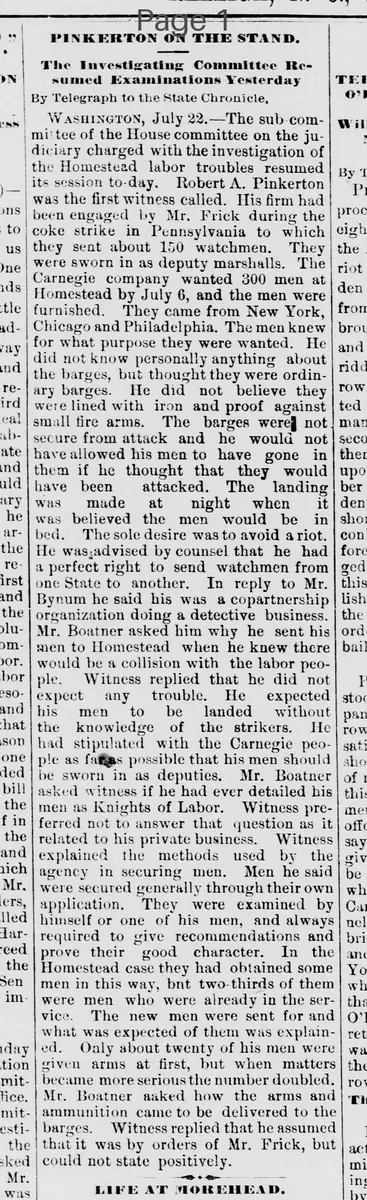
The Investigating Committee Resumed Examinations Yesterday
By Telegraph to the State Chronicle,
WASHINGTON, July 22.-The sub committee of the House committee on the judiciary charged with the investigation of the Homestead labor troubles resumed its session to-day. Robert A. Pinkerton was the first witness called. His firm had been engaged by Mr. Frick during the coke strike in Pennsylvania to which they sent about 150 watchmen. They were sworn in as deputy marshals. The Carnegie company wanted 300 men at Homestead by July 6, and the men were furnished. They came from New York, Chicago and Philadelphia. The men knew for what purpose they were wanted. He did not know personally anything about the barges, but thought they were ordinary barges. He did not believe they were lined with iron and proof against small fire arms. The barges were not secure from attack and he would not have allowed his men to have gone in them if he thought that they would have been attacked. The landing was made at night when it was believed the men would be in bed. The sole desire was to avoid a riot. He was advised by counsel that he had a perfect right to send watchmen from one State to another. In reply to Mr. Bynum he said his was a copartnership organization doing a detective business. Mr. Boatner asked him why he sent his men to Homestead when he knew there would be a collision with the labor people. Witness replied that he did not expect any trouble. He expected his men to be landed without the knowledge of the strikers. He had stipulated with the Carnegie people as far as possible that his men should be sworn in as deputies. Mr. Boatner asked witness if he had ever detailed his men as Knights of Labor. Witness preferred not to answer that question as it related to his private business. Witness explained the methods used by the agency in securing men. Men he said were secured generally through their own application. They were examined by himself or one of his men, and always required to give recommendations and prove their good character. In the Homestead case they had obtained some men in this way, but two-thirds of them were men who were already in the service. The new men were sent for and what was expected of them was explained. Only about twenty of his men were given arms at first, but when matters became more serious the number doubled. Mr. Boatner asked how the arms and ammunition came to be delivered to the barges. Witness replied that he assumed that it was by orders of Mr. Frick, but could not state positively.
What sub-type of article is it?
What keywords are associated?
What entities or persons were involved?
Where did it happen?
Domestic News Details
Primary Location
Washington
Event Date
July 22
Key Persons
Event Details
The sub committee of the House committee on the judiciary charged with the investigation of the Homestead labor troubles resumed its session. Robert A. Pinkerton testified about his firm's engagement by Mr. Frick during the coke strike in Pennsylvania, sending about 150 watchmen sworn in as deputy marshals. The Carnegie company requested 300 men at Homestead by July 6, furnished from New York, Chicago, and Philadelphia. The men knew their purpose. Pinkerton described the barges as ordinary, not iron-lined or proof against firearms, and the landing was made at night to avoid riot. He believed he had the right to send watchmen across states. He did not expect trouble and stipulated men be sworn as deputies. He explained recruitment methods and arming of men. Arms and ammunition were assumed delivered by Mr. Frick's orders.