Thank you for visiting SNEWPapers!
Sign up free
The Enquirer
Richmond, Henrico County, Virginia
What is this article about?
The assassination of Russian Emperor Paul I in April 1801 by conspiring nobility, including Prince Soborsky, allegedly funded by the English ministry through a secret life insurance policy on his life, which paid out millions upon his death amid tensions from the Franco-Russian alliance.
Merged-components note: This is a single historical narrative story about the assassination of Emperor Paul of Russia, continuing across pages; relabeled from foreign_news for the second part as it fits story (full narrative) better than foreign_news (international reports).
Clippings
1 of 2
OCR Quality
Full Text
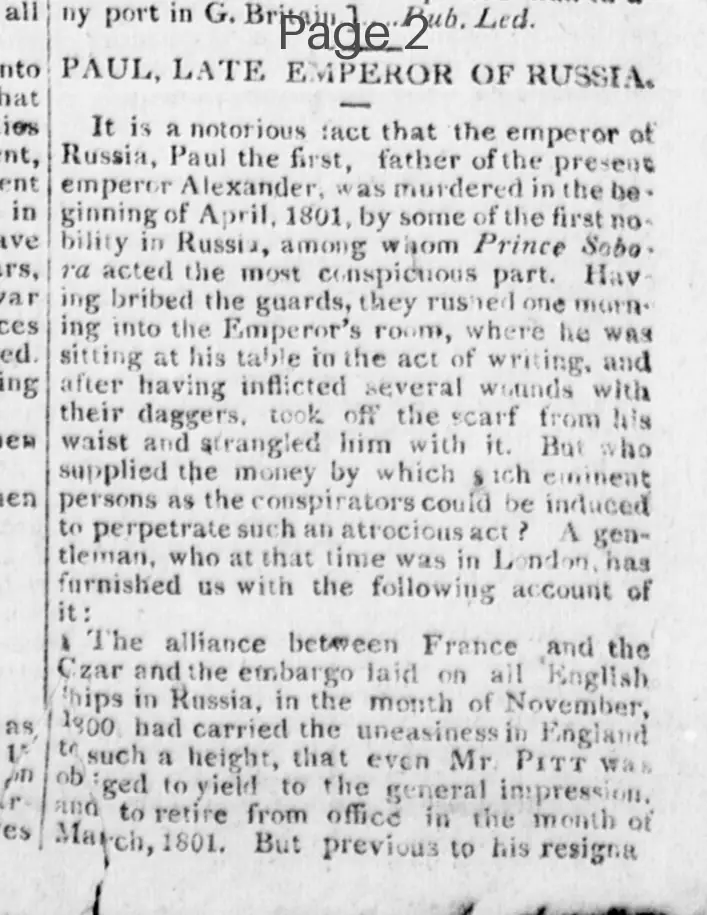
It is a notorious fact that the emperor of Russia, Paul the first, father of the present emperor Alexander, was murdered in the beginning of April, 1801, by some of the first nobility in Russia, among whom Prince Soborsky acted the most conspicuous part. Having bribed the guards, they rushed one morning into the Emperor's room, where he was sitting at his table to the act of writing, and after having inflicted several wounds with their daggers, took off the scarf from his waist and strangled him with it. But who supplied the money by which such eminent persons as the conspirators could be induced to perpetrate such an atrocious act? A gentleman, who at that time was in London, has furnished us with the following account of it:
The alliance between France and the Czar and the embargo laid on all English ships in Russia, in the month of November, 1800 had carried the uneasiness in England to such a height, that even Mr. Pitt was obliged to yield to the general impression, and to retire from office in the month of March, 1801. But previous to his resignation
On hand Mr. Dundas now Lord Minto—caused by their agents at Lloyd's Coffee house, to open a policy of insurance on the life of the Emperor Paul, to forfeit 50 guineas, which were paid down, if the Emperor died before the 1st of May—and to receive one hundred guineas if he was alive at that time. Every man in England anticipated the purpose of that scheme, and as they were all interested in the death of the Emperor Paul, the subscription amounted, in a few weeks, to one million of guineas. The gentleman above mentioned, out of mere curiosity to see how far the English ministry could carry their infamy, took himself a quarter share in 50 guineas, paid down by one of his friends, for which he received a check of one hundred guineas, payable if the Emperor Paul was alive until the 1st of May. But early in April he was assassinated. It was generally believed in England, that this infamous act cost the English ministry two millions of guineas. One million was raised in the way stated above—how they got the other million, is easily explained by recollecting that the EXTRAORDINARY EXPENCES of the war, closing in the year 1801, amounted to sixteen millions of pounds sterling, which were granted by the Parliament in 1802, on the motion of Mr. Addington, the then prime minister, who was merely the tool of Mr. Pitt... N.Y. Pub. Adv.
What sub-type of article is it?
What themes does it cover?
What keywords are associated?
What entities or persons were involved?
Where did it happen?
Story Details
Key Persons
Location
Russia And England
Event Date
Beginning Of April, 1801
Story Details
Russian nobility, led by Prince Soborsky, assassinated Emperor Paul I in his room by stabbing and strangling, bribing guards; allegedly funded by English ministry via a Lloyd's insurance policy on his life that raised one million guineas, paying out upon his death before May 1, 1801, amid political tensions from Franco-Russian alliance.