Thank you for visiting SNEWPapers!
Sign up free
Story
October 2, 1852
Weekly National Intelligencer
Washington, District Of Columbia
What is this article about?
Account of Gen. Winfield Scott's 1847 triumphant entry into Mexico City after conquering it, his just administration, subsequent court-martial as a prisoner in the same palace due to U.S. politics, and emotional 1848 departure honored by troops despite disgrace.
Clipping
OCR Quality
98%
Excellent
Full Text
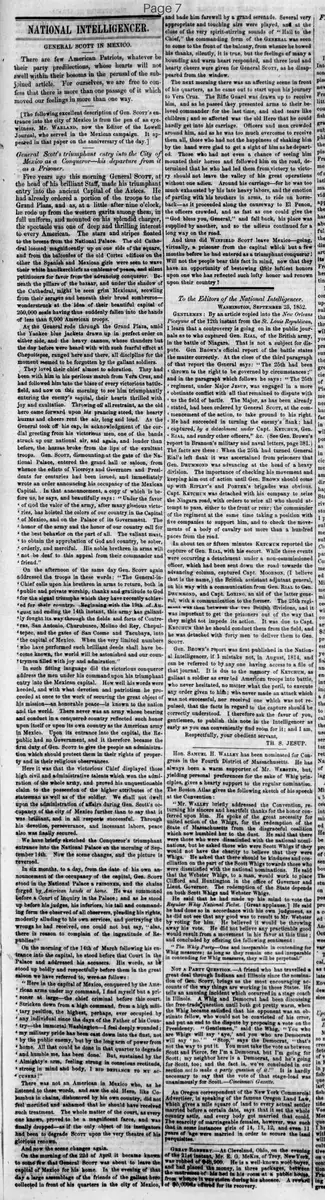
NATIONAL INTELLIGENCER.
GENERAL SCOTT IN MEXICO.
There are few American Patriots, whatever be their party predilections, whose hearts will not swell within their bosoms in the perusal of the subjoined article: "For ourselves, we are free to confess that there is more than one passage of it which moved our feelings in more than one way."
The following excellent description of Gen. Scott's entrance into the city of Mexico is from the pen of an eye-witness, Mr. WARLAND, now the Editor of the Lowell Journal, who served in the Mexican campaign. It appeared in that paper on the anniversary of the day.
General Scott's triumphant entry into the City of Mexico as a Conqueror—his departure from it as a Prisoner.
Five years ago this morning General Scott, at the head of his brilliant Staff, made his triumphant entry into the ancient Capital of the Aztecs. He had already ordered a portion of the troops to the Grand Plaza, and as, at a little after nine o'clock, he rode up from the western garita among them, in full uniform, and mounted on his splendid charger the spectacle was one of deep and thrilling interest to every American. The stars and stripes floated to the breeze from the National Palace. The old Cathedral loomed magnificently up on one side of the square, and from the balconies of the old Cortez edifices on the other the Spanish and Mexican girls were seen to wave their white handkerchiefs as emblems of peace, and silent petitioners for favor from the advancing conqueror. Beneath the pillars of the bazaar, and under the shadow of the Cathedral, might be seen grim Mexicans, scowling from their serapes and beneath their broad sombreros—wonderstruck at the idea of their beautiful capital of 250,000 souls having thus suddenly fallen into the hands of less than 8,000 American troops.
As the General rode through the Grand Plaza, amid the Yankee blue jackets drawn up in perfect order on either side, and the heavy cannon, whose thunders but the day before were heard with such fearful effect at Chapultepec, ranged here and there, all discipline for the moment seemed to be forgotten by the gallant soldiers. They loved their chief almost to adoration. They had been with him in his perilous march from Vera Cruz, and had followed him into the blaze of every victorious battle-field, and now on this morning to see him triumphantly entering the enemy's capital, their hearts thrilled with joy and exultation. Throwing of all restraint, as the old hero came forward upon his prancing steed, the hearty huzzas and cheers rent the air, long and loud. As the General took off his cap, in acknowledgment of the cordial greeting from his victorious men, one of the bands struck up our national air, and again, and louder than before, the huzzas broke from the lips of the exultant troops. Gen. Scott, dismounting at the gate of the National Palace, entered the grand hall or saloon, from whence the edicts of Viceroys and Governors and Presidents for centuries had been issued, and immediately wrote an order announcing his occupancy of the Mexican Capital. In that announcement, a copy of which is before us, he says, and beautifully says: "Under the favor of God the valor of the army, after many glorious victories, has hoisted the colors of our country in the Capital of Mexico, and on the Palace of its Government. The honor of the army and the honor of our country call for the best behavior on the part of all. The valiant must, to obtain the approbation of God and country, be sober, orderly, and merciful. His noble brethren in arms will not be deaf to this appeal from their commander and friend."
On the afternoon of the same day Gen. Scott again addressed the troops in these words: "The General-in-Chief calls upon his brethren in arms to return, both in public and private worship, thanks and gratitude to God for the signal triumphs which they have recently achieved for their country. Beginning with the 19th of August and ending the 14th instant, this army has gallantly fought its way through the fields and forts of Contreras, San Antonio, Churubusco, Molino del Rey, Chapultepec, and the gates of San Cosme and Tacubaya, into the capital of Mexico. When the very limited numbers who have performed such brilliant deeds shall have become known, the world will be astonished and our countrymen filled with joy and admiration."
In such fitting language did the victorious conqueror address the men under his command upon his triumphant entry into the Mexican capital. How well his words were heeded, and with what devotion and patriotism he proceeded at once to the work of securing the great object of his mission—an honorable peace—is known to the nation and the world. There never was an army whose bearing and conduct in a conquered country reflected such honor upon itself or upon its own country as the American army in Mexico. Upon its entrance into the capital, the Republic had no Government, and it therefore became the first duty of Gen. Scott to give the people an administration which should protect them in their rights of property and in their religious observances.
Here it was that the victorious Chief displayed those high civil and administrative talents which won the admiration of the whole army, and proved his unquestionable claim to the possession of the higher attributes of the statesman as well as of the soldier. We shall not dwell upon the administration of affairs during Gen. Scott's occupancy of the city of Mexico further than to say that it was brilliant, and in all respects successful. Through his devotion, perseverance, and incessant labors, peace also was finally secured.
We have briefly sketched the Conqueror's triumphant entrance into the National Palace on the morning of September 13th. Now the scene changes, and the picture is reversed.
In six months, to a day, from the date of his own announcement of the occupancy of the capital, Gen. Scott stood in the National Palace a Prisoner, and the chains forged by American hands at home. He was summoned before a Court of Inquiry in the Palace; and as he stood up before his judges, his inferiors, his tall and commanding form the observed of all observers, pleading his rights, modestly alluding to his own services, and portraying the wrongs he had received, one could not but say, "alas, there is reason to complain of the ingratitude of Republics!"
On the morning of the 14th of March following his entrance into the capital, he stood before that Court in the Palace and addressed his accusers. His words, as he stood up boldly and respectfully before them in the great saloon we have referred to, were as follows:
"Here in the capital of Mexico, conquered by the American arms under my command, I find myself but a prisoner at large—the chief criminal before this court. Stricken down from a high command, from a high military position, the highest, perhaps, ever occupied by any individual since the days of the Father of his Country—the immortal Washington—I feel deeply wounded; my military pride has been cast down into the dust, not by the public enemy, but by the long arm of power from home. All that could be done in that quarter to degrade and humble me, has been done. But, sustained by the Almighty's arm, feeling strong in conscious rectitude, strong in mind and body, I BID DEFIANCE TO MY ACCUSERS!"
There was not an American in Mexico who, as he listened to these words, and saw the old Hero, like Columbus in chains, dishonored by his own country, did not feel mortified and ashamed that he should have received such treatment. The whole matter of the court, as every one knows, proved to be a magnificent farce, and was finally dropped—as if the only object of its instigators had been to degrade Scott upon the very theatre of his glorious renown.
And now the scene changes again.
On the morning of the 22d of April it became known to some few that General Scott was about to leave the capital of Mexico for his home. In the evening of that day a large assemblage of the friends of the gallant hero collected in front of his quarters in the city of Mexico, and bade him farewell by a grand serenade. Several very appropriate and touching airs were played, and at the close of the very spirit-stirring sounds of "Hail to the Chief," the commanding form of the General was seen to come to the front of the balcony, from whence he bowed his thanks, silently, it is true, but the feelings of many a bounding and warm heart responded, and three loud and hearty cheers were given for General Scott, as he disappeared from the window.
The next morning there was an affecting scene in front of his quarters, as he came out to start upon his journey to Vera Cruz. The Rifle Guard was drawn up to receive him, and as he passed they presented arms to their beloved commander for the last time, and shed tears like children; and so affected was the old Hero that he could hardly get into his carriage. Officers and men crowded around him, and as he was too much overcome to receive them all, those who had not the happiness of shaking him by the hand were glad to get a sight of him as he departed. Those who had not even a chance of seeing him mounted their horses and followed him on the road, determined that he who had led them from victory to victory should not leave the valley of his great operations without one adieu. Around his carriage—for he was too much exhausted by his late heavy labors, and the emotion of parting with his brothers in arms, to ride on horseback—as it proceeded along the causeway to El Penon, the officers crowded, and as fast as one could give the "God bless you, General," and fall back, his place was supplied by another, and so the adieus continued for a long way on the road.
And thus did Winfield Scott leave Mexico—going, virtually, a prisoner from the capital which but a few months before he had entered as a triumphant conqueror!
Will not the people bear this fact in mind, now that they have an opportunity of bestowing their loftiest honors upon one who has reflected such lofty honor and renown upon their country?
GENERAL SCOTT IN MEXICO.
There are few American Patriots, whatever be their party predilections, whose hearts will not swell within their bosoms in the perusal of the subjoined article: "For ourselves, we are free to confess that there is more than one passage of it which moved our feelings in more than one way."
The following excellent description of Gen. Scott's entrance into the city of Mexico is from the pen of an eye-witness, Mr. WARLAND, now the Editor of the Lowell Journal, who served in the Mexican campaign. It appeared in that paper on the anniversary of the day.
General Scott's triumphant entry into the City of Mexico as a Conqueror—his departure from it as a Prisoner.
Five years ago this morning General Scott, at the head of his brilliant Staff, made his triumphant entry into the ancient Capital of the Aztecs. He had already ordered a portion of the troops to the Grand Plaza, and as, at a little after nine o'clock, he rode up from the western garita among them, in full uniform, and mounted on his splendid charger the spectacle was one of deep and thrilling interest to every American. The stars and stripes floated to the breeze from the National Palace. The old Cathedral loomed magnificently up on one side of the square, and from the balconies of the old Cortez edifices on the other the Spanish and Mexican girls were seen to wave their white handkerchiefs as emblems of peace, and silent petitioners for favor from the advancing conqueror. Beneath the pillars of the bazaar, and under the shadow of the Cathedral, might be seen grim Mexicans, scowling from their serapes and beneath their broad sombreros—wonderstruck at the idea of their beautiful capital of 250,000 souls having thus suddenly fallen into the hands of less than 8,000 American troops.
As the General rode through the Grand Plaza, amid the Yankee blue jackets drawn up in perfect order on either side, and the heavy cannon, whose thunders but the day before were heard with such fearful effect at Chapultepec, ranged here and there, all discipline for the moment seemed to be forgotten by the gallant soldiers. They loved their chief almost to adoration. They had been with him in his perilous march from Vera Cruz, and had followed him into the blaze of every victorious battle-field, and now on this morning to see him triumphantly entering the enemy's capital, their hearts thrilled with joy and exultation. Throwing of all restraint, as the old hero came forward upon his prancing steed, the hearty huzzas and cheers rent the air, long and loud. As the General took off his cap, in acknowledgment of the cordial greeting from his victorious men, one of the bands struck up our national air, and again, and louder than before, the huzzas broke from the lips of the exultant troops. Gen. Scott, dismounting at the gate of the National Palace, entered the grand hall or saloon, from whence the edicts of Viceroys and Governors and Presidents for centuries had been issued, and immediately wrote an order announcing his occupancy of the Mexican Capital. In that announcement, a copy of which is before us, he says, and beautifully says: "Under the favor of God the valor of the army, after many glorious victories, has hoisted the colors of our country in the Capital of Mexico, and on the Palace of its Government. The honor of the army and the honor of our country call for the best behavior on the part of all. The valiant must, to obtain the approbation of God and country, be sober, orderly, and merciful. His noble brethren in arms will not be deaf to this appeal from their commander and friend."
On the afternoon of the same day Gen. Scott again addressed the troops in these words: "The General-in-Chief calls upon his brethren in arms to return, both in public and private worship, thanks and gratitude to God for the signal triumphs which they have recently achieved for their country. Beginning with the 19th of August and ending the 14th instant, this army has gallantly fought its way through the fields and forts of Contreras, San Antonio, Churubusco, Molino del Rey, Chapultepec, and the gates of San Cosme and Tacubaya, into the capital of Mexico. When the very limited numbers who have performed such brilliant deeds shall have become known, the world will be astonished and our countrymen filled with joy and admiration."
In such fitting language did the victorious conqueror address the men under his command upon his triumphant entry into the Mexican capital. How well his words were heeded, and with what devotion and patriotism he proceeded at once to the work of securing the great object of his mission—an honorable peace—is known to the nation and the world. There never was an army whose bearing and conduct in a conquered country reflected such honor upon itself or upon its own country as the American army in Mexico. Upon its entrance into the capital, the Republic had no Government, and it therefore became the first duty of Gen. Scott to give the people an administration which should protect them in their rights of property and in their religious observances.
Here it was that the victorious Chief displayed those high civil and administrative talents which won the admiration of the whole army, and proved his unquestionable claim to the possession of the higher attributes of the statesman as well as of the soldier. We shall not dwell upon the administration of affairs during Gen. Scott's occupancy of the city of Mexico further than to say that it was brilliant, and in all respects successful. Through his devotion, perseverance, and incessant labors, peace also was finally secured.
We have briefly sketched the Conqueror's triumphant entrance into the National Palace on the morning of September 13th. Now the scene changes, and the picture is reversed.
In six months, to a day, from the date of his own announcement of the occupancy of the capital, Gen. Scott stood in the National Palace a Prisoner, and the chains forged by American hands at home. He was summoned before a Court of Inquiry in the Palace; and as he stood up before his judges, his inferiors, his tall and commanding form the observed of all observers, pleading his rights, modestly alluding to his own services, and portraying the wrongs he had received, one could not but say, "alas, there is reason to complain of the ingratitude of Republics!"
On the morning of the 14th of March following his entrance into the capital, he stood before that Court in the Palace and addressed his accusers. His words, as he stood up boldly and respectfully before them in the great saloon we have referred to, were as follows:
"Here in the capital of Mexico, conquered by the American arms under my command, I find myself but a prisoner at large—the chief criminal before this court. Stricken down from a high command, from a high military position, the highest, perhaps, ever occupied by any individual since the days of the Father of his Country—the immortal Washington—I feel deeply wounded; my military pride has been cast down into the dust, not by the public enemy, but by the long arm of power from home. All that could be done in that quarter to degrade and humble me, has been done. But, sustained by the Almighty's arm, feeling strong in conscious rectitude, strong in mind and body, I BID DEFIANCE TO MY ACCUSERS!"
There was not an American in Mexico who, as he listened to these words, and saw the old Hero, like Columbus in chains, dishonored by his own country, did not feel mortified and ashamed that he should have received such treatment. The whole matter of the court, as every one knows, proved to be a magnificent farce, and was finally dropped—as if the only object of its instigators had been to degrade Scott upon the very theatre of his glorious renown.
And now the scene changes again.
On the morning of the 22d of April it became known to some few that General Scott was about to leave the capital of Mexico for his home. In the evening of that day a large assemblage of the friends of the gallant hero collected in front of his quarters in the city of Mexico, and bade him farewell by a grand serenade. Several very appropriate and touching airs were played, and at the close of the very spirit-stirring sounds of "Hail to the Chief," the commanding form of the General was seen to come to the front of the balcony, from whence he bowed his thanks, silently, it is true, but the feelings of many a bounding and warm heart responded, and three loud and hearty cheers were given for General Scott, as he disappeared from the window.
The next morning there was an affecting scene in front of his quarters, as he came out to start upon his journey to Vera Cruz. The Rifle Guard was drawn up to receive him, and as he passed they presented arms to their beloved commander for the last time, and shed tears like children; and so affected was the old Hero that he could hardly get into his carriage. Officers and men crowded around him, and as he was too much overcome to receive them all, those who had not the happiness of shaking him by the hand were glad to get a sight of him as he departed. Those who had not even a chance of seeing him mounted their horses and followed him on the road, determined that he who had led them from victory to victory should not leave the valley of his great operations without one adieu. Around his carriage—for he was too much exhausted by his late heavy labors, and the emotion of parting with his brothers in arms, to ride on horseback—as it proceeded along the causeway to El Penon, the officers crowded, and as fast as one could give the "God bless you, General," and fall back, his place was supplied by another, and so the adieus continued for a long way on the road.
And thus did Winfield Scott leave Mexico—going, virtually, a prisoner from the capital which but a few months before he had entered as a triumphant conqueror!
Will not the people bear this fact in mind, now that they have an opportunity of bestowing their loftiest honors upon one who has reflected such lofty honor and renown upon their country?
What sub-type of article is it?
Historical Event
Biography
Military Action
What themes does it cover?
Bravery Heroism
Triumph
Misfortune
What keywords are associated?
General Scott
Mexico City
Triumphant Entry
Court Of Inquiry
Mexican War
National Palace
American Troops
What entities or persons were involved?
General Scott
Mr. Warland
Where did it happen?
City Of Mexico
Story Details
Key Persons
General Scott
Mr. Warland
Location
City Of Mexico
Event Date
September 13th
Story Details
General Scott enters Mexico City triumphantly as conqueror after victories, administers justly, but later faces a court of inquiry as a prisoner in the same palace, and departs emotionally amid honors from troops.