Thank you for visiting SNEWPapers!
Sign up free
Scandinavian American
Seattle, King County, Washington
What is this article about?
A review of 1949 as a year of emerging atomic threats but growing international cooperation through the United Nations, highlighting peaceful resolutions to conflicts like Berlin blockade, Israel and Indonesia recognition, Kashmir cease-fire, and UN efforts in health, economy, and human rights.
Merged-components note: Merged multiple images with the main article text as they provide illustrations and captions integral to the United Nations 1949 review story; relabeled from story to match overarching narrative on international events, but original is story.
Clipping
OCR Quality
Full Text
Some will remember 1949 primarily as the year in which it became general knowledge that at least two nations now possessed the "secret" of the atomic bomb—in which, therefore, the atomic age really began. Others may prefer to remember it as the year in which a better recognition that conciliation and compromise are essential to a secure peace began to spread through the minds of people everywhere.
Whether or not the diffusion of atomic knowledge will end only with war and destruction for all nations, or will be used for the benefit of mankind, is a question of tremendous social, political and historic significance. Also significant, however, is the fact that, during 1949, the peoples and representatives of 59 United Nations began working toward a fuller realization of the ideals proclaimed in the unprecedented Universal Declaration of Human Rights.
In many ways 1949 was a year of troubles and of fear and worry, like the other years since World War II ended in 1945. But several events and trends made 1949 a more hopeful year than any of the previous three.
Not only was world peace maintained, but several international conflicts, each capable of setting off a major war, were effectively settled, or at least eased, during 1949. Among such peaceful adjustments were the settlement of the Berlin deadlock, announced from United Nations headquarters in May: the acceptance of the new Republic of Israel as a full member of the world community: the creation of a new and sovereign United States of Indonesia, after mediation by U.N.: the cease-fire agreement effected under U.N. auspices between India and Pakistan in the dispute in Kashmir; and action on the future of the former Italian colonies by the U.N. General Assembly.
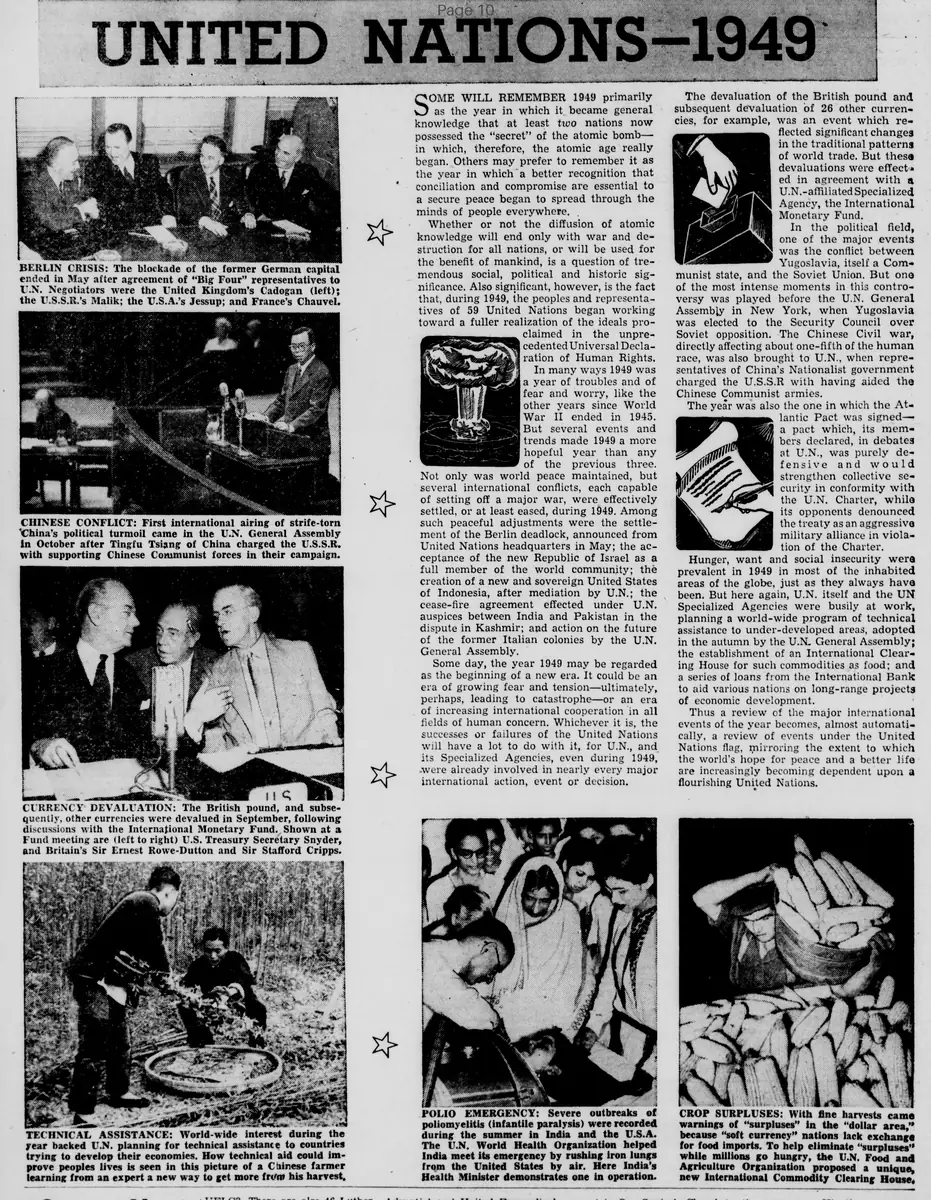
BERLIN CRISIS: The blockade of the former German capital ended in May after agreement of "Big Four" representatives to U.N. Negotiators were the United Kingdom's Cadogan (left): the U.S.S.R.'s Malik: the U.S.A.'s Jessup: and France's Chauvel.
Some day, the year 1949 may be regarded as the beginning of a new era. It could be an era of growing fear and tension—ultimately, perhaps, leading to catastrophe—or an era of increasing international cooperation in all fields of human concern. Whichever it is, the successes or failures of the United Nations will have a lot to do with it, for U.N., and its Specialized Agencies, even during 1949, were already involved in nearly every major international action, event or decision.
POLIO EMERGENCY: Severe outbreaks of poliomyelitis (infantile paralysis) were recorded during the summer in India and the U.S.A. The U.N. World Health Organization helped India meet its emergency by rushing iron lungs from the United States by air. Here India's Health Minister demonstrates one in operation.
The devaluation of the British pound and subsequent devaluation of 26 other currencies, for example, was an event which reflected significant changes in the traditional patterns of world trade. But these devaluations were effected in agreement with a U.N.-affiliated Specialized Agency, the International Monetary Fund.
CURRENCY DEVALUATION: The British pound, and subsequently, other currencies were devalued in September, following discussions with the International Monetary Fund. Shown at a Fund meeting are (left to right) U.S. Treasury Secretary Snyder, and Britain's Sir Ernest Rowe-Dutton and Sir Stafford Cripps.
In the political field, one of the major events was the conflict between Yugoslavia, itself a Communist state, and the Soviet Union. But one of the most intense moments in this controversy was played before the U.N. General Assembly in New York, when Yugoslavia was elected to the Security Council over Soviet opposition. The Chinese Civil war, directly affecting about one-fifth of the human race, was also brought to U.N., when representatives of China's Nationalist government charged the U.S.S.R. with having aided the Chinese Communist armies.
CHINESE CONFLICT: First international airing of strife-torn China's political turmoil came in the U.N. General Assembly in October after Tingfu Tsiang of China charged the U.S.S.R. with supporting Chinese Communist forces in their campaign.
The year was also the one in which the Atlantic Pact was signed—a pact which, its members declared, in debates at U.N., was purely defensive and would strengthen collective security in conformity with the U.N. Charter, while its opponents denounced the treaty as an aggressive military alliance in violation of the Charter.
Hunger, want and social insecurity were prevalent in 1949 in most of the inhabited areas of the globe, just as they always have been. But here again, U.N. itself and the UN Specialized Agencies were busily at work, planning a world-wide program of technical assistance to under-developed areas, adopted in the autumn by the U.N. General Assembly: the establishment of an International Clearing House for such commodities as food; and a series of loans from the International Bank to aid various nations on long-range projects of economic development.
TECHNICAL ASSISTANCE: World-wide interest during the year backed U.N. planning for technical assistance to countries trying to develop their economies. How technical aid could improve peoples lives is seen in this picture of a Chinese farmer learning from an expert a new way to get more from his harvest.
Thus a review of the major international events of the year becomes, almost automatically, a review of events under the United Nations flag, mirroring the extent to which the world's hope for peace and a better life are increasingly becoming dependent upon a flourishing United Nations.
CROP SURPLUSES: With fine harvests came warnings of "surpluses" in the "dollar area," because "soft currency" nations lack exchange for food imports. To help eliminate "surpluses" while millions go hungry, the U.N. Food and Agriculture Organization proposed a unique, new International Commodity Clearing House.
What sub-type of article is it?
What themes does it cover?
What keywords are associated?
What entities or persons were involved?
Where did it happen?
Story Details
Key Persons
Location
United Nations, Worldwide
Event Date
1949
Story Details
1949 marked the atomic age's start with multiple nations possessing the bomb, yet saw hopeful UN-mediated resolutions to conflicts including Berlin blockade end, Israel and Indonesia's recognition, Kashmir cease-fire, and advancements in human rights, health aid, economic stability, and technical assistance amid global tensions like Chinese Civil War and Atlantic Pact.