Thank you for visiting SNEWPapers!
Sign up free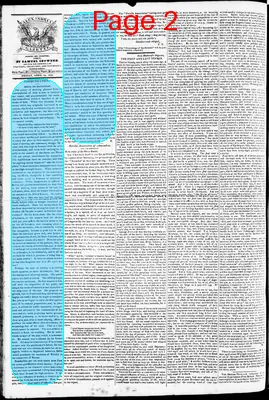
Editorial
April 24, 1829
Phenix Gazette
Alexandria, Virginia
What is this article about?
An editorial critiquing the pursuit of novelty in education, advocating for steady, foundational instruction to build character and usefulness in youth. It warns against fickleness from changing methods and emphasizes parental and teacher unity for moral and intellectual development.
Clipping
OCR Quality
95%
Excellent
Full Text
COMMUNICATIONS.
HINTS ON EDUCATION.
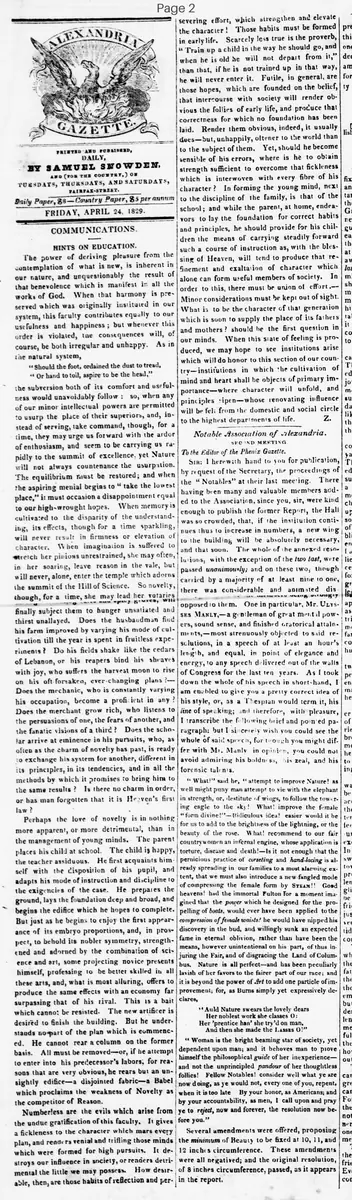
The power of deriving pleasure from the contemplation of what is new, is inherent in our nature, and unquestionably the result of that benevolence which is manifest in all the works of God. When that harmony is preserved which was originally instituted in our system, this faculty contributes equally to our usefulness and happiness; but whenever this order is violated, the consequences will, of course, be both irregular and unhappy.
As in the natural system,
"Should the foot, ordained the dust to tread,
Or hand to toil, aspire to be the head,"
the subversion both of its comfort and usefulness would unavoidably follow: so, when any of our minor intellectual powers are permitted to usurp the place of their superiors, and, instead of serving, take command, though, for a time, they may urge us forward with the ardor of enthusiasm, and seem to be carrying us rapidly to the summit of excellence, yet Nature will not always countenance the usurpation. The equilibrium must be restored; and when the aspiring menial begins to "take the lowest place," it must occasion a disappointment equal to our high-wrought hopes.
When memory is cultivated to the disparagement of the understanding, its effects, though for a time sparkling, will never result in firmness or elevation of character.
When imagination is suffered to stretch her pinions unrestrained, she may often, in her soaring, leave reason in the vale, but will never, alone, enter the temple which adorns the summit of the Hill of Science. So novelty, though, for a time, she may lead her votaries finally subject them to hunger unsatiated and thirst unallayed. Does the husbandman find his farm improved by varying his mode of cultivation till the year is spent in fruitless experiments? Do his fields shake like the cedars of Lebanon, or his reapers bind his sheaves with joy, who suffers the harvest moon to rise on his oft-forsaken, ever-changing plans?
Does the mechanic, who is constantly varying his occupation, become a proficient in any? Does the merchant grow rich, who listens to the persuasions of one, the fears of another, and the fanatic visions of a third? Does the scholar arrive at eminence in his pursuits, who, as often as the charm of novelty has past, is ready to exchange his system for another, different in its principles, in its tendencies, and in all the methods by which it promises to bring him to the same results? Is there no charm in order, or has man forgotten that it is Heaven's first law?
Perhaps the love of novelty is in nothing more apparent, or more detrimental, than in the management of young minds. The parent places his child at school. The child is happy, the teacher assiduous. He first acquaints himself with the disposition of his pupil, and adapts his mode of instruction and discipline to the exigencies of the case. He prepares the ground, lays the foundation deep and broad, and begins the edifice which he hopes to complete. But just as he begins to enjoy the first appearance of its embryo proportions, and, in prospect, to behold its nobler symmetry, strengthened and adorned by the combination of science and art, some projecting novice presents himself, professing to be better skilled in all these arts, and, what is most alluring, offers to produce the same effects with an economy far surpassing that of his rival. This is a bait which cannot be resisted. The new artificer is desired to finish the building. But he understands no part of the plan which is commenced. He cannot rear a column on the former basis. All must be removed—or, if he attempt to enter into his predecessor's labors; for reasons that are very obvious, he rears but an unsightly edifice—a disjointed fabric—a Babel which proclaims the weakness of Novelty as the competitor of Reason.
Numberless are the evils which arise from the undue gratification of this faculty. It gives a fickleness to the character which mars every plan, and renders venial and trifling those minds which were formed for high pursuits. It destroys our influence in society, or renders detrimental the little we may possess. How desirable, then, are those habits of reflection and persevering effort, which strengthen and elevate the character! Those habits must be formed in early life. Scarcely less true is the proverb, "Train up a child in the way he should go, and when he is old he will not depart from it," than that, if he is not trained up in that way, he will never enter it. Futile, in general, are those hopes, which are founded on the belief, that intercourse with society will render obvious the follies of early life, and produce that correctness for which no foundation has been laid. Render them obvious, indeed, it usually does—but, unhappily, oftener to the world than to the subject of them. Yet, should he become sensible of his errors, where is he to obtain strength sufficient to overcome that fickleness which is interwoven with every fibre of his character? In forming the young mind, next to the discipline of the family, is that of the school; and while the parent, at home, endeavors to lay the foundation for correct habits and principles, he should provide for his children the means of carrying steadily forward such a course of instruction as, with the blessing of Heaven, will tend to produce that refinement and exaltation of character which alone can form useful members of society. In order to this, there must be union of effort.— Minor considerations must be kept out of sight. What is to be the character of that generation which is soon to supply the place of its fathers and mothers? should be the first question in our minds. When this state of feeling is produced, we may hope to see institutions arise which will do honor to this section of our country—institutions in which the cultivation of mind and heart shall be objects of primary importance—where character will unfold, and principles ripen—whose renovating influence will be felt from the domestic and social circle to the highest departments of life.
HINTS ON EDUCATION.
The power of deriving pleasure from the contemplation of what is new, is inherent in our nature, and unquestionably the result of that benevolence which is manifest in all the works of God. When that harmony is preserved which was originally instituted in our system, this faculty contributes equally to our usefulness and happiness; but whenever this order is violated, the consequences will, of course, be both irregular and unhappy.
As in the natural system,
"Should the foot, ordained the dust to tread,
Or hand to toil, aspire to be the head,"
the subversion both of its comfort and usefulness would unavoidably follow: so, when any of our minor intellectual powers are permitted to usurp the place of their superiors, and, instead of serving, take command, though, for a time, they may urge us forward with the ardor of enthusiasm, and seem to be carrying us rapidly to the summit of excellence, yet Nature will not always countenance the usurpation. The equilibrium must be restored; and when the aspiring menial begins to "take the lowest place," it must occasion a disappointment equal to our high-wrought hopes.
When memory is cultivated to the disparagement of the understanding, its effects, though for a time sparkling, will never result in firmness or elevation of character.
When imagination is suffered to stretch her pinions unrestrained, she may often, in her soaring, leave reason in the vale, but will never, alone, enter the temple which adorns the summit of the Hill of Science. So novelty, though, for a time, she may lead her votaries finally subject them to hunger unsatiated and thirst unallayed. Does the husbandman find his farm improved by varying his mode of cultivation till the year is spent in fruitless experiments? Do his fields shake like the cedars of Lebanon, or his reapers bind his sheaves with joy, who suffers the harvest moon to rise on his oft-forsaken, ever-changing plans?
Does the mechanic, who is constantly varying his occupation, become a proficient in any? Does the merchant grow rich, who listens to the persuasions of one, the fears of another, and the fanatic visions of a third? Does the scholar arrive at eminence in his pursuits, who, as often as the charm of novelty has past, is ready to exchange his system for another, different in its principles, in its tendencies, and in all the methods by which it promises to bring him to the same results? Is there no charm in order, or has man forgotten that it is Heaven's first law?
Perhaps the love of novelty is in nothing more apparent, or more detrimental, than in the management of young minds. The parent places his child at school. The child is happy, the teacher assiduous. He first acquaints himself with the disposition of his pupil, and adapts his mode of instruction and discipline to the exigencies of the case. He prepares the ground, lays the foundation deep and broad, and begins the edifice which he hopes to complete. But just as he begins to enjoy the first appearance of its embryo proportions, and, in prospect, to behold its nobler symmetry, strengthened and adorned by the combination of science and art, some projecting novice presents himself, professing to be better skilled in all these arts, and, what is most alluring, offers to produce the same effects with an economy far surpassing that of his rival. This is a bait which cannot be resisted. The new artificer is desired to finish the building. But he understands no part of the plan which is commenced. He cannot rear a column on the former basis. All must be removed—or, if he attempt to enter into his predecessor's labors; for reasons that are very obvious, he rears but an unsightly edifice—a disjointed fabric—a Babel which proclaims the weakness of Novelty as the competitor of Reason.
Numberless are the evils which arise from the undue gratification of this faculty. It gives a fickleness to the character which mars every plan, and renders venial and trifling those minds which were formed for high pursuits. It destroys our influence in society, or renders detrimental the little we may possess. How desirable, then, are those habits of reflection and persevering effort, which strengthen and elevate the character! Those habits must be formed in early life. Scarcely less true is the proverb, "Train up a child in the way he should go, and when he is old he will not depart from it," than that, if he is not trained up in that way, he will never enter it. Futile, in general, are those hopes, which are founded on the belief, that intercourse with society will render obvious the follies of early life, and produce that correctness for which no foundation has been laid. Render them obvious, indeed, it usually does—but, unhappily, oftener to the world than to the subject of them. Yet, should he become sensible of his errors, where is he to obtain strength sufficient to overcome that fickleness which is interwoven with every fibre of his character? In forming the young mind, next to the discipline of the family, is that of the school; and while the parent, at home, endeavors to lay the foundation for correct habits and principles, he should provide for his children the means of carrying steadily forward such a course of instruction as, with the blessing of Heaven, will tend to produce that refinement and exaltation of character which alone can form useful members of society. In order to this, there must be union of effort.— Minor considerations must be kept out of sight. What is to be the character of that generation which is soon to supply the place of its fathers and mothers? should be the first question in our minds. When this state of feeling is produced, we may hope to see institutions arise which will do honor to this section of our country—institutions in which the cultivation of mind and heart shall be objects of primary importance—where character will unfold, and principles ripen—whose renovating influence will be felt from the domestic and social circle to the highest departments of life.
What sub-type of article is it?
Education
Social Reform
Moral Or Religious
What keywords are associated?
Education
Novelty
Character Formation
Perseverance
Teaching Methods
Youth Training
Moral Habits
Editorial Details
Primary Topic
Dangers Of Novelty In Education And Advocacy For Steady Foundational Instruction
Stance / Tone
Cautionary Advocacy For Perseverance And Order In Education
Key Arguments
Novelty In Intellectual Pursuits Disrupts Natural Harmony And Leads To Disappointment.
Overemphasizing Memory Or Imagination Over Understanding Hinders Character Development.
Constant Changes In Occupation Or Methods Prevent Proficiency And Success In Farming, Mechanics, Commerce, And Scholarship.
In Education, Switching Teachers Or Methods Mid Process Results In Disjointed Learning And Wasted Efforts.
Fickleness From Novelty Mars Character And Societal Influence.
Early Habits Of Reflection And Perseverance Are Essential For Strong Character.
Parental And School Efforts Must Unite For Steady Instruction To Form Useful Societal Members.