Thank you for visiting SNEWPapers!
Sign up free
Story
June 15, 1862
Sunday Dispatch
New York, New York County, New York
What is this article about?
A correspondent describes the harsh yet spirited life of over 300 contraband slaves in ruined houses at Harper's Ferry under General Banks' army, surviving on camp scraps and discarded items while anticipating freedom in the North.
Clipping
OCR Quality
95%
Excellent
Full Text
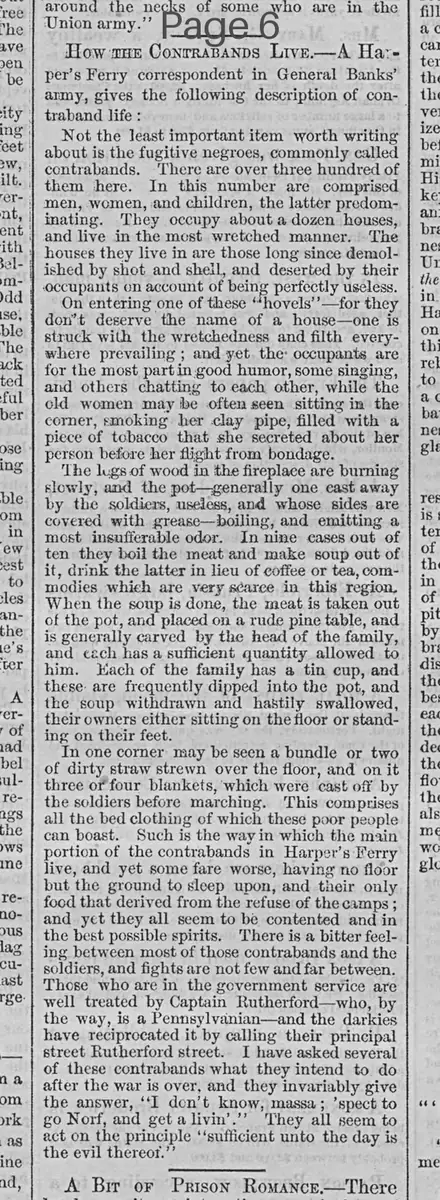
HOW THE CONTRABANDS LIVE.—A Harper's Ferry correspondent in General Banks army, gives the following description of contraband life :
Not the least important item worth writing about is the fugitive negroes, commonly called contrabands. There are over three hundred of them here. In this number are comprised men, women, and children, the latter predominating. They occupy about a dozen houses, and live in the most wretched manner. The houses they live in are those long since demolished by shot and shell, and deserted by their occupants on account of being perfectly useless.
On entering one of these "hovels"—for they don't deserve the name of a house—one is struck with the wretchedness and filth everywhere prevailing; and yet the occupants are for the most part in good humor, some singing, and others chatting to each other, while the old women may be often seen sitting in the corner, smoking her clay pipe, filled with a piece of tobacco that she secreted about her person before her flight from bondage.
The logs of wood in the fireplace are burning slowly, and the pot—generally one cast away by the soldiers, useless, and whose sides are covered with grease—boiling, and emitting a most insufferable odor. In nine cases out of ten they boil the meat and make soup out of it, drink the latter in lieu of coffee or tea, commodities which are very scarce in this region.
When the soup is done, the meat is taken out of the pot, and placed on a rude pine table, and is generally carved by the head of the family and each has a sufficient quantity allowed to him. Each of the family has a tin cup, and these are frequently dipped into the pot, and the soup withdrawn and hastily swallowed their owners either sitting on the floor or standing on their feet.
In one corner may be seen a bundle or two of dirty straw strewn over the floor, and on it three or four blankets, which were cast off by the soldiers before marching. This comprises all the bed clothing of which these poor people can boast. Such is the way in which the main portion of the contrabands in Harper's Ferry live, and yet some fare worse, having no floor but the ground to sleep upon, and their only food that derived from the refuse of the camps; and yet they all seem to be contented and in the best possible spirits. There is a bitter feeling between most of those contrabands and the soldiers, and fights are not few and far between.
Those who are in the government service are well treated by Captain Rutherford—who, by the way, is a Pennsylvanian—and the darkies have reciprocated it by calling their principal street Rutherford street. I have asked several of these contrabands what they intend to do after the war is over, and they invariably give the answer, "I don't know, massa; 'spect to go Norf, and get a livin'." They all seem to act on the principle "sufficient unto the day is the evil thereof."
Not the least important item worth writing about is the fugitive negroes, commonly called contrabands. There are over three hundred of them here. In this number are comprised men, women, and children, the latter predominating. They occupy about a dozen houses, and live in the most wretched manner. The houses they live in are those long since demolished by shot and shell, and deserted by their occupants on account of being perfectly useless.
On entering one of these "hovels"—for they don't deserve the name of a house—one is struck with the wretchedness and filth everywhere prevailing; and yet the occupants are for the most part in good humor, some singing, and others chatting to each other, while the old women may be often seen sitting in the corner, smoking her clay pipe, filled with a piece of tobacco that she secreted about her person before her flight from bondage.
The logs of wood in the fireplace are burning slowly, and the pot—generally one cast away by the soldiers, useless, and whose sides are covered with grease—boiling, and emitting a most insufferable odor. In nine cases out of ten they boil the meat and make soup out of it, drink the latter in lieu of coffee or tea, commodities which are very scarce in this region.
When the soup is done, the meat is taken out of the pot, and placed on a rude pine table, and is generally carved by the head of the family and each has a sufficient quantity allowed to him. Each of the family has a tin cup, and these are frequently dipped into the pot, and the soup withdrawn and hastily swallowed their owners either sitting on the floor or standing on their feet.
In one corner may be seen a bundle or two of dirty straw strewn over the floor, and on it three or four blankets, which were cast off by the soldiers before marching. This comprises all the bed clothing of which these poor people can boast. Such is the way in which the main portion of the contrabands in Harper's Ferry live, and yet some fare worse, having no floor but the ground to sleep upon, and their only food that derived from the refuse of the camps; and yet they all seem to be contented and in the best possible spirits. There is a bitter feeling between most of those contrabands and the soldiers, and fights are not few and far between.
Those who are in the government service are well treated by Captain Rutherford—who, by the way, is a Pennsylvanian—and the darkies have reciprocated it by calling their principal street Rutherford street. I have asked several of these contrabands what they intend to do after the war is over, and they invariably give the answer, "I don't know, massa; 'spect to go Norf, and get a livin'." They all seem to act on the principle "sufficient unto the day is the evil thereof."
What sub-type of article is it?
Historical Event
Curiosity
What themes does it cover?
Misfortune
Survival
What keywords are associated?
Contrabands
Fugitive Negroes
Harper's Ferry
Living Conditions
Civil War
Army Refuse
Captain Rutherford
What entities or persons were involved?
Captain Rutherford
General Banks
Where did it happen?
Harper's Ferry
Story Details
Key Persons
Captain Rutherford
General Banks
Location
Harper's Ferry
Story Details
Description of over three hundred contraband fugitive negroes living in demolished houses at Harper's Ferry, in wretched conditions with minimal food and bedding from army refuse, yet remaining in good spirits; some work for the government under Captain Rutherford and plan to go North after the war.