Thank you for visiting SNEWPapers!
Sign up free
The Topeka State Journal
Topeka, Shawnee County, Kansas
What is this article about?
Topeka to resume using Harrison Street well water, abandoned 30 years ago due to contamination from sewers, as emergency supply amid shortage. Opposed by C.P. Bolmar citing past Supreme Court ban and worse conditions now, but state health board tests confirm safety.
Clipping
OCR Quality
Full Text
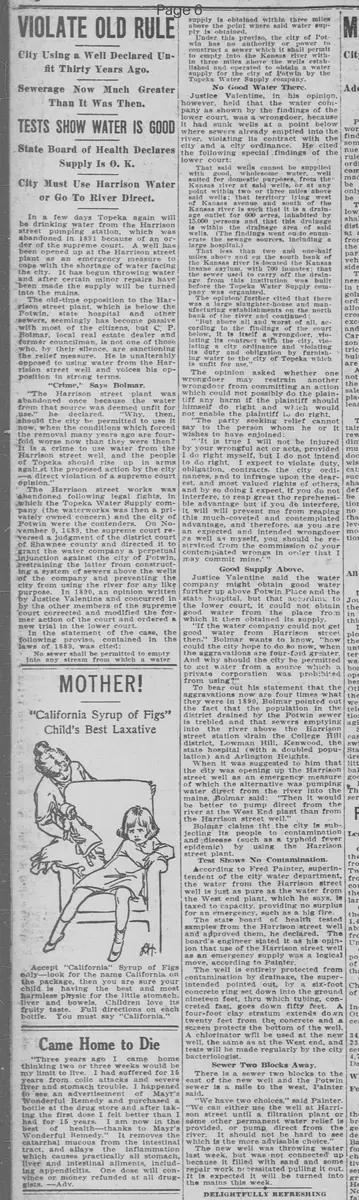
OLD
RULE
City Using a Well Declared Unfit Thirty Years Ago.
Sewerage Now Much Greater Than It Was Then,
TESTS SHOW WATER IS GOOD
State Board of Health Declares Supply Is O. K.
City Must Use Harrison Water or Go To River Direct.
In a few days Topeka again will be drinking water from the Harrison street pumping station, which was abandoned in 1891 because of an order of the supreme court. A well has been opened up at the Harrison street plant as an emergency measure to cope with the shortage of water facing the city. It has begun throwing water and after certain minor repairs have been made the supply will be turned into the mains.
The old-time opposition to the Harrison street plant, which is below the Potwin, state hospital and other sewers, seemingly has become passive with most of the citizens, but C. P. Bolmar, local real estate dealer and former councilman, is not one of those who, by their silence, are sanctioning the relief measure. He is unalterably opposed to using water from the Harrison street well and voices his opposition in strong terms.
"Crime,"
Says Bolmar.
"The Harrison street plant was abandoned once because the water from that source was deemed unfit for use," he declared. "Why, then, should the city be permitted to use it now, when the conditions which forced the removal many years ago are four-fold worse now than they were then?
It is a crime to use water from the Harrison street well, and the people of Topeka should rise up in arms against the proposed action by the city - a direct violation of a supreme court opinion."
The Harrison street works was abandoned following legal fights, in which the Topeka Water Supply company (the waterworks was then a privately owned concern) and the city of Potwin were the contenders. On November 9, 1889, the supreme court reversed a judgment of the district court of Shawnee county and directed it to grant the water company a perpetual injunction against the city of Potwin, restraining the latter from constructing a system of sewers above the wells of the company and preventing the city from using the river for any like purpose. In 1890, an opinion written by Justice Valentine and concurred in by the other members of the supreme court corrected and modified the former action of the court and ordered a new trial in the lower court.
In the statement of the case, the following proviso, contained in the laws of 1889, was cited:
No sewer shall be permitted to empty into any stream from which a water supply is obtained within three miles above the point where said water supply is obtained.
Under this proviso, the city of Potwin has no authority or power to construct a sewer which it shall permit to empty into the Kansas river within three miles above the wells established and operated to obtain a water supply for the city of Potwin by the Topeka Water Supply company.
No Good Water There.
Justice Valentine, in his opinion, however, held that the water company as shown by the findings of the lower court, was a wrongdoer, because it had sunk wells at a point below where sewers already emptied into the river, violating its contract with the city and a city ordinance. He cited the following special findings of the lower court:
That said wells cannot be supplied with good, wholesome water, well suited for domestic purposes, from the Kansas river at said wells, or at any point within two or three miles above said wells: that territory lying west of Kansas avenue and south of the Kansas river is such that it is a drainage outlet for 600 acres, inhabited by 15,000 persons and that this drainage is within the drainage area of said wells. (The findings went on to enumerate the sewage sources, including a large hospital.)
That less than two and one-half miles above and on the south bank of the Kansas river is located the Kansas insane asylum, with 700 inmates: that the sewer used to carry off the drainage from this institution was built before the Topeka Water Supply company was organized.
The opinion further cited that there was a large slaughter-house and manufacturing establishments on the north bank of the river and continued:
"But above all and worst of all, according to the findings of the court below, it is itself a wrongdoer, violating its contract with the city, violating a city ordinance and violating its duty and obligation by furnishing water to the city of Topeka which is unfit for use."
The opinion asked whether one wrongdoer may restrain another wrongdoer from committing an action which could not possibly do the plaintiff any harm if the plaintiff should himself do right and which would not enable the plaintiff to do right.
"The party seeking relief cannot say to the person whom he or it wishes to have enjoined:
"'It is true I will not be injured by your wrongful act or acts, provided I do right myself, but I do not intend to do right. I expect to violate duty, obligation, contracts, the city ordinances, and to infringe upon the dearest and most valued rights of others, and by so doing I expect, if you do not interfere, to reap great tho reprehensible advantage but if you do interfere, it will prevent me from reaping this much-coveted and contemplated advantage, and therefore, as you are an expected and intended wrongdoer as well as myself, you should be restrained from the commission of your contemplated wrongs in order that I may commit mine.'"
Good Supply Above.
Justice Valentine said the water company might obtain good water further up above Potwin Place and the state hospital, but that according to the lower court, it could not obtain good water from the place from which it then obtained its supply.
"If the water company could not get good water from Harrison street then," Bolmar wants to know, "how could the city hope to do so now, when the aggravations are four-fold greater.
And why should the city be permitted to get water from a source which a private corporation was prohibited from using.
To bear out his statement that the aggravations now are four times what they were in 1890, Bolmar pointed out the fact that the population in the district drained by the Potwin sewer is trebled and that sewers emptying into the river above the Harrison street station drain the College Hill district, Lowman Hill, Kenwood, the state hospital (with a doubled population) and Arlington Heights.
When it was suggested to him that the city was opening up the Harrison street well as an emergency measure of which the alternative was pumping water direct from the river into the mains, Bolmar said:
"Then it would be better to pump direct from the river at the West End plant than from the Harrison street well."
Bolmar claims that the city is subjecting its people to contamination and disease (such as a typhoid fever epidemic) by using the Harrison street plant.
Test Shows No Contamination.
According to Fred Painter, superintendent of the city water department, the water from the Harrison street well is just as pure as the water from the West end plant, which he says, is taxed to capacity, providing no surplus for an emergency, such as a big fire.
The state board of health tested samples from the Harrison street well and approved them, he declared. The board's engineer stated it as his opinion that use of the Harrison street well as an emergency supply was a logical move, according to Painter.
The well is entirely protected from contamination by drainage, the superintendent pointed out, by a six-foot concrete ring set down into the ground nineteen feet, thru which tubing, concreted fast, goes down fifty feet. A four-foot clay stratum extends down twenty feet from the concrete and a screen protects the bottom of the well.
A chlorinator will be used at the new well, the same as at the West end, and tests will be made regularly by the city bacteriologist.
Sewer Two Blocks Away.
There is a sewer two blocks to the east of the new well and the Potwin sewer is a mile to the west, Painter said.
"We have two choices," said Painter. "We can either use the well at Harrison street until a filtration plant or some other permanent water relief is provided, or pump direct from the river. It should not be hard to see which is the more advisable choice."
The new well was throwing water last week, but was not connected up because it filled with sand and some repair work necessitated pulling it out. It is expected it will be turned into the mains this week.
What sub-type of article is it?
What keywords are associated?
What entities or persons were involved?
Where did it happen?
Domestic News Details
Primary Location
Topeka
Event Date
Last Week
Key Persons
Outcome
water from harrison street well tested and approved as safe by state board of health; well to be connected to mains this week despite opposition citing potential contamination risks.
Event Details
Topeka to reopen Harrison street pumping station well, abandoned in 1891 per supreme court order due to sewer contamination, as emergency measure for water shortage. Local real estate dealer C. P. Bolmar opposes, calling it a crime and violation of past ruling, noting increased sewerage. Superintendent Fred Painter states water is pure, protected by concrete and clay, with chlorinator; alternative is direct river pumping. Historical 1889-1890 court cases cited prohibiting sewers above wells and deeming Harrison water unfit then.