Thank you for visiting SNEWPapers!
Sign up free
The Daily Advertiser ; Political, Historical, And Commercial
New York, New York County, New York
What is this article about?
In the Pennsylvania General Assembly on Saturday, the 20th ult., only 44 members initially answered the roll, lacking a quorum. Officers retrieved absent members, including Mr. M'Calmont who was brought by force and denied leave to withdraw after debate. The House then resolved on dates for electing delegates to a convention and its meeting in Philadelphia, rejecting Lancaster.
Clipping
OCR Quality
Full Text
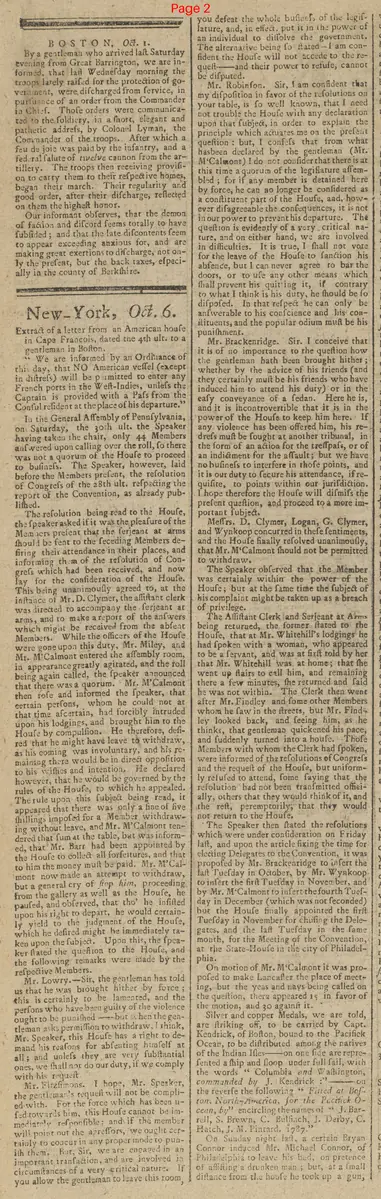
The resolution being read to the House, the Speaker asked if it was the pleasure of the Members present that the sergeant at arms should be sent to the seceding Members desiring their attendance in their places, and informing them of the resolution of Congress which had been received, and now lay for the consideration of the House.
This being unanimously agreed to, at the instance of Mr. D. Clymer, the assistant clerk was directed to accompany the sergeant at arms, and to make a report of the answers which might be received from the absent Members. While the officers of the House were gone upon this duty, Mr. Miley, and Mr. M'Calmont entered the assembly room, in appearance greatly agitated, and the roll being again called, the Speaker announced that there was a quorum. Mr. M'Calmont then rose and informed the Speaker, that certain persons, whom he could not at that time ascertain, had forcibly intruded upon his lodgings, and brought him to the House by compulsion. He therefore, desired that he might have leave to withdraw, as his coming was involuntary, and his remaining there would be in direct opposition to his wishes and intention. He declared however, that he would be governed by the rules of the House, to which he appealed.
The rule upon this subject being read, it appeared that there was only a fine of five shillings imposed for a Member withdrawing without leave, and Mr. M'Calmont tendered that sum at the table, but was informed, that Mr. Barr had been appointed by the House to collect all forfeitures, and that to him the money must be paid. Mr. M'Calmont now made an attempt to withdraw, but a general cry of "stop him," proceeding from the gallery as well as the House, he paused, and observed, that tho' he insisted upon his right to depart, he would certainly yield to the judgment of the House, which he desired might be immediately taken upon the subject. Upon this, the Speaker stated the question to the House, and the following remarks were made by the respective Members.
Mr. Lowry.--Sir, the gentleman has told us that he was brought hither by force; this is certainly to be lamented, and the persons who have been guilty of the violence ought to be punished--but as the gentleman asks permission to withdraw, I think, Mr. Speaker, this House has a right to demand his reasons for absenting himself at all; and unless they are very substantial ones, we shall not do our duty, if we comply with his request.
Mr. Fitzsimons. I hope, Mr. Speaker, the gentleman's request will not be complied with. For the force which has been used towards him, this House cannot be immediately responsible; and if the member will point out the actors, we ought certainly to concur in any proper mode to punish them. But, Sir, we are engaged in an important transaction, and are involved in circumstances of a very critical nature. If you allow the gentleman to leave this room you defeat the whole business of the legislature, and, in effect, put it in the power of an individual to dissolve the government. The alternative being so stated--I am confident the House will not accede to the request--and their power to refuse, cannot be disputed.
Mr. Robinson. Sir, I am confident that my disposition in favor of the resolutions on your table, is so well known, that I need not trouble the House with any declaration upon that subject, in order to explain the principle which actuates me on the present question: but, I confess that from what has been declared by the gentleman (Mr. M'Calmont) I do not consider that there is at this time a quorum of the legislature assembled; for if any member is detained here by force, he can no longer be considered as a constituent part of the House, and, however disagreeable the consequences, it is not in our power to prevent his departure. The question is evidently of a very critical nature, and on either hand, we are involved in difficulties. It is true, I shall not vote for the leave of the House to sanction his absence, but I can never agree to bar the doors, or to use any other means which shall prevent his quitting it, if contrary to what I think is his duty, he should be so disposed. In that respect he can only be answerable to his conscience and his constituents, and the popular odium must be his punishment.
Mr. Brackenridge. Sir. I conceive that it is of no importance to the question how the gentleman has been brought hither; whether by the advice of his friends (and they certainly must be his friends who have induced him to attend his duty) or in the easy conveyance of a sedan. Here he is, and it is incontrovertible that it is in the power of the House to keep him here. If any violence has been offered him, his redress must be sought at another tribunal, in the form of an action for the trespass, or of an indictment for the assault; but we have no business to interfere in those points. and it is our duty to secure his attendance. if requisite, to pains within our jurisdiction. I hope therefore the House will dismiss the present question, and proceed to a more important subject.
Messrs. D. Clymer, Logan, G. Clymer, and Wynkoop concurred in these sentiments, and the House finally resolved unanimously, that Mr. M'Calmont should not be permitted to withdraw.
The Speaker observed that the Member was certainly within the power of the House; but at the same time the subject of his complaint might be taken up as a breach of privilege.
The Assistant Clerk and Sergeant at Arms being returned, the former stated to the House, that at Mr. Whitehill's lodgings he had spoken with a woman, who appeared to be a servant, and was at first told by her that Mr. Whitehill was at home; that he went up stairs to call him, and remaining there a few minutes, she returned and said he was not within. The Clerk then went after Mr. Findley and some other Members whom he saw in the streets, but Mr. Findley looked back, and seeing him, as he thinks, that gentleman quickened his pace, and suddenly turned into a house. Those Members with whom the Clerk had spoken, were informed of the resolutions of Congress and the request of the House. but uniformly refused to attend, some saying that the resolution had not been transmitted officially, others that they would think of it, and the rest, peremptorily, "that they would not return to the House."
The Speaker then stated the resolutions which were under consideration on Friday last, and upon the article fixing the time for electing Delegates to the Convention, it was proposed by Mr. Brackenridge to insert the last Tuesday in October, by Mr. Wynkoop to insert the first Tuesday in November, and by Mr. M'Calmont to insert the fourth Tuesday in December (which was not seconded) but the House finally appointed the first Tuesday in November for choosing the Delegates, and the last Tuesday in the same month, for the Meeting of the Convention, at the State-House in the city of Philadelphia.
On motion of Mr. M'Calmont it was proposed to make Lancaster the place of meeting, but the yeas and nays being called on the question, there appeared 15 in favor of the motion, and 20 against it.
What sub-type of article is it?
What keywords are associated?
What entities or persons were involved?
Where did it happen?
Domestic News Details
Primary Location
Pennsylvania
Event Date
Saturday, The 20th Ult.
Key Persons
Outcome
mr. m'calmont denied permission to withdraw; first tuesday in november appointed for electing delegates; last tuesday in november for convention meeting at state-house in philadelphia; motion for lancaster rejected 15-20.
Event Details
The Assembly faced quorum issues with absent members. Officers summoned them, bringing Mr. M'Calmont forcibly. He sought to withdraw, paying a fine, but after debate on force used and legislative importance, the House unanimously refused. Report on other absentees noted refusals to return. Resolutions set election and convention dates in Philadelphia.