Thank you for visiting SNEWPapers!
Sign up free
Literary
January 21, 1859
Lewisburg Chronicle
Lewisburg, Union County, Pennsylvania
What is this article about?
At Madame Duffand's home, a birthday party for her daughter Henrietta faces a crisis when the pianist and violinist cannot attend. The young guests, unable to dance, improvise with parlor games like 'fans,' word games, and 'pigeon-hole' forfeits, turning the evening into merry fun until late.
Clipping
OCR Quality
95%
Excellent
Full Text
Translated from the French for the Lewisburg Chronicle.
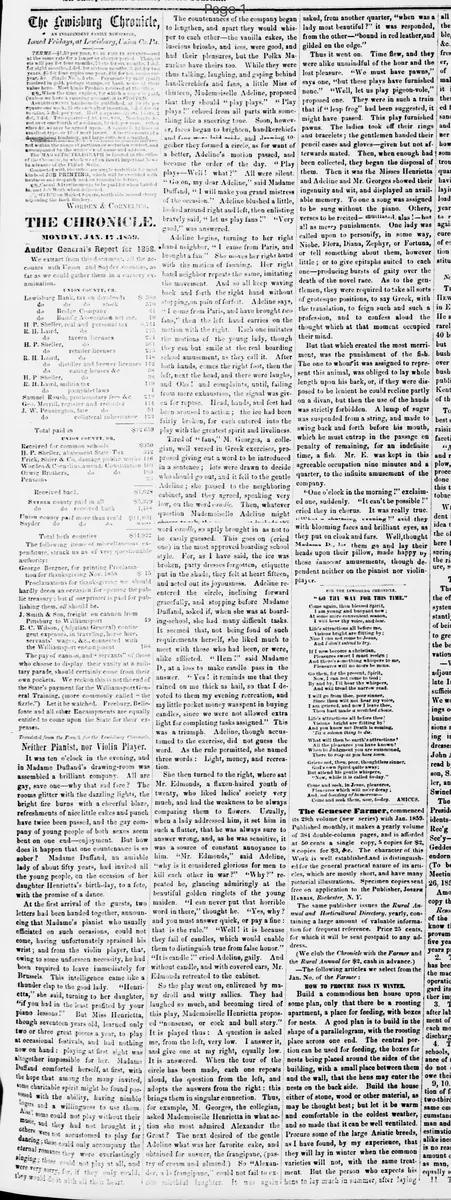
Neither Pianist, nor Violin Player.
It was ten o'clock in the evening, and in Madame Duffand's drawing-room was assembled a brilliant company. All are gay, save one-why that sad face? The rooms glitter with the dazzling lights, the bright fire burns with a cheerful blaze, refreshments of nice little cakes and punch have twice been passed, and the gay company of young people of both sexes seem bent on one end-enjoyment.
But how does it happen that one countenance is so sober? Madame Duffand, an amiable lady of about fifty years, had invited all the young people, on the occasion of her daughter Henrietta's birth-day, to a fete, with the promise of a dance.
At the first arrival of the guests, two letters had been handed together, announcing that Madame's pianist who usually officiated on such occasions, could not come, having unfortunately sprained his wrist; and from the violin player, that, owing to some unforeseen necessity, he had been required to leave immediately for Brussels. This intelligence came like a thunder clap to the good lady.
"Henrietta," she said, turning to her daughter, "if you had in the least profited by your piano lessons!"
But Miss Henrietta, though seventeen years old, learned only two or three great pieces a year, to play at occasional festivals, and had nothing now on hand: playing at first sight was altogether impossible for her. Madame Duffand comforted herself, at first, with the hope that among the many invited, some charitable spirit might be found possessed with the ability, having nimble fingers and a willingness to use them.
Alas! some could not play without their music, and they had not brought it; others were not accustomed to play for dancing; these could only accompany the eternal romance they were everlastingly singing; those could not play at all, and were very sorry, for, if they only could, they would do it with all their heart.
The countenances of the company began to lengthen, and apart they would whisper to each other-the vanilla cakes, the luscious brioches, and ices, were good, and had their pleasures, but the Polka Mazurkas have theirs too.
While they were thus talking, laughing, and gaping behind handkerchiefs and fans, a little Miss of thirteen, Mademoiselle Adeline, proposed that they should "play plays."
"Play plays!" echoed from all parts with something like a sneering tone. Soon, however, faces began to brighten, handkerchiefs and fans were laid aside, and drawing together they formed a circle, as for want of a better, Adeline's motion passed, and became the order of the day. "Play plays--Well! what?" All were silent.
"Go on, my dear Adeline," said Madame Duffand, "I will make you grand mistress of the occasion." Adeline blushed a little, looked around right and left, then enlisting bravely said, "let us play fans!" "Very good," was answered.
Adeline begins, turning to her right hand neighbor, "I came from Paris, and brought a fan" She moves her right hand with the motion of fanning. Her right hand neighbor repeats the same, imitating the movement. And so all keep waving back and forth the right hand without stopping, on pain of forfeit. Adeline says, "I come from Paris, and have brought two fans," then the left hand carries on the motion with the right. Each one imitates the motions of the young lady, though they can but smile at the real boarding school amusement, as they call it. After both hands, comes the right foot, then the left, next the head, and there were laughs, and Ohs! and complaints, until, failing from mere exhaustion, the signal was given for repose. Head, hands, and feet had been aroused to action: the ice had been fairly broken, for each entered into the play with the greatest spirit and liveliness.
Tired of "fans," M. Georges, a collegian, well versed in Greek exercises, proposed giving out a word to be introduced in a sentence; lots were drawn to decide who should go out, and it fell to the gentle Adeline; she passed to the neighboring cabinet, and they agreed, speaking very low, on the word candle. Then, whatever question Mademoiselle Adeline might ask, the answer must contain the word candle, so aptly brought in as not to be easily guessed. This goes on (cried one) in the most approved boarding school style. For, as I have said, the ice was broken, party dresses forgotten, etiquette put in the shade, they felt at heart fifteen, and acted out its joyousness. Adeline re-entered the circle, inclining forward gracefully, and stopping before Madame Duffand, asked if, when she was at boarding-school, she had many difficult tasks. It seemed that, not being fond of such requirements herself, she liked much to meet with those who had been, or were, alike afflicted.
"Hem!" said Madame D., at a loss to make candle pass in the answer. "Yes! it reminds me that they rained on me thick as hail, so that I devoted to them my evening recreation, and my little pocket money was spent in buying candles, since we were not allowed extra light for completing tasks assigned." This was a triumph. Adeline, though accustomed to the exercise, did not guess the word. As the rule permitted, she named three words: Light, money, and recreation.
She then turned to the right, where sat Mr. Edmonds, a flaxen-haired youth of twenty, who liked ladies' society very much, and had the weakness to be always comparing them to flowers. Usually, when a lady addressed him, it set him in such a flutter, that he was always sure to answer wrong, and, as he was sensitive, it was a source of constant annoyance to him. "Mr. Edmonds," said Adeline, "why is it considered glorious for men to kill each other in war?"
"Why?" repeated he, glancing admiringly at the beautiful golden ringlets of the young maiden. "I can never put that horrible word in there," thought he. "Yes, why? and you must answer quick, or pay a fine: that is the rule."
"Well! it is because they fail of candles, which would enable them to distinguish true from false honor."
"It is candle!" cried Adeline, gaily. And without candle, and with covered ears, Mr. Edmonds retreated to the cabinet.
So the play went on, enlivened by many droll and witty sallies. They had laughed so much, and becoming tired of this play, Mademoiselle Henrietta proposed "nonsense, or cock and bull story."
It is played thus: A question is asked me, from the left, very low. I answer it, and give one at my right, equally low. It is answered. When the tour of the circle has been made, each one repeats aloud, the question from the left, and adopts the answers from the right: this brings them in singular connection. Thus, for example, M. Georges, the collegian, asked Mademoiselle Henrietta in what action she most admired Alexander the Great? The next desired of the gentle Adeline what was her favorite cake, and obtained for answer, the frangipane, (pastry of cream and almond. So "Alexander, a la frangipane," could not fail to excite mirthful laughter. It was again asked, from another quarter, "when was a lady most beautiful?" it was responded, from the other-"bound in red leather, and gilded on the edge.
Thus it went on. Time flew, and they were alike unmindful of the hour and the lost pleasure.
"We must have pawns," says one, "but these plays have furnished none."
"Well, let us play pigeon-hole," proposed one. They were in such a train that if "leap frog" had been suggested, it might have passed. This play furnished pawns.
The ladies took off their rings and bracelets; the gentlemen handed their pencil cases and gloves-given but not afterwards redeemed. Then, when enough had been collected, they began the disposal of them. Then it was the Misses Henrietta and Adeline and Mr. Georges showed their ingenuity and wit, and displayed an available memory. To one a song was assigned to be sung without the piano. Others, verses to be recited-mutilated, alas!-but all as merry punishments. One lady was called upon to personify, in some way, Niobe, Flora, Diana, Zephyr, or Fortuna, or tell something about them, however little; or to give epitaphs suited to each one-producing bursts of gaiety over the death of the novel race. As to the gentlemen, they were required to take all sorts of grotesque positions, to say Greek, with the translation, to feign such and such a profession, and to confess aloud the thought which at that moment occupied their mind.
But that which created the most merriment, was the punishment of the fish. The one to whom it was assigned to represent this animal, was obliged to lay whole length upon his back, or, if they were disposed to be lenient he could recline partly on a divan, but then the use of the hands was strictly forbidden. A lump of sugar was suspended from a string, and made to swing back and forth before his mouth, which he must entrap in the passage on penalty of remaining, for an indefinite time, a fish. Mr. E. was kept in this agreeable occupation nine minutes and a quarter, to the infinite amusement of the company.
"One o'clock in the morning!" exclaimed one, suddenly.
"It can't be possible!" cried they in chorus.
It was really true. "A burning morning" said they with blooming faces and brilliant eyes, as they put on cloak and furs. Well, thought Madame D., let them go and lay their heads upon their pillow, made happy by those innocent amusements, though dependent neither on the pianist nor violin-player.
Neither Pianist, nor Violin Player.
It was ten o'clock in the evening, and in Madame Duffand's drawing-room was assembled a brilliant company. All are gay, save one-why that sad face? The rooms glitter with the dazzling lights, the bright fire burns with a cheerful blaze, refreshments of nice little cakes and punch have twice been passed, and the gay company of young people of both sexes seem bent on one end-enjoyment.
But how does it happen that one countenance is so sober? Madame Duffand, an amiable lady of about fifty years, had invited all the young people, on the occasion of her daughter Henrietta's birth-day, to a fete, with the promise of a dance.
At the first arrival of the guests, two letters had been handed together, announcing that Madame's pianist who usually officiated on such occasions, could not come, having unfortunately sprained his wrist; and from the violin player, that, owing to some unforeseen necessity, he had been required to leave immediately for Brussels. This intelligence came like a thunder clap to the good lady.
"Henrietta," she said, turning to her daughter, "if you had in the least profited by your piano lessons!"
But Miss Henrietta, though seventeen years old, learned only two or three great pieces a year, to play at occasional festivals, and had nothing now on hand: playing at first sight was altogether impossible for her. Madame Duffand comforted herself, at first, with the hope that among the many invited, some charitable spirit might be found possessed with the ability, having nimble fingers and a willingness to use them.
Alas! some could not play without their music, and they had not brought it; others were not accustomed to play for dancing; these could only accompany the eternal romance they were everlastingly singing; those could not play at all, and were very sorry, for, if they only could, they would do it with all their heart.
The countenances of the company began to lengthen, and apart they would whisper to each other-the vanilla cakes, the luscious brioches, and ices, were good, and had their pleasures, but the Polka Mazurkas have theirs too.
While they were thus talking, laughing, and gaping behind handkerchiefs and fans, a little Miss of thirteen, Mademoiselle Adeline, proposed that they should "play plays."
"Play plays!" echoed from all parts with something like a sneering tone. Soon, however, faces began to brighten, handkerchiefs and fans were laid aside, and drawing together they formed a circle, as for want of a better, Adeline's motion passed, and became the order of the day. "Play plays--Well! what?" All were silent.
"Go on, my dear Adeline," said Madame Duffand, "I will make you grand mistress of the occasion." Adeline blushed a little, looked around right and left, then enlisting bravely said, "let us play fans!" "Very good," was answered.
Adeline begins, turning to her right hand neighbor, "I came from Paris, and brought a fan" She moves her right hand with the motion of fanning. Her right hand neighbor repeats the same, imitating the movement. And so all keep waving back and forth the right hand without stopping, on pain of forfeit. Adeline says, "I come from Paris, and have brought two fans," then the left hand carries on the motion with the right. Each one imitates the motions of the young lady, though they can but smile at the real boarding school amusement, as they call it. After both hands, comes the right foot, then the left, next the head, and there were laughs, and Ohs! and complaints, until, failing from mere exhaustion, the signal was given for repose. Head, hands, and feet had been aroused to action: the ice had been fairly broken, for each entered into the play with the greatest spirit and liveliness.
Tired of "fans," M. Georges, a collegian, well versed in Greek exercises, proposed giving out a word to be introduced in a sentence; lots were drawn to decide who should go out, and it fell to the gentle Adeline; she passed to the neighboring cabinet, and they agreed, speaking very low, on the word candle. Then, whatever question Mademoiselle Adeline might ask, the answer must contain the word candle, so aptly brought in as not to be easily guessed. This goes on (cried one) in the most approved boarding school style. For, as I have said, the ice was broken, party dresses forgotten, etiquette put in the shade, they felt at heart fifteen, and acted out its joyousness. Adeline re-entered the circle, inclining forward gracefully, and stopping before Madame Duffand, asked if, when she was at boarding-school, she had many difficult tasks. It seemed that, not being fond of such requirements herself, she liked much to meet with those who had been, or were, alike afflicted.
"Hem!" said Madame D., at a loss to make candle pass in the answer. "Yes! it reminds me that they rained on me thick as hail, so that I devoted to them my evening recreation, and my little pocket money was spent in buying candles, since we were not allowed extra light for completing tasks assigned." This was a triumph. Adeline, though accustomed to the exercise, did not guess the word. As the rule permitted, she named three words: Light, money, and recreation.
She then turned to the right, where sat Mr. Edmonds, a flaxen-haired youth of twenty, who liked ladies' society very much, and had the weakness to be always comparing them to flowers. Usually, when a lady addressed him, it set him in such a flutter, that he was always sure to answer wrong, and, as he was sensitive, it was a source of constant annoyance to him. "Mr. Edmonds," said Adeline, "why is it considered glorious for men to kill each other in war?"
"Why?" repeated he, glancing admiringly at the beautiful golden ringlets of the young maiden. "I can never put that horrible word in there," thought he. "Yes, why? and you must answer quick, or pay a fine: that is the rule."
"Well! it is because they fail of candles, which would enable them to distinguish true from false honor."
"It is candle!" cried Adeline, gaily. And without candle, and with covered ears, Mr. Edmonds retreated to the cabinet.
So the play went on, enlivened by many droll and witty sallies. They had laughed so much, and becoming tired of this play, Mademoiselle Henrietta proposed "nonsense, or cock and bull story."
It is played thus: A question is asked me, from the left, very low. I answer it, and give one at my right, equally low. It is answered. When the tour of the circle has been made, each one repeats aloud, the question from the left, and adopts the answers from the right: this brings them in singular connection. Thus, for example, M. Georges, the collegian, asked Mademoiselle Henrietta in what action she most admired Alexander the Great? The next desired of the gentle Adeline what was her favorite cake, and obtained for answer, the frangipane, (pastry of cream and almond. So "Alexander, a la frangipane," could not fail to excite mirthful laughter. It was again asked, from another quarter, "when was a lady most beautiful?" it was responded, from the other-"bound in red leather, and gilded on the edge.
Thus it went on. Time flew, and they were alike unmindful of the hour and the lost pleasure.
"We must have pawns," says one, "but these plays have furnished none."
"Well, let us play pigeon-hole," proposed one. They were in such a train that if "leap frog" had been suggested, it might have passed. This play furnished pawns.
The ladies took off their rings and bracelets; the gentlemen handed their pencil cases and gloves-given but not afterwards redeemed. Then, when enough had been collected, they began the disposal of them. Then it was the Misses Henrietta and Adeline and Mr. Georges showed their ingenuity and wit, and displayed an available memory. To one a song was assigned to be sung without the piano. Others, verses to be recited-mutilated, alas!-but all as merry punishments. One lady was called upon to personify, in some way, Niobe, Flora, Diana, Zephyr, or Fortuna, or tell something about them, however little; or to give epitaphs suited to each one-producing bursts of gaiety over the death of the novel race. As to the gentlemen, they were required to take all sorts of grotesque positions, to say Greek, with the translation, to feign such and such a profession, and to confess aloud the thought which at that moment occupied their mind.
But that which created the most merriment, was the punishment of the fish. The one to whom it was assigned to represent this animal, was obliged to lay whole length upon his back, or, if they were disposed to be lenient he could recline partly on a divan, but then the use of the hands was strictly forbidden. A lump of sugar was suspended from a string, and made to swing back and forth before his mouth, which he must entrap in the passage on penalty of remaining, for an indefinite time, a fish. Mr. E. was kept in this agreeable occupation nine minutes and a quarter, to the infinite amusement of the company.
"One o'clock in the morning!" exclaimed one, suddenly.
"It can't be possible!" cried they in chorus.
It was really true. "A burning morning" said they with blooming faces and brilliant eyes, as they put on cloak and furs. Well, thought Madame D., let them go and lay their heads upon their pillow, made happy by those innocent amusements, though dependent neither on the pianist nor violin-player.
What sub-type of article is it?
Prose Fiction
What themes does it cover?
Social Manners
What keywords are associated?
Birthday Party
Social Games
Improvised Entertainment
Boarding School Plays
Innocent Amusements
What entities or persons were involved?
Translated From The French
Literary Details
Title
Neither Pianist, Nor Violin Player.
Author
Translated From The French
Subject
Henrietta's Birthday Fete
Key Lines
It Was Ten O'clock In The Evening, And In Madame Duffand's Drawing Room Was Assembled A Brilliant Company.
Madame Duffand, An Amiable Lady Of About Fifty Years, Had Invited All The Young People, On The Occasion Of Her Daughter Henrietta's Birth Day, To A Fete, With The Promise Of A Dance.
Adeline Begins, Turning To Her Right Hand Neighbor, "I Came From Paris, And Brought A Fan" She Moves Her Right Hand With The Motion Of Fanning.
"It Is Candle!" Cried Adeline, Gaily.
Well, Thought Madame D., Let Them Go And Lay Their Heads Upon Their Pillow, Made Happy By Those Innocent Amusements, Though Dependent Neither On The Pianist Nor Violin Player.