Thank you for visiting SNEWPapers!
Sign up free
The Louisiana Democrat
Alexandria, Rapides County, Louisiana
What is this article about?
Two French inventors, M. Clemendot and M. Baillehache, developed electrical railway signaling systems tested on French lines. Clemendot's uses rail resistances and train wheels for safer signaling; Baillehache's employs an insulated counter rail to signal train presence, speed, and length. Prizes awarded for their merits.
Clipping
OCR Quality
Full Text
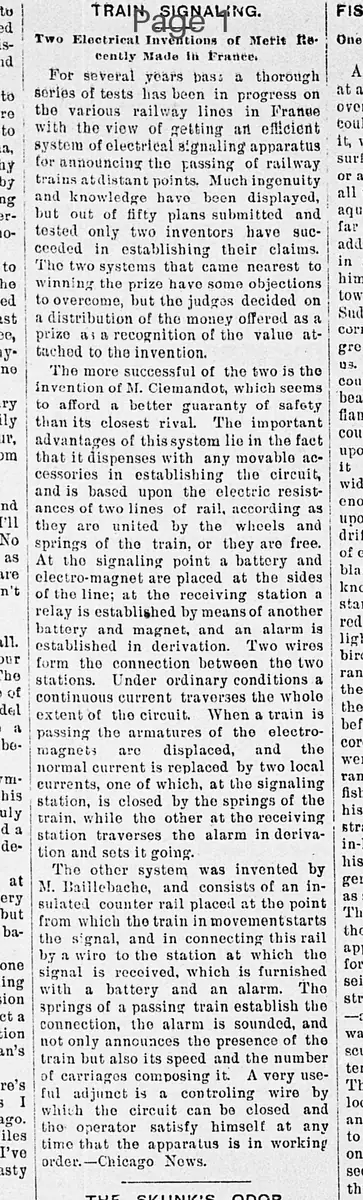
For several years past a thorough series of tests has been in progress on the various railway lines in France with the view of getting an efficient system of electrical signaling apparatus for announcing the passing of railway trains at distant points. Much ingenuity and knowledge have been displayed, but out of fifty plans submitted and tested only two inventors have succeeded in establishing their claims.
The two systems that came nearest to winning the prize have some objections to overcome, but the judges decided on a distribution of the money offered as a prize as a recognition of the value attached to the invention.
The more successful of the two is the invention of M. Clemendot, which seems to afford a better guaranty of safety than its closest rival. The important advantages of this system lie in the fact that it dispenses with any movable accessories in establishing the circuit, and is based upon the electric resistances of two lines of rail, according as they are united by the wheels and springs of the train, or they are free.
At the signaling point a battery and electro-magnet are placed at the sides of the line; at the receiving station a relay is established by means of another battery and magnet, and an alarm is established in derivation. Two wires form the connection between the two stations. Under ordinary conditions a continuous current traverses the whole extent of the circuit. When a train is passing the armatures of the electro-magnets are displaced, and the normal current is replaced by two local currents, one of which, at the signaling station, is closed by the springs of the train, while the other at the receiving station traverses the alarm in derivation and sets it going.
The other system was invented by M. Baillehache, and consists of an insulated counter rail placed at the point from which the train in movement starts the signal, and in connecting this rail by a wire to the station at which the signal is received, which is furnished with a battery and an alarm. The springs of a passing train establish the connection, the alarm is sounded, and not only announces the presence of the train but also its speed and the number of carriages composing it. A very useful adjunct is a controlling wire by which the circuit can be closed and the operator satisfy himself at any time that the apparatus is in working order.-Chicago News.
What sub-type of article is it?
What themes does it cover?
What keywords are associated?
What entities or persons were involved?
Where did it happen?
Story Details
Key Persons
Location
Railway Lines In France
Event Date
Several Years Past
Story Details
Tests on French railways led to prizes for two electrical signaling inventions: M. Clemendot's system using rail resistances and train wheels for safe circuit changes triggering alarms; M. Baillehache's with insulated counter rail signaling train presence, speed, and length via connections.