Thank you for visiting SNEWPapers!
Sign up free
Vermont Telegraph
Brandon, Rutland County, Vermont
What is this article about?
The Vermont Anti-Slavery Society held a convention in Manchester on September 25-26, 1839, electing officers, adopting resolutions condemning slavery, discussing its moral and political implications, and concluding with prayers and lectures. A letter from Hon. W. R. Ranney was incorporated.
Clipping
OCR Quality
Full Text
BRANDON, WEDNESDAY, OCT. 9, 1839.
For the Vermont Telegraph.
ANTI-SLAVERY CONVENTION.
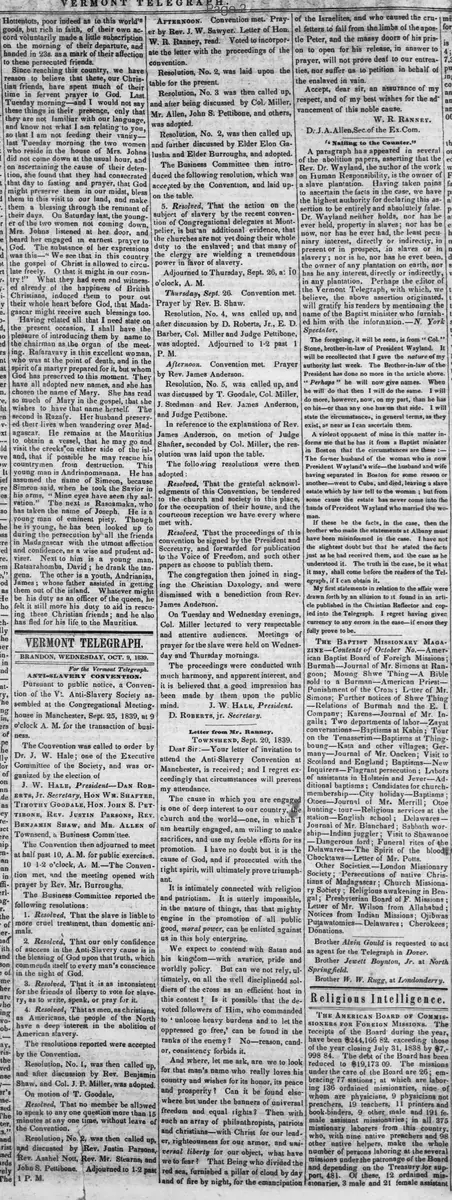
Pursuant to public notice, a Convention of the V. Anti-Slavery Society assembled at the Congregational Meeting-house in Manchester, Sept. 25, 1839, at 9 o'clock A. M. for the transaction of business.
The Convention was called to order by Dr. J. W. Hale; one of the Executive Committee of the Society, and was organized by the election of J. W. Hale, President—Daniel Roberts, Jr. Secretary, Hon. Wm. Shafter, Timothy Goodale, Hon. John S. Pettibone, Rev. Justin Parsons, Rev. Benjamin Shaw, and Mr. Allen of Townsend, a Business Committee.
The Convention then adjourned to meet at half past 10, A. M. for public exercises.
10 1-2 o'clock, A. M.—The Convention met, and the meeting opened with prayer by Rev. Mr. Burroughs.
The Business Committee reported the following resolutions:
1. Resolved, That the slave is liable to more cruel treatment, than domestic animals.
2. Resolved, That our only confidence of success in the Anti-Slavery cause is in the blessing of God upon that truth, which commends itself to every man's conscience in the sight of God.
3. Resolved, That it is as inconsistent for the friends of liberty to vote for slavery, as to write, speak, or pray for it.
4. Resolved, That as men, as christians, as Americans, the people of the North have a deep interest in the abolition of American slavery.
The resolutions reported were accepted by the Convention.
Resolution, No. 1, was then called up, and after discussion by Rev. Benjamin Shaw, and Col. J. P. Miller, was adopted.
On motion of T. Goodale,
Resolved, That no member be allowed to speak to any one question more than 15 minutes at any one time, without leave of the Convention.
Resolution, No. 2, was then called up, and discussed by Rev. Justin Parsons, Rev. Asahel Nott, Rev. Mr. Stearns, and John S. Pettibone. Adjourned to 1-2 past 1 P.M.
Afternoon. Convention met. Prayer by Rev. J. W. Sawyer. Letter of Hon. W. R. Ranney, read. Voted to incorporate the letter with the proceedings of the convention.
Resolution, No. 2, was laid upon the table for the present.
Resolution, No. 3 was then called up, and after being discussed by Col. Miller, Mr. Allen, John S. Pettibone, and others, was adopted.
Resolution, No. 2, was then called up, and further discussed by Elder Elon Galusha and Elder Burroughs, and adopted.
The Business Committee then introduced the following resolution, which was accepted by the Convention, and laid upon the table.
5. Resolved, That the action on the subject of slavery by the recent convention of Congregational delegates at Montpelier, is but an additional evidence, that the churches are not yet doing their whole duty to the enslaved; and that many of the clergy are wielding a tremendous power in favor of slavery.
Adjourned to Thursday, Sept. 26, at 10 o'clock, A. M.
Thursday, Sept. 26.
Convention met. Prayer by Rev. B. Shaw.
Resolution, No. 4. was called up, and after discussion by D. Roberts, Jr., E. D. Barber, Col. Miller and Judge Pettibone, was adopted. Adjourned to 1-2 past 1 P. M.
Afternoon. Convention met. Prayer by Rev. James Anderson.
Resolution, No. 5, was called up, and was discussed by T. Goodale, Col. Miller, J. Stedman and Rev. James Anderson, and Judge Pettibone.
In reference to the explanations of Rev. James Anderson, on motion of Judge Shafter, seconded by Col. Miller, the resolution was laid upon the table.
The following resolutions were then adopted:
Resolved, That the grateful acknowledgments of this Convention, be tendered to the church and society in this place, for the occupation of their house, and the courteous reception we have every where met with.
Resolved, That the proceedings of this convention be signed by the President and Secretary, and forwarded for publication to the Voice of Freedom, and such other papers as choose to publish them.
The congregation then joined in singing the Christian Doxology, and were dismissed with a benediction from Rev. James Anderson.
On Tuesday and Wednesday evenings, Col. Miller lectured to very respectable and attentive audiences. Meetings of prayer for the slave were held on Wednesday and Thursday mornings.
The proceedings were conducted with much harmony, and apparent interest, and it is believed that a good impression has been made by them upon the public mind.
J. W. HALE, President.
D. ROBERTS, jr. Secretary.
Letter from Mr. Ranney
TOWNSHEND, Sept. 20, 1839.
Dear Sir:—Your letter of invitation to attend the Anti-Slavery Convention at Manchester, is received; and I regret exceedingly that circumstances will prevent my attendance.
The cause in which you are engaged is one of deep interest to our country, the church and the world—one, in which I am heartily engaged, am willing to make sacrifices, and use my feeble efforts for its promotion. I have no doubt but it is the cause of God, and if prosecuted with the right spirit, will ultimately prove triumphant.
It is intimately connected with religion and patriotism. It is utterly impossible, in the nature of things, that that mighty engine in the promotion of all public good, moral power, can be enlisted against us in this holy enterprise.
We expect to contend with Satan and his kingdom—with avarice, pride and worldly policy. But can we not rely, ultimately, on all the well disciplined soldiers of the cross as an efficient host in this contest? Is it possible that the devoted followers of Him, who commanded to 'unloose heavy burdens and to let the oppressed go free,' can be found in the ranks of the enemy? No—reason, candor, consistency forbids it.
And where, let me ask, are we to look for that man's name who really loves his country and wishes for its honor, its peace and prosperity? Can it be found elsewhere but under the banners of universal freedom and equal rights? Then with such an array of philanthropists, patriots and christians—with Christ for our leader, righteousness for our armor, and universal liberty for our object, what have we to fear? That Being who divided the red sea, furnished a pillar of cloud by day and of fire by night, for the emancipation of the Israelites, and who caused the cruel fetters to fall from the limbs of the apostle Peter, and the massy doors of his prison to open for his release, in answer to prayer, will not prove deaf to our entreaties, nor suffer us to petition in behalf of the enslaved in vain.
Accept, dear sir, an assurance of my respect, and of my best wishes for the advancement of this noble cause.
What sub-type of article is it?
What keywords are associated?
What entities or persons were involved?
Where did it happen?
Domestic News Details
Primary Location
Manchester, Vermont
Event Date
Sept. 25 26, 1839
Key Persons
Outcome
resolutions adopted condemning slavery and calling for northern involvement in abolition; proceedings conducted harmoniously with positive public impression; lectures and prayer meetings held.
Event Details
The Vermont Anti-Slavery Society convention assembled at the Congregational Meeting-house in Manchester, elected officers including President J. W. Hale and Secretary Daniel Roberts, Jr., reported and discussed five resolutions on slavery's cruelty, reliance on divine blessing, inconsistency of voting for slavery, northern interest in abolition, and churches' insufficient action against slavery. Resolutions 1-4 adopted; Resolution 5 tabled. Included prayers, a letter from Hon. W. R. Ranney, lectures by Col. Miller, and prayer meetings for slaves.