Thank you for visiting SNEWPapers!
Sign up free
Editorial
August 25, 1838
The Madisonian
Washington, District Of Columbia
What is this article about?
Editorial in Poughkeepsie Journal denounces Martin Van Buren for betraying Democratic Republican principles via party discipline and Loco-foco alliances, urging adherence to Jefferson and Jackson's limits on executive power against consolidation and self-aggrandizement.
Clipping
OCR Quality
98%
Excellent
Full Text
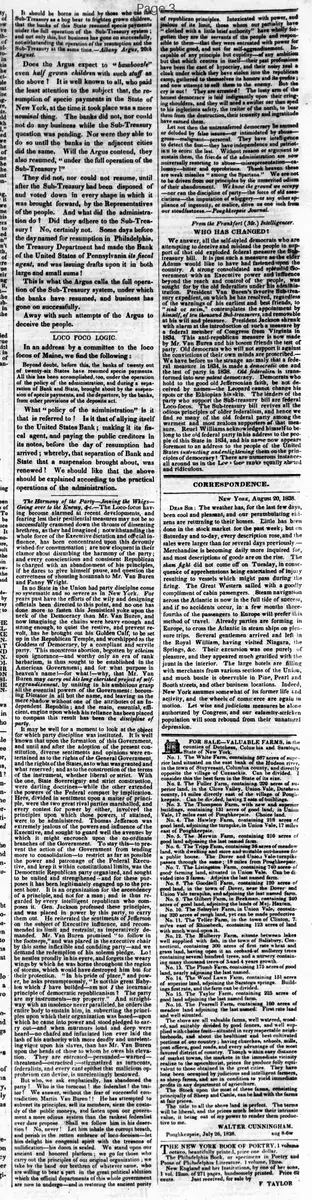
The Harmony of the Party—Joining the Whigs—Going over to the Enemy, &c.—The Loco-focos having become alarmed at recent developments, and fearing lest their pestilential measures may not be so successfully crammed down the throats of dissenting brethren, as they had imagined; notwithstanding the whole force of the Executive dictation and official influence, has been concentrated upon this devoutly wished-for consummation; are now eloquent in their clamor about disturbing the harmony of the party; and every conscientious and consistent Republican is charged with an abandonment of his principles, if he dares to give himself pause, and question the correctness of shouting hosannah to Mr. Van Buren and Fanny Wright.
In no State in the Union had party discipline come so systematic and so severe as in New York. For years past have the efforts of the wily and designing officials been directed to this point, and no one has done more to fasten this Jesuistical yoke upon the neck of the Democracy than Mr. Van Buren, and now imagining the chains were heavy enough and strong enough, to quiet the restive, and prevent revolt, has he brought out his Golden Calf, to be set up in the Republican Temple, and worshipped as the Goddess of Democracy, by a compliant and servile party. This monstrous abortion, begotten by atheism upon ignorance—and worthy only an era of rank barbarism, is thus sought to be established in the American Government; and for what purpose in heaven's name!—for what!—why, that Mr. Van Buren may carry out his long cherished project of self-aggrandizement, by uniting in his ambitious grasp all the essential powers of the Government: becoming Dictator in all but the name, and leaving us the mere shadow without one of the attributes of an Independent Republic; and the main, essential, efficient, engine upon which his reliance has been placed to compass this result has been the discipline of party.
It may be well for a moment to look at the object for which party discipline was instituted. It is well known that upon the formation of this Government, and until and after the adoption of the present constitution, diverse sentiments and opinions were entertained as to the rights of the General Government, and the rights of the States, as to what was granted and what reserved; and as to the construction of the terms of the instrument, whether liberal or strict. With the one, State Sovereignty and strict construction were darling doctrines—while the other extended the powers of the Federal compact by implication.
Here, divided in sentiment upon a matter of principle, were the two great rival parties marshalled, and every contest for power by either, involved the principles upon which those powers, if attained, were to be administered. Thomas Jefferson was extremely jealous of the powers and influence of the Executive, and sought to guard well the avenues by which it might encroach upon the co-ordinate branches of the Government. To stay this—to prevent the action of the Government from tending more to consolidation—to restrict as far as possible the power and patronage of the Federal Executive, and keep it within constitutional limits, was the Democratic Republican party organized, and sought to be united and strengthened—and for these purposes it has been legitimately engaged up to the present hour. It is an organization for the ascendency of a principle, and not for a man; and is thus regarded by every intelligent republican who composes it. Gen. Jackson professed these principles, and was placed in power by this party, to carry them out. "He reiterated the sentiments of Jefferson on the subject of Executive influence, and recommended its limit and restraint, as imperatively demanded. Mr. Van Buren promised "to follow in the footsteps." and was placed in the executive chair by this same inflexible and confiding party—and we demand the redemption of his solemn pledge. Lo! he nestles proudly in his eyrie, and forgets the weary wings by which he was borne throughout the region of storms, which would have destroyed him but for their protection. "In his pride of place," and power, he asks presumptuously, "Is not this great Babylon which I have builded—am not I the incarnate principle of democratic republicanism? The party are my instruments—my property." And straightway with an insolence never paralleled, he orders the entire body to sustain him, in subverting the principles upon which their organization was based—upon which he came into power and stood pledged to carry out—and when murmurs loud and deep were heard—no chafed and infuriated lion ever laid the lash of his authority with more deadly and unrelenting vigor upon his slaves, than has Mr. Van Buren upon the heads of those to whom he owes his elevation. They are entreated—persuaded—warned—threatened—ostracised; stigmatized as turncoats, federalists, and every cant epithet that malicious opprobrium can devise, is unrelentingly bestowed.
But who, we ask emphatically, has abandoned the party! Who is the turncoat? the federalist? the traitor? We answer, without the fear of successful contradiction Martin Van Buren!! He—has attempted to subvert its principles. sell its members, seize the custody of the public moneys, and fasten upon our government a more odious system than the rankest federalist ever dare propose. Shall we follow him in his desertion! No, never! Let him inhale the corrupt breath, and perish in the rotten embrace of loco-focoism—let him delight his congenial spirit with the treasons of nullification—his doom is sealed. We stand upon our ancient and honored platform; we go for those who carry out the principles of our original organization; we take by the hand our brethren of whatever name, who are willing to bear a part in the great political ablution which the official departments of this whole government are now to undergo—and in restoring the ancient purity of republican principles. Intoxicated with power, and jealous of its limit, those whom our partiality have "clothed with a little brief authority" have wholly forgotten they are the servants of the people and responsible to them—that they were entrusted with power for the public good, and not for self-aggrandizement.
Incapable of any principle but cupidity—of any ambition but that which centres in itself—their past professions have been the cant of hypocrisy, and their noisy zeal the cloak under which they have stolen into the republican camp, gathered to themselves its honors and its profits; and now attempt to sell them to the enemy.
But the cry is out! They are arrested! The lusty arm of the honest democracy is laid indignantly upon their cringing shoulders, and they will need a swifter oar than sped to his inglorious safety, the traitor of the north, to bear them from the destruction, their temerity and ingratitude have earned them.
Let not then the untransferred democracy be amazed or deluded by false issues—or intimidated by abuse—gross—malignant—personal. They have intelligence to detect the first—they have independence and patriotism to scorn the last.
Without reason or argument to sustain them, the friends of the administration are now universally resorting to abuse—misrepresentation—calumny—bitter and opprobrious. Thank heaven these are weak missiles "among the Spartans."
We are not to be driven from our principles by the unmerited odium of their abandonment." We know the ground we occupy—nor can the discipline of party—the force of old associations—the imputation of whiggery—or any other appliance of ingenuity, or malice, drive us one inch from our steadfastness.—Poughkeepsie Journal.
In no State in the Union had party discipline come so systematic and so severe as in New York. For years past have the efforts of the wily and designing officials been directed to this point, and no one has done more to fasten this Jesuistical yoke upon the neck of the Democracy than Mr. Van Buren, and now imagining the chains were heavy enough and strong enough, to quiet the restive, and prevent revolt, has he brought out his Golden Calf, to be set up in the Republican Temple, and worshipped as the Goddess of Democracy, by a compliant and servile party. This monstrous abortion, begotten by atheism upon ignorance—and worthy only an era of rank barbarism, is thus sought to be established in the American Government; and for what purpose in heaven's name!—for what!—why, that Mr. Van Buren may carry out his long cherished project of self-aggrandizement, by uniting in his ambitious grasp all the essential powers of the Government: becoming Dictator in all but the name, and leaving us the mere shadow without one of the attributes of an Independent Republic; and the main, essential, efficient, engine upon which his reliance has been placed to compass this result has been the discipline of party.
It may be well for a moment to look at the object for which party discipline was instituted. It is well known that upon the formation of this Government, and until and after the adoption of the present constitution, diverse sentiments and opinions were entertained as to the rights of the General Government, and the rights of the States, as to what was granted and what reserved; and as to the construction of the terms of the instrument, whether liberal or strict. With the one, State Sovereignty and strict construction were darling doctrines—while the other extended the powers of the Federal compact by implication.
Here, divided in sentiment upon a matter of principle, were the two great rival parties marshalled, and every contest for power by either, involved the principles upon which those powers, if attained, were to be administered. Thomas Jefferson was extremely jealous of the powers and influence of the Executive, and sought to guard well the avenues by which it might encroach upon the co-ordinate branches of the Government. To stay this—to prevent the action of the Government from tending more to consolidation—to restrict as far as possible the power and patronage of the Federal Executive, and keep it within constitutional limits, was the Democratic Republican party organized, and sought to be united and strengthened—and for these purposes it has been legitimately engaged up to the present hour. It is an organization for the ascendency of a principle, and not for a man; and is thus regarded by every intelligent republican who composes it. Gen. Jackson professed these principles, and was placed in power by this party, to carry them out. "He reiterated the sentiments of Jefferson on the subject of Executive influence, and recommended its limit and restraint, as imperatively demanded. Mr. Van Buren promised "to follow in the footsteps." and was placed in the executive chair by this same inflexible and confiding party—and we demand the redemption of his solemn pledge. Lo! he nestles proudly in his eyrie, and forgets the weary wings by which he was borne throughout the region of storms, which would have destroyed him but for their protection. "In his pride of place," and power, he asks presumptuously, "Is not this great Babylon which I have builded—am not I the incarnate principle of democratic republicanism? The party are my instruments—my property." And straightway with an insolence never paralleled, he orders the entire body to sustain him, in subverting the principles upon which their organization was based—upon which he came into power and stood pledged to carry out—and when murmurs loud and deep were heard—no chafed and infuriated lion ever laid the lash of his authority with more deadly and unrelenting vigor upon his slaves, than has Mr. Van Buren upon the heads of those to whom he owes his elevation. They are entreated—persuaded—warned—threatened—ostracised; stigmatized as turncoats, federalists, and every cant epithet that malicious opprobrium can devise, is unrelentingly bestowed.
But who, we ask emphatically, has abandoned the party! Who is the turncoat? the federalist? the traitor? We answer, without the fear of successful contradiction Martin Van Buren!! He—has attempted to subvert its principles. sell its members, seize the custody of the public moneys, and fasten upon our government a more odious system than the rankest federalist ever dare propose. Shall we follow him in his desertion! No, never! Let him inhale the corrupt breath, and perish in the rotten embrace of loco-focoism—let him delight his congenial spirit with the treasons of nullification—his doom is sealed. We stand upon our ancient and honored platform; we go for those who carry out the principles of our original organization; we take by the hand our brethren of whatever name, who are willing to bear a part in the great political ablution which the official departments of this whole government are now to undergo—and in restoring the ancient purity of republican principles. Intoxicated with power, and jealous of its limit, those whom our partiality have "clothed with a little brief authority" have wholly forgotten they are the servants of the people and responsible to them—that they were entrusted with power for the public good, and not for self-aggrandizement.
Incapable of any principle but cupidity—of any ambition but that which centres in itself—their past professions have been the cant of hypocrisy, and their noisy zeal the cloak under which they have stolen into the republican camp, gathered to themselves its honors and its profits; and now attempt to sell them to the enemy.
But the cry is out! They are arrested! The lusty arm of the honest democracy is laid indignantly upon their cringing shoulders, and they will need a swifter oar than sped to his inglorious safety, the traitor of the north, to bear them from the destruction, their temerity and ingratitude have earned them.
Let not then the untransferred democracy be amazed or deluded by false issues—or intimidated by abuse—gross—malignant—personal. They have intelligence to detect the first—they have independence and patriotism to scorn the last.
Without reason or argument to sustain them, the friends of the administration are now universally resorting to abuse—misrepresentation—calumny—bitter and opprobrious. Thank heaven these are weak missiles "among the Spartans."
We are not to be driven from our principles by the unmerited odium of their abandonment." We know the ground we occupy—nor can the discipline of party—the force of old associations—the imputation of whiggery—or any other appliance of ingenuity, or malice, drive us one inch from our steadfastness.—Poughkeepsie Journal.
What sub-type of article is it?
Partisan Politics
Constitutional
What keywords are associated?
Van Buren Criticism
Party Discipline
Democratic Principles
Executive Overreach
Loco Focos
Republican Purity
What entities or persons were involved?
Martin Van Buren
Thomas Jefferson
Gen. Jackson
Loco Focos
Fanny Wright
Whigs
Executive
Editorial Details
Primary Topic
Criticism Of Van Buren For Subverting Democratic Republican Principles Through Party Discipline
Stance / Tone
Strongly Anti Van Buren And Pro Original Jeffersonian Republican Ideals
Key Figures
Martin Van Buren
Thomas Jefferson
Gen. Jackson
Loco Focos
Fanny Wright
Whigs
Executive
Key Arguments
Loco Focos Fear Loss Of Party Harmony Due To Dissent Against Their Measures
Van Buren Uses Party Discipline To Impose His Self Aggrandizing Agenda
Democratic Party Organized To Limit Executive Power And Prevent Consolidation
Van Buren Has Abandoned Principles By Allying With Atheism And Ignorance
True Republicans Must Uphold Original Principles Against Van Buren's Betrayal
Administration Resorts To Abuse And Calumny To Maintain Control