Thank you for visiting SNEWPapers!
Sign up free
The New Hampshire Gazette
Portsmouth, Rockingham County, New Hampshire
What is this article about?
Pondicherry, capital of the French East India Company on the Coromandel Coast, surrendered to the English on January 17. The report details its strategic location, fortifications with 400 cannons, population of 120,000, key buildings like the governor's palace and Jesuit convent, and thriving trade in piece-goods, silk, spices, and diamonds.
Clipping
OCR Quality
Full Text
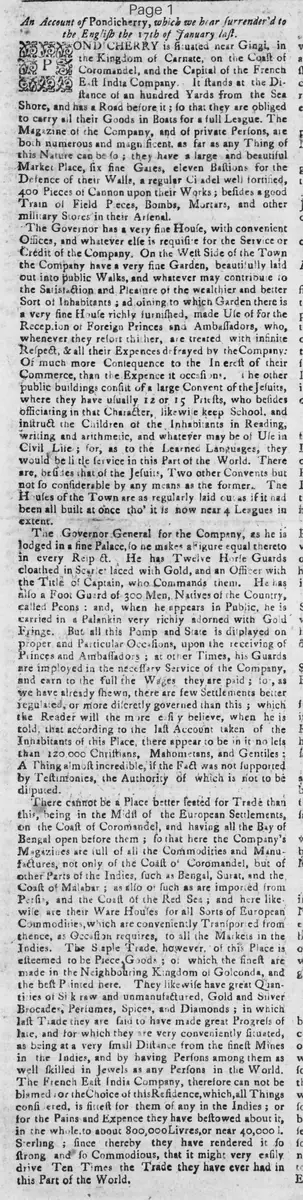
Pondicherry is situated near Gingi in the Kingdom of Carnate, on the Coast of Coromandel, and the Capital of the French East India Company. It stands at the Distance of an hundred Yards from the Sea Shore, and has a Road before it: so that they are obliged to carry all their Goods in Boats for a full League. The Magazine of the Company, and of private Persons, are both numerous and magnificent, as far as any Thing of this Nature can be so; they have a large and beautiful Market Place, six fine Gates, eleven Bastions for the Defence of their Walls, a regular Citadel well fortified, 400 Pieces of Cannon upon their Works; besides a good Train of Field Pieces, Bombs, Mortars, and other military Stores in their Arsenal.
The Governor has a very fine House, with convenient Offices, and whatever else is requisite for the Service or Credit of the Company. On the West Side of the Town the Company have a very fine Garden, beautifully laid Out into Public Walks, and whatever may contribute to the Satisfaction and Pleasure of the wealthier and better Sort of Inhabitants; adjoining to which Garden there is a very fine House richly furnished, made Use of for the Reception of Foreign Princes and Ambassadors, who, whenever they resort thither, are treated with infinite Respect, & all their Expences defrayed by the Company: Of much more Consequence to the Interest of their Commerce, than the Expence it occasions. The other public buildings consist of a large Convent of the Jesuits, where they have usually 12 or 15 Priests, who besides officiating in that Character, likewise keep School, and instruct the Children of the Inhabitants in Reading, writing and arithmetic, and whatever may be of Use in Civil Life; for, as to the Learned Languages, they would be little service in this Part of the World. There are, besides that of the Jesuits, Two other Convents but not so considerable by any means as the former. The Rules of the Town are as regularly laid out as if it had been all built at once tho' it is now near 4 Leagues in extent.
The Governor General for the Company, as he is lodged in a fine Palace, so he makes a Figure equal thereto in every Respect. He has Twelve Horse Guards cloathed in Scarlet laced with Gold, and an Officer with the Title Of Captain, who Commands them. He has also a Foot Guard of 200 Men, Natives of the Country, called Peons: and, when he appears in Public, he is carried in a Palankin very richly adorned with Gold Fringe. But all this Pomp and State is displayed on proper and Particular Occasions, upon the receiving of Princes and Ambassadors; at other Times, his Guards are imployed in the necessary Service of the Company, and earn to the full the Wages they are paid; for, as we have already shewn, there are few Settlements better regulated, or more discreetly governed than this; which the Reader will the more easily believe, when he is told, that according to the last Account taken of the Inhabitants of this Place, there appear to be in it no less than 120,000 Christians, Mahometans, and Gentiles: A Thing almost incredible, if the Fact was not supported by Testimonies, the Authority of which is not to be disputed.
There cannot be a Place better seated for Trade than this, being in the Midst of the European Settlements, on the Coast of Coromandel, and having all the Bay of Bengal open before them; so that here the Company's Magazines are full of all the Commodities and Manufactures, not only of the Coast of Coromandel, but of other Parts of the Indies, such as Bengal, Surat, and the Coast of Malabar; as also of such as are imported from Persia, and the Coast of the Red Sea; and here likewise are their Ware Houses for all Sorts of European Commodities, which are conveniently Transported from thence, as Occasion requires, to all the Markets in the Indies. The Staple Trade, however, of this Place is esteemed to be Piece-Goods; of which the finest are made in the Neighbouring Kingdom of Golconda, and the best Printed here. They likewise have great Quantities of Silk raw and unmanufactured, Gold and Silver Brocades, Perianes, Spices, and Diamonds; in which last Trade they are said to have made great Progress of late, and for which they are very conveniently situated, as being at a very small Distance from the finest Mines in the Indies, and by having Persons among them as well skilled in Jewels as any Persons in the World.
The French East India Company, therefore can not be blamed for the Choice of this Residence, which, all Things considered, is fittest for them of any in the Indies; or for the Pains and Expence they have bestowed about it, in the whole to about 800,000 Livres, or near 40,000 l. Sterling; since thereby they have rendered it so strong and so Commodious, that it might very easily drive Ten Times the Trade they have ever had in this Part of the World.
What sub-type of article is it?
What keywords are associated?
Where did it happen?
Foreign News Details
Primary Location
Pondicherry
Event Date
The 17th Of January Last
Outcome
surrender'd to the english
Event Details
Pondicherry, situated near Gingi in the Kingdom of Carnate on the Coast of Coromandel, capital of the French East India Company, with fortifications including eleven bastions, a citadel, and 400 pieces of cannon, a population of 120,000, and key trade in piece-goods, silk, spices, and diamonds, surrendered to the English.