Thank you for visiting SNEWPapers!
Sign up free
Literary
June 28, 1827
The Wilmingtonian, And Delaware Advertiser
Wilmington, New Castle County, Delaware
What is this article about?
A seaman's tale of a violent storm at sea where Frederick seemingly sacrifices himself to save Captain Sears, reflecting on lost love Mary. Years later, Frederick and Mary surprise the crew alive and reunited, toasting with 'A light in the binnacle.'
Clipping
OCR Quality
95%
Excellent
Full Text
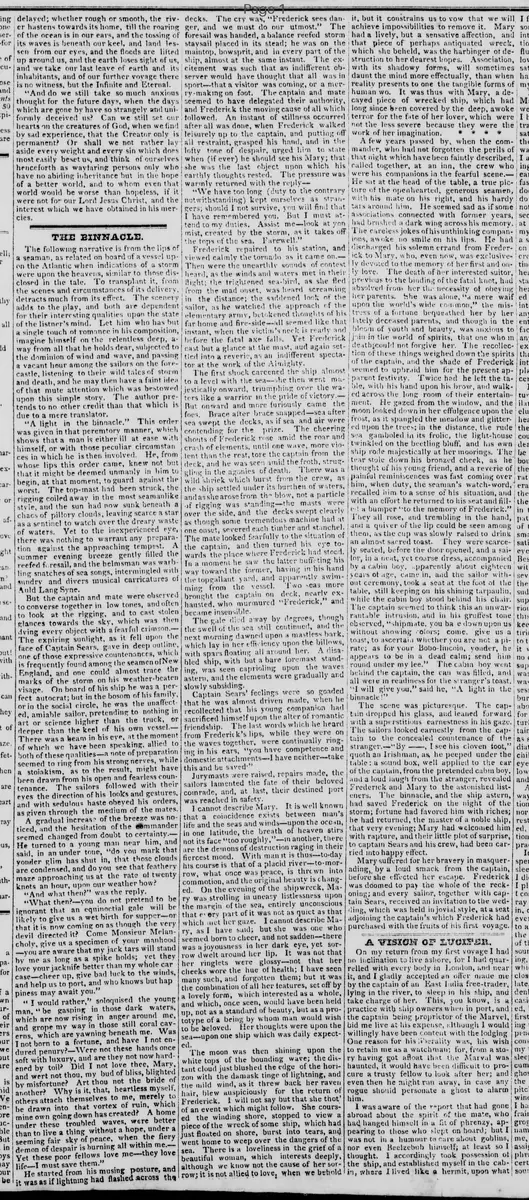
THE BINNACLE.
The following narrative is from the lips of a seaman, as related on board of a vessel upon the Atlantic when indications of a storm were upon the heavens, similar to those disclosed in the tale. To transplant it from the scenes and circumstances of its delivery detracts much from its effect. The scenery adds to the play, and both are dependent for their interesting qualities upon the state of the listener's mind. Let him who has but a single touch of romance in his composition, imagine himself on the relentless deep, away from all that he holds dear, subjected to the dominion of wind and wave, and passing a vacant hour among the sailors on the forecastle, listening to their wild tales of storm and death, and he may then have a faint idea of that mute attention which was bestowed upon this simple story. The author pretends to no other credit than that which is due to a mere translator.
"A light in the binnacle." This order was given in that peremptory manner, which shows that a man is either ill at ease with himself, or with those peculiar circumstances in which he is then involved. He, from whose lips this order came, knew not but that it might be deemed unmanly in him to begin, at that moment, to guard against the worst. The top-mast had been struck, the rigging coiled away in the most seamanlike style, and the sun had now sunk beneath a chaos of billowy clouds, leaving scarce a star as a sentinel to watch over the dreary waste of waters. Yet to the inexperienced eye, there was nothing to warrant any preparation against the approaching tempest. A summer evening breeze gently filled the reefed foresail, and the helmsman was warbling snatches of sea songs, intermingled with sundry and divers musical caricatures of Auld Lang Syne. But the captain and mate were observed to converse together in low tones, and often to look at the rigging, and to cast stolen glances towards the sky, which was then dying every object with a fearful crimson.--- The expiring sunlight, as it fell upon the face of Captain Sears, gave in deep outline, one of those expressive countenances, which is frequently found among the seamen of New England, and one could almost trace the marks of the storm on his weather-beaten visage. On board of his ship he was a perfect autocrat; but in the bosom of his family, or in the social circle, he was the unaffected, amiable sailor, pretending to nothing in art or science higher than the truck, or deeper than the keel of his own vessel.-- There was a beam in his eye, at the moment of which we have been speaking, allied to a stoicism, as to the result, might have seemed to ring from his strong nerves, while both of these qualities--a note of preparation been drawn from his open and fearless countenance. The sailors followed with their eyes the direction of his looks and gestures, and with sedulous haste obeyed his orders, as given through the medium of the mates. A gradual increase of the breeze was noticed, and the hesitation of the commander seemed changed from doubt to certainty.- He turned to a young man near him, and said, in an under tone, "do you mark that yonder glim has shut in, that those clouds are condensed, and do you see that feathery maze approaching us at the rate of twenty knots an hour, upon our weather bow?"
"And what then?" was the reply.
"What then?-you do not pretend to be ignorant that an equinoctial gale will be likely to give us a wet berth for supper—or that it is now coming on as though the very devil directed it? Come Monsieur Melancholy, give us a specimen of your manhood -you are aware that my jack tars will stand by me as long as a spike holds; yet they cease—cheer up, give bad luck to the winds, love your jackknife better than my whole cargo and help us to port, and who knows but happiness may await you."
" I would rather," soliloquised the young man, "be gasping in those dark waters, and grope my way in those still coral caverns, which are yawning beneath me. Was I not born to a fortune, and have I not endured penury?-Were not these hands once soft with luxury, and are they not now hardened by toil? Did I not love thee, Mary, and wert not thou, my bud of bliss, blighted by misfortune? Art thou not the bride of another? Why is it, that, heartless myself, others attach themselves to me, merely to be drawn into that vortex of ruin, which mine own going down has created? A home under these troubled waves, were better than to live a thing without a hope, under a seeming fair sky of peace, when the fiery demon of despair is burning all within me.- Yet these poor fellows love me--they love life-I must save them."
He started from his musing posture, and it was as if lightning had flashed across the decks. The cry was, "Frederick sees danger, and we must do our utmost." The foresail was handed, a balance reefed storm staysail placed in its stead; he was on the maintop, bowsprit, and in every part of the ship, almost at the same instant. The excitement was such that an indifferent observer would have thought that all was in sport--that a visitor was coming, or a merry-making on foot. The captain and mate seemed to have delegated their authority, and Frederick the moving cause of all which followed. An instant of stillness occurred after all was done, when Frederick walked leisurely up to the captain, and putting off all restraint, grasped his hand, and in the lofty tone of despair, urged him to state when (if ever) he should see his Mary; that she was the last object upon which his earthly thoughts rested. The pressure was warmly returned with the reply-- "We have too long (duty to the contrary notwithstanding) kept ourselves as strangers; should I not survive, you will find that I have remembered you. But I must attend to my duties. Assist me-look at yon mist, created by the storm, as it takes off the tops of the sea. Farewell."
Frederick repaired to his station, and viewed calmly the tornado as it came on.-- Then were the unearthly sounds of contest heard, as the winds and waters met in their might; the frightened sea-bird, as she fled from the mad onset, was heard screaming in the distance; the saddened look of the sailor, as he watched the approach of the elementary army, betokened thoughts of his far home and fire-side--all seemed like that instant, when the victim's neck is ready and before the fatal axe falls. Yet Frederick cast but a glance at the mast, and again settled into a reverie, as an indifferent spectator at the work of the Almighty.
The first shock careened the ship almost to a level with the sea--she then went majestically onward, triumphing over the waters like a warrior in the pride of victory.- But onward and more furiously came the foes. Brace after brace snapped-sea after sea swept the decks, as if sea and air were contending for the prize. The cheering shouts of Frederick rose amid the roar and crash of elements, until one wave, more violent than the rest, tore the captain from the deck, and he was seen amid the froth, struggling in the agonies of death. There was a wild shriek which burst from the crew, as the ship settled under its burden of waters, and as she rose from the blow, not a particle of rigging was standing-the masts were over the side, and the decks swept clearly as though some tremendous machine had at one onset, severed each timber and stanchel. The mate looked fearfully to the situation of the captain, and then turned his eye towards the place where Frederick had stood. In a moment he saw the latter buffeting his way toward the former, having in his hand the topgallant yard, and apparently swimming from the vessel. Two seas more brought the captain on deck, nearly exhausted, who murmured "Frederick," and became insensible.
The gale died away by degrees, though the swell of the sea still continued, and the next morning dawned upon a mastless bark, which lay in her inefficiency upon the billows, with spars floating all around her. A disabled ship, with but a bare foremast standing, was seen caprioling upon the waves astern, and the elements were gradually and slowly subsiding.
Captain Sears' feelings were so goaded that he was almost driven mad, when he recollected that his young companion had sacrificed himself upon the altar of romantic friendship. The last words which he heard from Frederick's lips, while they were on the waves together, were continually ringing in his ears, "you have competence and domestic attachments-I have neither--take this and be saved."
Jury-masts were raised, repairs made, the sailors lamented the fate of their beloved comrade, and, at last, their destined port was reached in safety.
I cannot describe Mary. It is well known that a coincidence exists between man's life and the seas and winds-upon the ocean, in one latitude, the breath of heaven stirs not its face "too roughly,"-in another, there are the demons of destruction raging in their fiercest mood. With man it is thus--to-day his course is that of a placid river-to-morrow, what once was peace, is thrown into commotion, and the original beauty is changed. On the evening of the shipwreck, Mary was strolling in uneasy listlessness upon the margin of the sea, entirely unconscious that every part of it was not as quiet as that which met her gaze. I cannot describe Mary, as I have said; but she was one who seemed born to cheer, and not sadden--there was a joyousness in her dark eye, yet sorrow dwelt around her lip. It was not that her ringlets were glossy--not that her cheeks wore the hue of health; I have seen many such, and forgotten them; but it was the combination of all her features, set off by a lovely form, which interested as a whole, and which, once seen, would have been held up, not as a standard of beauty, but as a prototype of a being by whom man would wish to be beloved. Her thoughts were upon the sea--upon one ship which was daily expected. The moon was then shining upon the white tops of the bounding wave; the distant cloud just blushed the edge of the horizon with the damask tinge of lightning, and the mild wind, as it threw back her raven hair, blew auspiciously for the return of Frederick. I will not say but that she thought of an event which might follow. She coursed the winding shore, stopped to view a piece of the wreck of some ship, which had just floated on shore, burst into tears, and went home to weep over the dangers of the sea. There is a loveliness in the grief of a beautiful woman, which interests deeply, although we know not the cause of her sorrow; it is not allied to love, when we behold it, but it constrains us to vow that we will achieve impossibilities to remove it. Mary had a lively, but a sensitive affection. and that piece of perhaps antiquated wreck, which she beheld, was the harbinger of destruction to her dearest hopes. Association, with its shadowy forms, will sometimes daunt the mind more effectually, than when reality presents to one the tangible forms of human wo. It was thus with Mary, a decayed piece of wrecked ship, which had long since been covered by the deep, awoke terror for the fate of her lover, which were not the less severe because they were the work of her imagination.
A few years passed by, when the commander, who had not forgotten the perils of that night which have been faintly described, called together, at an inn, the crew who were his companions in the fearful scene.- He sat at the head of the table, a true picture of the openhearted, generous seaman, with his mate on his right, and his hardy tars around him. He seemed sad as if some associations connected with former years, had brushed a dark wing across his memory. The careless jokes of his unthinking companions, awoke no smile on his lips. He had discharged his solemn errand from Frederick to Mary, who, even now, was exclusively devoted to the memory of her first and only love. The death of her interested suitor previous to the binding of the fatal knot, had absolved from her the necessity of obeying her parents. She was alone, "a mere waif upon the world's wide common," the mistress of a fortune bequeathed her by her lately deceased parents, and though in the bloom of youth and beauty, was anxious to join in the world of spirits, that one who in death could not forgive her. The recollection of these things weighed down the spirits of the captain, and the shade of Frederick seemed to upbraid him for the present apparent festivity. Twice had he left the table, with his hand upon his brow, and walked across the long room of their entertainment. He gazed from the window, and the moon looked down in her effulgence upon the frost, as it spangled the meadow and glittered upon the trees: in the distance, the rude sea gamboled in its frolic, the light-house twinkled on the beetling bluff, and his own ship rode majestically at her moorings. The tear stole down his bronzed cheek, as he thought of his young friend, and a reverie of painful reminiscences was fast coming over him, when duty, the seaman's watch-word, recalled him to a sense of his situation, and with an effort he returned to his seat and filled a bumper "to the memory of Frederick." They all rose, and trembling in the hand, and a quiver of the lip could be seen among them, as the cup was slowly raised to drink an almost sacred toast. They were scarcely seated, before the door opened, and a sailor, in a neat, yet coarse dress, accompanied by a cabin boy, apparently about eighteen years of age, came in, and the sailor without ceremony, took a seat at the foot of the table, still keeping on his shining tarpaulin, while the cabin boy stood behind his chair. The captain seemed to think this an unwarrantable intrusion, and in his gruffest tone observed, "shipmate, you have come down upon us without showing colors; come, give us a toast, to ascertain whether you are not a pirate; as for your Bobo-lincoln, yonder, he appears to be in a dead calm; send him round under my lee." The cabin boy went behind the captain, the can was filled, and all were in readiness for the stranger's toast.
"I will give you," said he, "A light in the binnacle!"
The scene was picturesque. The captain dropped his glass, and leaned forward with a superstitious earnestness in his gaze. The sailors looked earnestly from the captain to the concealed countenance of the stranger.-"By --, I see his cloven foot." quoth an Irishman, as he peeped under the table: a sound box, well applied to the ear of the captain, from the pretended cabin boy, and a loud laugh from the stranger, revealed Frederick and Mary to the astonished listeners. The binnacle, and the ship astern, had saved Frederick on the night of the storm; fortune had favored him with riches; he had returned, the master of a noble ship, that very evening; Mary had welcomed him with rapture, and their little plot of surprise, to captain Sears and his crew, had been carried into happy effect.
Mary suffered for her bravery in masquerading, by a loud smack from the captain, before she effected her escape. Frederick was doomed to pay the whole of the reckoning; and every sailor, together with captain Sears, received an invitation to the wedding, which was held in jovial style, at a seat adjoining the captain's which Frederick had purchased with the fruits of his first voyage.
The following narrative is from the lips of a seaman, as related on board of a vessel upon the Atlantic when indications of a storm were upon the heavens, similar to those disclosed in the tale. To transplant it from the scenes and circumstances of its delivery detracts much from its effect. The scenery adds to the play, and both are dependent for their interesting qualities upon the state of the listener's mind. Let him who has but a single touch of romance in his composition, imagine himself on the relentless deep, away from all that he holds dear, subjected to the dominion of wind and wave, and passing a vacant hour among the sailors on the forecastle, listening to their wild tales of storm and death, and he may then have a faint idea of that mute attention which was bestowed upon this simple story. The author pretends to no other credit than that which is due to a mere translator.
"A light in the binnacle." This order was given in that peremptory manner, which shows that a man is either ill at ease with himself, or with those peculiar circumstances in which he is then involved. He, from whose lips this order came, knew not but that it might be deemed unmanly in him to begin, at that moment, to guard against the worst. The top-mast had been struck, the rigging coiled away in the most seamanlike style, and the sun had now sunk beneath a chaos of billowy clouds, leaving scarce a star as a sentinel to watch over the dreary waste of waters. Yet to the inexperienced eye, there was nothing to warrant any preparation against the approaching tempest. A summer evening breeze gently filled the reefed foresail, and the helmsman was warbling snatches of sea songs, intermingled with sundry and divers musical caricatures of Auld Lang Syne. But the captain and mate were observed to converse together in low tones, and often to look at the rigging, and to cast stolen glances towards the sky, which was then dying every object with a fearful crimson.--- The expiring sunlight, as it fell upon the face of Captain Sears, gave in deep outline, one of those expressive countenances, which is frequently found among the seamen of New England, and one could almost trace the marks of the storm on his weather-beaten visage. On board of his ship he was a perfect autocrat; but in the bosom of his family, or in the social circle, he was the unaffected, amiable sailor, pretending to nothing in art or science higher than the truck, or deeper than the keel of his own vessel.-- There was a beam in his eye, at the moment of which we have been speaking, allied to a stoicism, as to the result, might have seemed to ring from his strong nerves, while both of these qualities--a note of preparation been drawn from his open and fearless countenance. The sailors followed with their eyes the direction of his looks and gestures, and with sedulous haste obeyed his orders, as given through the medium of the mates. A gradual increase of the breeze was noticed, and the hesitation of the commander seemed changed from doubt to certainty.- He turned to a young man near him, and said, in an under tone, "do you mark that yonder glim has shut in, that those clouds are condensed, and do you see that feathery maze approaching us at the rate of twenty knots an hour, upon our weather bow?"
"And what then?" was the reply.
"What then?-you do not pretend to be ignorant that an equinoctial gale will be likely to give us a wet berth for supper—or that it is now coming on as though the very devil directed it? Come Monsieur Melancholy, give us a specimen of your manhood -you are aware that my jack tars will stand by me as long as a spike holds; yet they cease—cheer up, give bad luck to the winds, love your jackknife better than my whole cargo and help us to port, and who knows but happiness may await you."
" I would rather," soliloquised the young man, "be gasping in those dark waters, and grope my way in those still coral caverns, which are yawning beneath me. Was I not born to a fortune, and have I not endured penury?-Were not these hands once soft with luxury, and are they not now hardened by toil? Did I not love thee, Mary, and wert not thou, my bud of bliss, blighted by misfortune? Art thou not the bride of another? Why is it, that, heartless myself, others attach themselves to me, merely to be drawn into that vortex of ruin, which mine own going down has created? A home under these troubled waves, were better than to live a thing without a hope, under a seeming fair sky of peace, when the fiery demon of despair is burning all within me.- Yet these poor fellows love me--they love life-I must save them."
He started from his musing posture, and it was as if lightning had flashed across the decks. The cry was, "Frederick sees danger, and we must do our utmost." The foresail was handed, a balance reefed storm staysail placed in its stead; he was on the maintop, bowsprit, and in every part of the ship, almost at the same instant. The excitement was such that an indifferent observer would have thought that all was in sport--that a visitor was coming, or a merry-making on foot. The captain and mate seemed to have delegated their authority, and Frederick the moving cause of all which followed. An instant of stillness occurred after all was done, when Frederick walked leisurely up to the captain, and putting off all restraint, grasped his hand, and in the lofty tone of despair, urged him to state when (if ever) he should see his Mary; that she was the last object upon which his earthly thoughts rested. The pressure was warmly returned with the reply-- "We have too long (duty to the contrary notwithstanding) kept ourselves as strangers; should I not survive, you will find that I have remembered you. But I must attend to my duties. Assist me-look at yon mist, created by the storm, as it takes off the tops of the sea. Farewell."
Frederick repaired to his station, and viewed calmly the tornado as it came on.-- Then were the unearthly sounds of contest heard, as the winds and waters met in their might; the frightened sea-bird, as she fled from the mad onset, was heard screaming in the distance; the saddened look of the sailor, as he watched the approach of the elementary army, betokened thoughts of his far home and fire-side--all seemed like that instant, when the victim's neck is ready and before the fatal axe falls. Yet Frederick cast but a glance at the mast, and again settled into a reverie, as an indifferent spectator at the work of the Almighty.
The first shock careened the ship almost to a level with the sea--she then went majestically onward, triumphing over the waters like a warrior in the pride of victory.- But onward and more furiously came the foes. Brace after brace snapped-sea after sea swept the decks, as if sea and air were contending for the prize. The cheering shouts of Frederick rose amid the roar and crash of elements, until one wave, more violent than the rest, tore the captain from the deck, and he was seen amid the froth, struggling in the agonies of death. There was a wild shriek which burst from the crew, as the ship settled under its burden of waters, and as she rose from the blow, not a particle of rigging was standing-the masts were over the side, and the decks swept clearly as though some tremendous machine had at one onset, severed each timber and stanchel. The mate looked fearfully to the situation of the captain, and then turned his eye towards the place where Frederick had stood. In a moment he saw the latter buffeting his way toward the former, having in his hand the topgallant yard, and apparently swimming from the vessel. Two seas more brought the captain on deck, nearly exhausted, who murmured "Frederick," and became insensible.
The gale died away by degrees, though the swell of the sea still continued, and the next morning dawned upon a mastless bark, which lay in her inefficiency upon the billows, with spars floating all around her. A disabled ship, with but a bare foremast standing, was seen caprioling upon the waves astern, and the elements were gradually and slowly subsiding.
Captain Sears' feelings were so goaded that he was almost driven mad, when he recollected that his young companion had sacrificed himself upon the altar of romantic friendship. The last words which he heard from Frederick's lips, while they were on the waves together, were continually ringing in his ears, "you have competence and domestic attachments-I have neither--take this and be saved."
Jury-masts were raised, repairs made, the sailors lamented the fate of their beloved comrade, and, at last, their destined port was reached in safety.
I cannot describe Mary. It is well known that a coincidence exists between man's life and the seas and winds-upon the ocean, in one latitude, the breath of heaven stirs not its face "too roughly,"-in another, there are the demons of destruction raging in their fiercest mood. With man it is thus--to-day his course is that of a placid river-to-morrow, what once was peace, is thrown into commotion, and the original beauty is changed. On the evening of the shipwreck, Mary was strolling in uneasy listlessness upon the margin of the sea, entirely unconscious that every part of it was not as quiet as that which met her gaze. I cannot describe Mary, as I have said; but she was one who seemed born to cheer, and not sadden--there was a joyousness in her dark eye, yet sorrow dwelt around her lip. It was not that her ringlets were glossy--not that her cheeks wore the hue of health; I have seen many such, and forgotten them; but it was the combination of all her features, set off by a lovely form, which interested as a whole, and which, once seen, would have been held up, not as a standard of beauty, but as a prototype of a being by whom man would wish to be beloved. Her thoughts were upon the sea--upon one ship which was daily expected. The moon was then shining upon the white tops of the bounding wave; the distant cloud just blushed the edge of the horizon with the damask tinge of lightning, and the mild wind, as it threw back her raven hair, blew auspiciously for the return of Frederick. I will not say but that she thought of an event which might follow. She coursed the winding shore, stopped to view a piece of the wreck of some ship, which had just floated on shore, burst into tears, and went home to weep over the dangers of the sea. There is a loveliness in the grief of a beautiful woman, which interests deeply, although we know not the cause of her sorrow; it is not allied to love, when we behold it, but it constrains us to vow that we will achieve impossibilities to remove it. Mary had a lively, but a sensitive affection. and that piece of perhaps antiquated wreck, which she beheld, was the harbinger of destruction to her dearest hopes. Association, with its shadowy forms, will sometimes daunt the mind more effectually, than when reality presents to one the tangible forms of human wo. It was thus with Mary, a decayed piece of wrecked ship, which had long since been covered by the deep, awoke terror for the fate of her lover, which were not the less severe because they were the work of her imagination.
A few years passed by, when the commander, who had not forgotten the perils of that night which have been faintly described, called together, at an inn, the crew who were his companions in the fearful scene.- He sat at the head of the table, a true picture of the openhearted, generous seaman, with his mate on his right, and his hardy tars around him. He seemed sad as if some associations connected with former years, had brushed a dark wing across his memory. The careless jokes of his unthinking companions, awoke no smile on his lips. He had discharged his solemn errand from Frederick to Mary, who, even now, was exclusively devoted to the memory of her first and only love. The death of her interested suitor previous to the binding of the fatal knot, had absolved from her the necessity of obeying her parents. She was alone, "a mere waif upon the world's wide common," the mistress of a fortune bequeathed her by her lately deceased parents, and though in the bloom of youth and beauty, was anxious to join in the world of spirits, that one who in death could not forgive her. The recollection of these things weighed down the spirits of the captain, and the shade of Frederick seemed to upbraid him for the present apparent festivity. Twice had he left the table, with his hand upon his brow, and walked across the long room of their entertainment. He gazed from the window, and the moon looked down in her effulgence upon the frost, as it spangled the meadow and glittered upon the trees: in the distance, the rude sea gamboled in its frolic, the light-house twinkled on the beetling bluff, and his own ship rode majestically at her moorings. The tear stole down his bronzed cheek, as he thought of his young friend, and a reverie of painful reminiscences was fast coming over him, when duty, the seaman's watch-word, recalled him to a sense of his situation, and with an effort he returned to his seat and filled a bumper "to the memory of Frederick." They all rose, and trembling in the hand, and a quiver of the lip could be seen among them, as the cup was slowly raised to drink an almost sacred toast. They were scarcely seated, before the door opened, and a sailor, in a neat, yet coarse dress, accompanied by a cabin boy, apparently about eighteen years of age, came in, and the sailor without ceremony, took a seat at the foot of the table, still keeping on his shining tarpaulin, while the cabin boy stood behind his chair. The captain seemed to think this an unwarrantable intrusion, and in his gruffest tone observed, "shipmate, you have come down upon us without showing colors; come, give us a toast, to ascertain whether you are not a pirate; as for your Bobo-lincoln, yonder, he appears to be in a dead calm; send him round under my lee." The cabin boy went behind the captain, the can was filled, and all were in readiness for the stranger's toast.
"I will give you," said he, "A light in the binnacle!"
The scene was picturesque. The captain dropped his glass, and leaned forward with a superstitious earnestness in his gaze. The sailors looked earnestly from the captain to the concealed countenance of the stranger.-"By --, I see his cloven foot." quoth an Irishman, as he peeped under the table: a sound box, well applied to the ear of the captain, from the pretended cabin boy, and a loud laugh from the stranger, revealed Frederick and Mary to the astonished listeners. The binnacle, and the ship astern, had saved Frederick on the night of the storm; fortune had favored him with riches; he had returned, the master of a noble ship, that very evening; Mary had welcomed him with rapture, and their little plot of surprise, to captain Sears and his crew, had been carried into happy effect.
Mary suffered for her bravery in masquerading, by a loud smack from the captain, before she effected her escape. Frederick was doomed to pay the whole of the reckoning; and every sailor, together with captain Sears, received an invitation to the wedding, which was held in jovial style, at a seat adjoining the captain's which Frederick had purchased with the fruits of his first voyage.
What sub-type of article is it?
Prose Fiction
What themes does it cover?
Love Romance
Friendship
Death Mortality
What keywords are associated?
Sea Storm
Shipwreck
Romantic Sacrifice
Friendship
Reunion
Binnacle Light
Equinoctial Gale
Literary Details
Title
The Binnacle.
Subject
A Seaman's Tale Of Storm, Sacrifice, And Romantic Reunion
Key Lines
"A Light In The Binnacle."
" I Would Rather," Soliloquised The Young Man, "Be Gasping In Those Dark Waters... Yet These Poor Fellows Love Me They Love Life I Must Save Them."
"You Have Competence And Domestic Attachments I Have Neither Take This And Be Saved."
I Cannot Describe Mary... But It Was The Combination Of All Her Features, Set Off By A Lovely Form, Which Interested As A Whole...
"I Will Give You," Said He, "A Light In The Binnacle!"