Thank you for visiting SNEWPapers!
Sign up free
The Enquirer
Richmond, Henrico County, Virginia
What is this article about?
On March 29, in the U.S. House of Representatives, members debate a Senate bill regulating land grants south of Tennessee, focusing on controversial Georgia (Yazoo) claims. Speakers like Randolph and Clark argue for immediate rejection, citing bribery, corruption, and invalidity of the 1795 grants, while others seek postponement for discussion.
Merged-components note: Continuation of the congressional debate on the Georgia/Yazoo claims across pages; relabeled to 'story' as it is a full narrative article on national politics.
Clippings
1 of 2
OCR Quality
Full Text
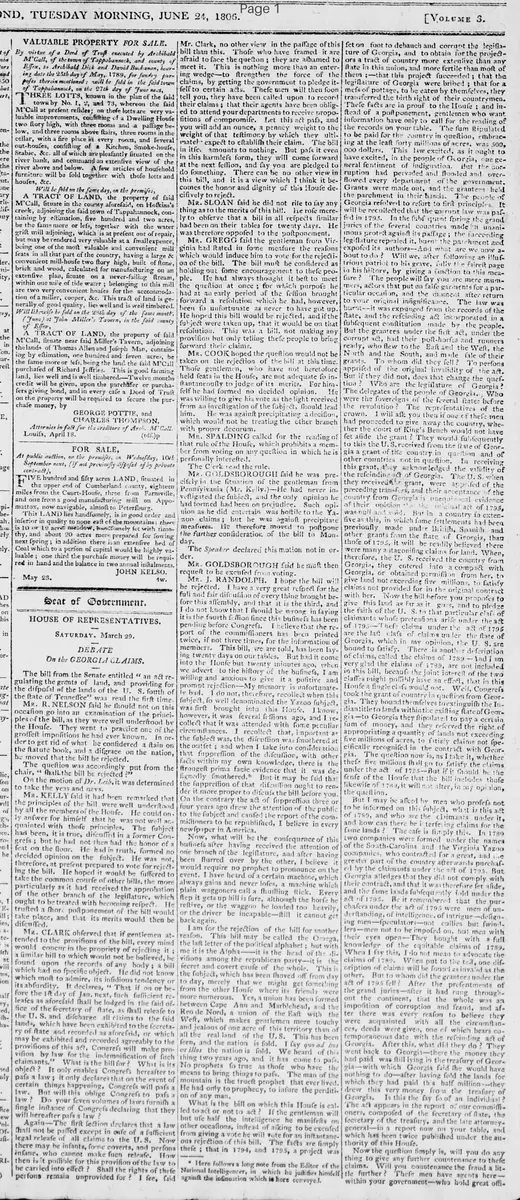
HOUSE OF REPRESENTATIVES.
SATURDAY, March 29.
DEBATE
On the GEORGIA CLAIMS.
The bill from the Senate entitled "an act regulating the grants of land, and providing for the disposal of the lands of the U. S. south of the state of Tennessee" was read the first time.
MR. R. NELSON said he should not on this occasion go into an examination of the principles of the bill, as they were well understood by the House. They went to practice one of the grossest impositions he had ever known. In order to get rid of what he considered a stain on the statute book, and a disgrace on the nation, he moved that the bill be rejected.
The question was accordingly put from the chair, "shall the bill be rejected?"
On the motion of Dr. Leib, it was determined to take the yeas and nays.
MR. KELLY said it had been remarked that the principles of the bill were well understood by all the members of the House. He could only answer for himself that he was not well acquainted with those principles. The subject had, it is true, been discussed in a former Congress; but he had not then had the honor of a seat on the floor. He had in truth, formed no decided opinion on the subject. He was not, therefore, at present prepared to vote for rejecting the bill. He hoped it would be suffered to take the common course of other bills, the more particularly as it had received the approbation of the other branch of the legislature, which ought to be treated with becoming respect. He trusted a short postponement of the bill would take place, and that its merits would then be discussed.
Mr. CLARK observed that if gentlemen attended to the provisions of the bill, every mind would concur in the propriety of rejecting it; a similar bill to which would not be believed, be found upon the records of any body; a bill which had no specific object. He did not know which most to admire, its insidious tendency or its absurdity. It declares, "That if on or before the 1st day of Jan. next, such sufficient releases as aforesaid shall be lodged in the said office of the secretary of state, as shall release to the U. S. and discharge all claims to the said lands, which have been exhibited to the secretary of state and recorded as aforesaid, or which may be exhibited and recorded agreeably to the provisions of this act, Congress will make provision by law for the indemnification of such claimants." What is the bill for? What is its object? It only enables Congress hereafter to pass a law; it only declares that on the event of certain things happening, Congress will pass a law. But will this oblige Congress to pass a law? Do your seven volumes of laws furnish a single instance of Congress declaring that they will hereafter pass a law?
Again—The first Section declares that a law shall not be passed except in case of a sufficient legal release of all claims to the U. S. Now there may be infants, feme coverts, and persons insane, who cannot make such release. How then is it possible for this provision of the law to be carried into effect? Shall the rights of these persons remain unprovided for? I see, said Mr. Clark, no other view in the passage of this bill than this. Those who have framed it are afraid to face the question; they are ashamed to meet it. This is nothing more than an entering wedge—to strengthen the force of the claims, by getting the government to pledge itself to certain acts. The men will then come and tell you, they have been called upon to record their claims; that their agents have been obliged to attend your departments to receive propositions of compromise. Let this act pass, and you will add an ounce, a penny weight to the weight of that testimony by which they ultimately expect to establish their claim. The bill in itself amounts to nothing. But pass it even in this harmless form, they will come forward at the next session, and say you are pledged to do something. There can be no other view in this bill. and it is a view which I think it becomes the honor and dignity of this House decisively to reject.
MR. SLOAN said he did not rise to say any thing as to the merits of this bill. He rose merely to observe that a bill in all respects similar had been on their tables for twenty days. He was therefore opposed to the postponement.
MR. GREGG said the gentleman from Virginia had stated in some measure the reasons which would induce him to vote for the rejection of the bill. The bill must be considered as holding out some encouragement to these people. He had always thought it best to meet the question at once; for which purpose he had at an early period of the session brought forward a resolution which he had, however, been too unfortunate as never to have got up. He hoped this bill would be rejected, and if the subject were taken up, that it would be on that resolution. This was a bill, not making any provision but only telling these people to bring forward their claims.
Mr. COOK hoped the question would not be taken on the rejection of the bill at this time. Those gentlemen, who have not heretofore held seats in the House, are not adequate so instantaneously to judge of its merits. For himself he had formed no decided opinion. He was willing to give his vote as the light received from an investigation of the subject, should lead him. He was against precipitating a decision, which would not be treating the other branch with proper decorum.
MR. SPALDING called for the reading of that rule of the House, which prohibits a member from voting on any question in which he is personally interested.
The Clerk read the rule.
MR. GOLDSBOROUGH said he was precisely in the situation of the gentleman from Pennsylvania (Mr. Kelly.)—He had never investigated the subject. and the only opinion he had formed had been on prejudice. Such opinion as he did entertain was hostile to the Yazoo claims; but he was against precipitate measures. He therefore moved to postpone the further consideration of the bill to Monday.
The Speaker declared this motion not in order.
MR. GOLDSBOROUGH said he must then request to be excused from voting.
Mr. J. RANDOLPH. I hope the bill will be rejected. I have a very great respect for the full and fair discussion of every thing brought before this assembly, and that it is the third, and I do not know that I should be wrong in saying it is the fourth session since this business has been pending before Congress. I believe that the report of the commissioners has been printed twice, if not three times, for the information of members. This bill, we are told, has been lying twenty days on our tables. But had it come into the House but twenty minutes ago, when we advert to the history of the business, I am willing and anxious to give it a positive and prompt rejection—My memory is unfortunate— it is bad. I do not, therefore, recollect when this subject, so well denominated the Yazoo subject, was first brought into this House. I know, however, it was several sessions ago, and I recollect that it was attended with some peculiar circumstances. I recollect that, important as the subject was, the discussion was smothered at the outset; and when I take into consideration that suppression of the discussion, with other facts within my own knowledge, there is the strongest prima facie evidence that it was designedly smothered. But it may be said that the suppression of that discussion ought to render it more proper to discuss the bill before you. On the contrary the act of suppression three or four years ago drew the attention of the public to the subject and caused the report of the commissioners to be republished, I believe in every newspaper in America.
Now, what will be the consequence of this business after having received the attention of one branch of the legislature, and after having been slurred over by the other, I believe it would require no prophet to pronounce on the event. I have heard of a certain machine, which always gains and never loses, a machine which plain waggoners call a shuffling stick. Every step it gets up hill is sure, although the horse be restive, or the waggon be loaded too heavily, or the driver be incapable—still it cannot get back again.
I am for the rejection of the bill for another reason. This bill may be called the Omega, the last letter of the political alphabet; but with me it is the Alpha—it is the head of those divisions among the republican party—it is the secret and covert cause of the whole. This is the subject, which has been shoved off from day to day, merely that we might get something from the other House where its friends were more numerous. Yes, a union has been formed between Cape Ann and Marblehead, and the Rhode Island, a union of the East with the West, which makes gentlemen more touchy and jealous of one acre of this territory than of all the real land of the U.S. This has been seen, and the nation is sold. I say quo ad hos or illos the nation is sold. We heard of this thing two years ago, and it has come to pass. No prophets so true as those who have the means to bring things to pass. The man of the mountain is the truest prophet that ever lived. He had only to prophecy, to insure the perdition of any man.
What is the bill on which this House is called to act or not to act? If the gentleman will but use half the intelligence he manifests on other occasions, instead of asking to be excused from giving a vote he will vote for an instantaneous rejection of this bill. The facts are simply these; that in 1794, and 1795, a project was set on foot to debauch and corrupt the legislature of Georgia, and to obtain for the projectors a tract of country more extensive than any state in this union, and more fertile than most of them;—that this project succeeded; that the legislature of Georgia were bribed; that for a mess of pottage, to be eaten by themselves, they transferred the birth right of their countrymen. These facts are in proof to the House; and instead of a postponement, gentlemen who want information have only to call for the reading of the records on your table. The sum stipulated to be paid for the country in question, embracing at the least forty millions of acres, was 500,000 dollars. This law excited, as it ought to have excited, in the people of Georgia, one general sentiment of indignation. But the corruption had pervaded and flooded and overflowed every department of the government. Grants were made out, and the grantees held the parchment in their hands. The people of Georgia resolved to resort to first principles. It will be recollected that the corrupt law was passed in 1795. In the subsequent spring the grand juries of the several counties made an unanimous protest against its passage; the succeeding legislature repealed it, burnt the parchment and exposed its authors—And what are we now about to do? Will we, after following an illustrious patriot to his grave, sully the brightest page in his history, by giving a sanction to this measure? The people will say you are mere mummers, actors that put on false garments for a particular occasion, and the moment after return to your original insignificance. The law was burnt—it was expunged from the records of the state, and the rescinding act incorporated in a subsequent constitution made by the people.
But the grantees under the first act, under the corrupt act, had their post-horses and runners ready, who flew to the East and the West, the North and the South, and made sale of their grants. To whom did they sell? To persons apprised of the original invalidity of the act. But if they did not, does that change the question? Who are the legislature of Georgia? The delegates of the people of Georgia. Who were the sovereigns of the several states before the revolution? The representatives of the crown. I will ask you then if one of these men had proceeded to give away the country, whether the court of King's Bench would not have set aside the grant? They would subsequently to this the U.S. received from the state of Georgia a grant of the country in question and of other countries not in question. In receiving this grant, they acknowledged the validity of the rescinding act of Georgia. The U. S. when they received a grant, were apprised of the preceding transfers, and their acceptance of the country from Georgia is unequivocal evidence of their opinion that the original act of 1795, was null and void. But in a country so extensive as this, in which some settlements had been previously made under British, Spanish and other grants from the state of Georgia, than those of 1795, it will be readily believed there were many antagonising claims for land. When, therefore, the U. S. received the country from Georgia, they entered into a compact with Georgia, or obtained permission from her, to give land not exceeding five millions, to satisfy claims not provided for in the original contract with her. Now the bill before you proposes to give this land as far as it goes, and to pledge the faith of the U. S. to that particular class of claimants whose pretensions arise under the act of 1795—The claims under the act of 1795 are the last class of claims under the state of Georgia, which in my opinion, the U. S. are bound to satisfy. There is another description of claims, called the claims of 1789—And I am very glad the claims of 1789, are not included in this bill, because the joint interest of the two classes might possibly have an effect, that in this House a single class would not. Well, Congress took the grant of country in question from Georgia. They bound themselves to extinguish the Indian title to lands within the existing state of Georgia—to Georgia they stipulated to pay a certain sum of money, and they reserved the right of appropriating a quantity of lands not exceeding five millions of acres, to satisfy claims not specifically recognised in the contract with Georgia. The question now is, as I take it, whether these five millions shall go to satisfy the claims under the act of 1795—But if it should be the sense of the House that the bill includes those likewise of 1789, it will not alter, in my opinion, the question.
But I may be asked by men who profess not to be informed on this subject, what is this act of 1789, and who are the claimants under it, and how can there be interfering claims for the same lands? The case is simply this. In 1789 two companies were formed under the names of the South-Carolina and the Virginia Yazoo companies, who contracted for a great, and in effect the greater part of the country afterwards purchased by the claimants under the act of 1795. But Georgia alleges that they did not comply with their contract, and that it was therefore set aside, and the same lands subsequently sold under the act of 1795. Be it remembered that the purchasers under the act of 1795 were men of understanding, of intelligence, of intrigue—designing men—speculators—not callies but swindlers—men not to be imposed on, but men with their eyes open—They bought with a full knowledge of the equitable claims of 1789. When I say this, I do not mean to advocate the claims of 1789. When put to the test, one description of claims will be found as invalid as the other. But to whom did the grantees under the act of 1795 sell? After the presentments of the grand juries—after it had rung throughout the continent, that the whole was an imposition of corruption and fraud, and after there was every reason to believe they were acquainted with all the circumstances, deeds were given, one of which bears contemporaneous date with the rescinding act of Georgia. After this, what did they do? They went back to Georgia—there the money they had paid was still lying in the treasury of Georgia—with which Georgia said she would have nothing to do—after having sold the lands for which they had paid this half million—they drew this very money from the treasury of Georgia. Is this the fair so of an individual? The act appears in the report of our commissioners, composed of the secretary of State, the secretary of the treasury, and the late attorney-general—in a report now on your table, and which has been twice published under the authority of this House.
Now the question simply is, will you do any thing to give any further countenance to these claims. Will you countenance the fraud a little further? These men have agents here— within your government—who hold great offices—cases under it. The whole weight of the executive government presses it on. We cannot bear up against it. The whole executive government has had a bias to the Yazoo interest ever since I had a seat here. This is the original sin, which has created all the mischiefs which gentlemen pretend to throw on the impressment of our seamen, and God knows what—this is the cause of these mischiefs, which existed years ago.
I hope I shall receive credit when I say that I never rose to address you more unprepared. The bill has been just sent down, and I had no intimation of such a discussion. But I call on gentlemen—not on those who have been advocating this measure at the fire-side for four months past—but on men who are free from any impression—to say whether they will give their sanction to this iniquity—whether after officers of the government of the United States have tampered with members of this and the other House for years, they are prepared to take that step which will open the door to this scene still wider? What will be the effect of a postponement? Gentlemen will come forward and say the Senate have passed a bill in favor of these claimants; these men will enquire whether this is not a countenance of their claims—they will tell you they have transferred their rights to A, B. and C, until at last resistance will fail, and you will give a handle to the axe which shall lay the whole woods in ruins.
I may be asked about this tampering of executive officers. At the last session I had the honor to carry up and conduct an impeachment before the other House. It proved unsuccessful; and one of the principal causes was this Yazoo sin. I overheard a conversation between a worthy friend of mine from Georgia, who has gone home, and a great officer of the government, when they were fitting up the green boxes for the magnates of the land. I heard the great officer of the government tampering with that man to get his vote. I overheard it. Let him be brought to your bar to-morrow, and he will tell you it is true. Why, sir, this is nothing—it is done every day, and every hour of the day. It is there (at the fire-side) and not on the floor, that the affairs of this country are discussed; and should this question, as a gentleman has said, be postponed till to-morrow—till Sabbath day, on which holy work is generally done—for myself I would not give one farthing for the question; if an adjournment take place till Monday, and if all the secret mechanism, which every body knows, be brought to bear upon it, I would not give a farthing for the issue. What have we seen as late as yesterday? A vote of 56 in favor of a resolution dwindled down by a conversation in the lobby to 25. As long as you adjourn and prolong this discussion, what do you do? I am willing to allow that what I have offered this morning is hardly worth an answer. But gentlemen will come in with their pieces of paper, with speeches ready cut and dry in reply to what I have now said. This is the fashion of the day—there is no doubt of it. Yesterday the House adjourned, and deferred the consideration of a resolution declaring the holding of civil and military offices in one person incompatible with the spirit of the constitution.
Well, gentlemen have come down to-day with their arguments. How comes it, they will say, that the President of the United States is commander in chief of the armies, at the same time that he is the first civil executive officer; I know they will—I am sure I am correct. And we may go on until executive influence shall become like a bow, which you may turn in any way, and point in any direction.
(To be continued.)
What sub-type of article is it?
What themes does it cover?
What keywords are associated?
What entities or persons were involved?
Where did it happen?
Story Details
Key Persons
Location
Seat Of Government, House Of Representatives
Event Date
Saturday, March 29
Story Details
Debate in the House on rejecting a Senate bill for Georgia land claims south of Tennessee, criticized as supporting fraudulent 1795 Yazoo grants obtained through bribery; speakers highlight corruption, invalidity, and executive influence, urging immediate rejection over postponement.