Thank you for visiting SNEWPapers!
Sign up free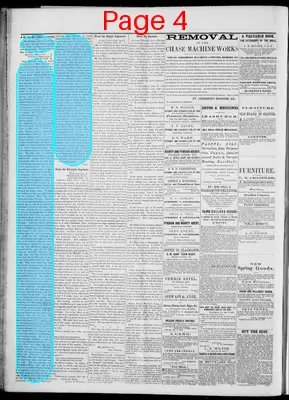
Story
July 10, 1863
Orleans Independent Standard
Irasburg, Barton, Orleans County, Vermont
What is this article about?
Letter from Union soldier Joel Buswell of the 15th Illinois Regiment to his brother, detailing the siege of Vicksburg in May 1863. Describes military movements, captures, harsh conditions, insect plagues, rebel defenses, and optimism for surrender without assault, crediting divine protection.
Clipping
OCR Quality
98%
Excellent
Full Text
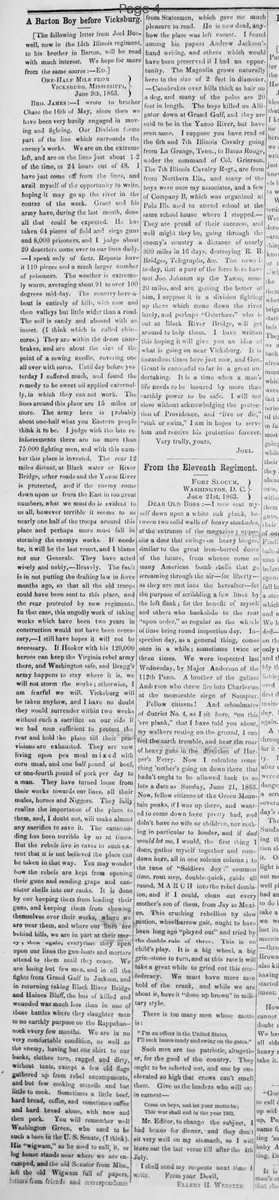
A Barton Boy before Vicksburg.
[The following letter from Joel Buswell, now in the 15th Illinois regiment, to his brother in Barton, will be read with much interest. We hope for more from the same source. -Ed.]
Bro. James: - I wrote to bro. Chase the 16th of May; since then we have been very busily engaged in moving and fighting. Our Division forms part of the line which surrounds the enemy's works. We are on the extreme left, and are on the lines just about 1/3 of the time, or 24 hours out of 48. We have just come off from the lines, and avail myself of the opportunity to write, hoping it may go up the river in the course of the week. Grant and his army have, during the last month, done all that could be expected. He has taken 64 pieces of field and siege guns and 8,000 prisoners, and I judge about 20 deserters come over to our lines daily. - I speak only of facts. Reports have it 110 pieces and a much larger number of prisoners. The weather is extremely warm, averaging about 91 to over 100 degrees mid-day. The country hereabout is entirely of hills, with now and then valleys but little wider than a road. The soil is sandy and abounds with an insect (I think which is called chinch-bugs.) They are within the dense cane-brakes, and are about the size of the point of a sewing needle, covering one all over with sores. Until day before yesterday I suffered much, and found the remedy to be sweet oil applied externally, in which they cannot work. The lines around this place are 15 miles or more. The army here is probably about one-half what you Eastern people think it to be. I judge with the late reinforcements there are no more than 75,000 fighting men, and with this number this place is invested. The rear 12 miles distant, at Black River Bridge, other roads and the Yazoo River is protected, and if the enemy come down upon us from the East in too great numbers, what we must do is evident to us all, however terrible it seems to us. Nearly one half of the troops around this place and perhaps more must fall in storming the enemy's works. If needs be, it will be the last resort, and I blame not our Generals. They have acted wisely and nobly - bravely. The fault is in not putting the drafting law in force months ago, so that all the old troops could have been sent to this place, and the rear protected by new regiments. In that case, this ungodly work of taking works which have been two years in construction would not have been necessary. - I still have hopes it will not be necessary. If Hooker with his 120,000 heroes can keep the Virginia rebel army there, and Washington safe, and Bragg's army happens to stay where it is, we will not storm the works; otherwise, I am fearful we will. Vicksburg will be taken anyhow, and I have no doubt they would surrender within two weeks without such a sacrifice on our side if we had men sufficient to protect the rear and hold the place till their provisions are exhausted. They are now living upon pea meal mixed with corn meal, and one half pound of beef, or one-fourth pound of pork per day to a man. They have turned loose from their works towards our lines, all their mules, horses and Negroes. They fully realize the importance of the place to them, and, I doubt not, will make almost any sacrifice to save it. The cannonading has been terrible by us at times. But the rebels live in caves to such extent that it is not believed the place can be taken in that way. You may wonder how the rebels are kept from opening their guns and sending grape and canister shells into our ranks. It is done by our keeping them from loading their guns, and keeping them from showing themselves over their works, where we are near them, and where our lines are behind hills, we are in part at their mercy then again, every time they open upon our lines the gun-boats and mortars attend to them until they cease. We are losing but few men, and in all the fights from Grand Gulf to Jackson, and in returning taking Black River Bridge and Haines Bluff, the loss of killed and wounded was much less than in one of those battles where they slaughter men to no earthly purpose on the Rappahannock every few months. We are in no very comfortable condition, as well as the enemy, having but one shirt to our backs, clothes torn, ragged and dirty, without tents, except a few old flags gathered up from rebel encampments, and but few cooking utensils and but little to cook. Sometimes a little beef, hard bread, coffee, and sometimes coffee and hard bread alone, with now and then pork. You will remember well Washington Green, who used to be such a bore in the U. S. Senate, (I think). His "wigwam," as he used to call it, or log house stands near where we are encamped, and the old Senator from Miss. left the old Wigwam full of papers, letters from friends and correspondence from Statesmen, which gave me much pleasure to read. He is now dead, anyhow the place was left vacant. I found among his papers Andrew Jackson's hand writing, and others which would have been preserved if I had an opportunity. The Magnolia grows naturally here to the size of 2 feet in diameter. -- Canebrakes over hills thick as hair on a dog, and many of the poles are 20 feet in length. The boys killed an Alligator down at Grand Gulf, and they are said to be in the Yazoo River, but have seen none. I suppose you have read of the 6th and 7th Illinois Cavalry going from La Grange, Tenn., to Baton Rouge, under the command of Col. Grierson. The 7th Illinois Cavalry Regt., are from Northern Ills., and many of the boys were once my associates, and a few of Company B, which was organized at Polo Ills. used to attend school at the same school house where I stopped. - They are proud of their success, and well might they be, going through the enemy's country a distance of nearly 800 miles in 16 days, destroying R. R. Bridges, Telegraphs, &c. The news to-day, that a part of the force he re have met Joe. Johnson up the Yazoo, some 20 miles, and are getting the better of him, I suppose it is a division fighting up there which come down the river lately. and perhaps "Osterhaus" who is out at Black River Bridge, will get around to help them. I have written this hoping it will give you an idea of what is going on near Vicksburg. It is hazardous times here just now, and Gen. Grant is successful so far in a great undertaking. It is a time when a man's life needs to be insured by more than earthly power to be safe. I will not close without acknowledging the protection of Providence, and "live or die," "sink or swim," I am in hopes to serve him and receive his protection forever.
Very truly, yours,
JOEL.
[The following letter from Joel Buswell, now in the 15th Illinois regiment, to his brother in Barton, will be read with much interest. We hope for more from the same source. -Ed.]
Bro. James: - I wrote to bro. Chase the 16th of May; since then we have been very busily engaged in moving and fighting. Our Division forms part of the line which surrounds the enemy's works. We are on the extreme left, and are on the lines just about 1/3 of the time, or 24 hours out of 48. We have just come off from the lines, and avail myself of the opportunity to write, hoping it may go up the river in the course of the week. Grant and his army have, during the last month, done all that could be expected. He has taken 64 pieces of field and siege guns and 8,000 prisoners, and I judge about 20 deserters come over to our lines daily. - I speak only of facts. Reports have it 110 pieces and a much larger number of prisoners. The weather is extremely warm, averaging about 91 to over 100 degrees mid-day. The country hereabout is entirely of hills, with now and then valleys but little wider than a road. The soil is sandy and abounds with an insect (I think which is called chinch-bugs.) They are within the dense cane-brakes, and are about the size of the point of a sewing needle, covering one all over with sores. Until day before yesterday I suffered much, and found the remedy to be sweet oil applied externally, in which they cannot work. The lines around this place are 15 miles or more. The army here is probably about one-half what you Eastern people think it to be. I judge with the late reinforcements there are no more than 75,000 fighting men, and with this number this place is invested. The rear 12 miles distant, at Black River Bridge, other roads and the Yazoo River is protected, and if the enemy come down upon us from the East in too great numbers, what we must do is evident to us all, however terrible it seems to us. Nearly one half of the troops around this place and perhaps more must fall in storming the enemy's works. If needs be, it will be the last resort, and I blame not our Generals. They have acted wisely and nobly - bravely. The fault is in not putting the drafting law in force months ago, so that all the old troops could have been sent to this place, and the rear protected by new regiments. In that case, this ungodly work of taking works which have been two years in construction would not have been necessary. - I still have hopes it will not be necessary. If Hooker with his 120,000 heroes can keep the Virginia rebel army there, and Washington safe, and Bragg's army happens to stay where it is, we will not storm the works; otherwise, I am fearful we will. Vicksburg will be taken anyhow, and I have no doubt they would surrender within two weeks without such a sacrifice on our side if we had men sufficient to protect the rear and hold the place till their provisions are exhausted. They are now living upon pea meal mixed with corn meal, and one half pound of beef, or one-fourth pound of pork per day to a man. They have turned loose from their works towards our lines, all their mules, horses and Negroes. They fully realize the importance of the place to them, and, I doubt not, will make almost any sacrifice to save it. The cannonading has been terrible by us at times. But the rebels live in caves to such extent that it is not believed the place can be taken in that way. You may wonder how the rebels are kept from opening their guns and sending grape and canister shells into our ranks. It is done by our keeping them from loading their guns, and keeping them from showing themselves over their works, where we are near them, and where our lines are behind hills, we are in part at their mercy then again, every time they open upon our lines the gun-boats and mortars attend to them until they cease. We are losing but few men, and in all the fights from Grand Gulf to Jackson, and in returning taking Black River Bridge and Haines Bluff, the loss of killed and wounded was much less than in one of those battles where they slaughter men to no earthly purpose on the Rappahannock every few months. We are in no very comfortable condition, as well as the enemy, having but one shirt to our backs, clothes torn, ragged and dirty, without tents, except a few old flags gathered up from rebel encampments, and but few cooking utensils and but little to cook. Sometimes a little beef, hard bread, coffee, and sometimes coffee and hard bread alone, with now and then pork. You will remember well Washington Green, who used to be such a bore in the U. S. Senate, (I think). His "wigwam," as he used to call it, or log house stands near where we are encamped, and the old Senator from Miss. left the old Wigwam full of papers, letters from friends and correspondence from Statesmen, which gave me much pleasure to read. He is now dead, anyhow the place was left vacant. I found among his papers Andrew Jackson's hand writing, and others which would have been preserved if I had an opportunity. The Magnolia grows naturally here to the size of 2 feet in diameter. -- Canebrakes over hills thick as hair on a dog, and many of the poles are 20 feet in length. The boys killed an Alligator down at Grand Gulf, and they are said to be in the Yazoo River, but have seen none. I suppose you have read of the 6th and 7th Illinois Cavalry going from La Grange, Tenn., to Baton Rouge, under the command of Col. Grierson. The 7th Illinois Cavalry Regt., are from Northern Ills., and many of the boys were once my associates, and a few of Company B, which was organized at Polo Ills. used to attend school at the same school house where I stopped. - They are proud of their success, and well might they be, going through the enemy's country a distance of nearly 800 miles in 16 days, destroying R. R. Bridges, Telegraphs, &c. The news to-day, that a part of the force he re have met Joe. Johnson up the Yazoo, some 20 miles, and are getting the better of him, I suppose it is a division fighting up there which come down the river lately. and perhaps "Osterhaus" who is out at Black River Bridge, will get around to help them. I have written this hoping it will give you an idea of what is going on near Vicksburg. It is hazardous times here just now, and Gen. Grant is successful so far in a great undertaking. It is a time when a man's life needs to be insured by more than earthly power to be safe. I will not close without acknowledging the protection of Providence, and "live or die," "sink or swim," I am in hopes to serve him and receive his protection forever.
Very truly, yours,
JOEL.
What sub-type of article is it?
Historical Event
Military Action
Survival
What themes does it cover?
Bravery Heroism
Providence Divine
Survival
What keywords are associated?
Vicksburg Siege
Civil War Letter
Union Army
Grant Campaign
Military Hardships
Divine Providence
Illinois Regiment
What entities or persons were involved?
Joel Buswell
Grant
Hooker
Bragg
Grierson
Washington Green
Andrew Jackson
Joe Johnson
Osterhaus
Where did it happen?
Vicksburg, Mississippi
Story Details
Key Persons
Joel Buswell
Grant
Hooker
Bragg
Grierson
Washington Green
Andrew Jackson
Joe Johnson
Osterhaus
Location
Vicksburg, Mississippi
Event Date
May 1863
Story Details
Union soldier Joel Buswell describes the siege of Vicksburg, including Grant's captures, harsh weather and insects, rebel defenses in caves, low rations on both sides, hopes to avoid storming without reinforcements, and credits divine protection amid hardships.