Thank you for visiting SNEWPapers!
Sign up free
Editorial
October 24, 1876
Wilmington Daily Commercial
Wilmington, New Castle County, Delaware
What is this article about?
Editorial refutes three false claims from the New York Herald against Republicans Dittenhoefer, Wheeler, Grant, and Hayes; discusses Carl Schurz's speech on reforms and Southern dangers; criticizes Milwaukee's debt under Democrats; notes Herald's warning on Southern claims.
Clipping
OCR Quality
98%
Excellent
Full Text
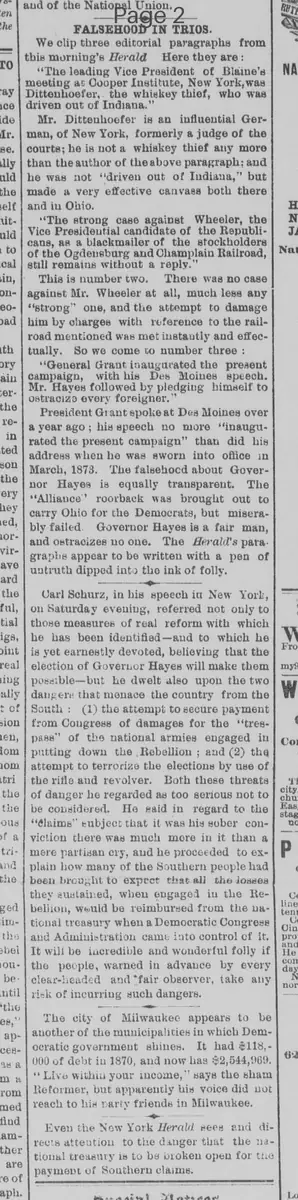
FALSEHOOD IN TRIOS
We clip three editorial paragraphs from this morning's Herald. Here they are:
"The leading Vice President of Blaine's meeting at Cooper Institute, New York, was Dittenhoefer, the whiskey thief, who was driven out of Indiana."
Mr. Dittenhoefer is an influential German, of New York, formerly a judge of the courts; he is not a whiskey thief any more than the author of the above paragraph; and he was not "driven out of Indiana," but made a very effective canvass both there and in Ohio.
"The strong case against Wheeler, the Vice Presidential candidate of the Republicans, as a blackmailer of the stockholders of the Ogdensburg and Champlain Railroad, still remains without a reply."
This is number two. There was no case against Mr. Wheeler at all, much less any "strong" one, and the attempt to damage him by charges with reference to the railroad mentioned was met instantly and effectually. So we come to number three:
"General Grant inaugurated the present campaign, with his Des Moines speech. Mr. Hayes followed by pledging himself to ostracize every foreigner."
President Grant spoke at Des Moines over a year ago; his speech no more "inaugurated the present campaign" than did his address when he was sworn into office in March, 1873. The falsehood about Governor Hayes is equally transparent. The "Alliance" roorback was brought out to carry Ohio for the Democrats, but miserably failed. Governor Hayes is a fair man, and ostracizes no one. The Herald's paragraphs appear to be written with a pen of untruth dipped into the ink of folly.
Carl Schurz, in his speech in New York, on Saturday evening, referred not only to those measures of real reform with which he has been identified—and to which he is yet earnestly devoted, believing that the election of Governor Hayes will make them possible—but he dwelt also upon the two dangers that menace the country from the South: (1) the attempt to secure payment from Congress of damages for the "trespass" of the national armies engaged in putting down the Rebellion; and (2) the attempt to terrorize the elections by use of the rifle and revolver. Both these threats of danger he regarded as too serious not to be considered. He said in regard to the "claims" subject that it was his sober conviction there was much more in it than a mere partisan cry, and he proceeded to explain how many of the Southern people had been brought to expect that all the losses they sustained, when engaged in the Rebellion, would be reimbursed from the national treasury when a Democratic Congress and Administration came into control of it. It will be incredible and wonderful folly if the people, warned in advance by every clear-headed and fair observer, take any risk of incurring such dangers.
The city of Milwaukee appears to be another of the municipalities in which Democratic government shines. It had $118,000 of debt in 1870, and now has $2,544,969. "Live within your income," says the sham Reformer, but apparently his voice did not reach to his party friends in Milwaukee.
Even the New York Herald sees and directs attention to the danger that the national treasury is to be broken open for the payment of Southern claims.
We clip three editorial paragraphs from this morning's Herald. Here they are:
"The leading Vice President of Blaine's meeting at Cooper Institute, New York, was Dittenhoefer, the whiskey thief, who was driven out of Indiana."
Mr. Dittenhoefer is an influential German, of New York, formerly a judge of the courts; he is not a whiskey thief any more than the author of the above paragraph; and he was not "driven out of Indiana," but made a very effective canvass both there and in Ohio.
"The strong case against Wheeler, the Vice Presidential candidate of the Republicans, as a blackmailer of the stockholders of the Ogdensburg and Champlain Railroad, still remains without a reply."
This is number two. There was no case against Mr. Wheeler at all, much less any "strong" one, and the attempt to damage him by charges with reference to the railroad mentioned was met instantly and effectually. So we come to number three:
"General Grant inaugurated the present campaign, with his Des Moines speech. Mr. Hayes followed by pledging himself to ostracize every foreigner."
President Grant spoke at Des Moines over a year ago; his speech no more "inaugurated the present campaign" than did his address when he was sworn into office in March, 1873. The falsehood about Governor Hayes is equally transparent. The "Alliance" roorback was brought out to carry Ohio for the Democrats, but miserably failed. Governor Hayes is a fair man, and ostracizes no one. The Herald's paragraphs appear to be written with a pen of untruth dipped into the ink of folly.
Carl Schurz, in his speech in New York, on Saturday evening, referred not only to those measures of real reform with which he has been identified—and to which he is yet earnestly devoted, believing that the election of Governor Hayes will make them possible—but he dwelt also upon the two dangers that menace the country from the South: (1) the attempt to secure payment from Congress of damages for the "trespass" of the national armies engaged in putting down the Rebellion; and (2) the attempt to terrorize the elections by use of the rifle and revolver. Both these threats of danger he regarded as too serious not to be considered. He said in regard to the "claims" subject that it was his sober conviction there was much more in it than a mere partisan cry, and he proceeded to explain how many of the Southern people had been brought to expect that all the losses they sustained, when engaged in the Rebellion, would be reimbursed from the national treasury when a Democratic Congress and Administration came into control of it. It will be incredible and wonderful folly if the people, warned in advance by every clear-headed and fair observer, take any risk of incurring such dangers.
The city of Milwaukee appears to be another of the municipalities in which Democratic government shines. It had $118,000 of debt in 1870, and now has $2,544,969. "Live within your income," says the sham Reformer, but apparently his voice did not reach to his party friends in Milwaukee.
Even the New York Herald sees and directs attention to the danger that the national treasury is to be broken open for the payment of Southern claims.
What sub-type of article is it?
Partisan Politics
What keywords are associated?
Partisan Falsehoods
New York Herald
1876 Election
Rutherford B. Hayes
Carl Schurz
Southern Claims
Milwaukee Debt
What entities or persons were involved?
New York Herald
Dittenhoefer
Wheeler
Grant
Hayes
Carl Schurz
Milwaukee
Editorial Details
Primary Topic
Refutation Of Falsehoods In The New York Herald Against Republican Figures
Stance / Tone
Strongly Pro Republican And Anti Democratic
Key Figures
New York Herald
Dittenhoefer
Wheeler
Grant
Hayes
Carl Schurz
Milwaukee
Key Arguments
Dittenhoefer Is An Influential German And Former Judge, Not A Whiskey Thief, And Was Not Driven Out Of Indiana
No Strong Case Against Wheeler As A Blackmailer; Charges Were Met Effectively
Grant's Des Moines Speech Did Not Inaugurate The Present Campaign; Hayes Did Not Pledge To Ostracize Foreigners
Schurz Highlighted Dangers From Southern Claims For Rebellion Damages And Election Terrorization
Milwaukee's Debt Increased Under Democratic Government From $118,000 In 1870 To $2,544,969
Herald Notes Danger Of National Treasury Paying Southern Claims