Thank you for visiting SNEWPapers!
Sign up free
Editorial
November 22, 1942
Imperial Valley Press
El Centro, Imperial County, California
What is this article about?
Editorial criticizes excessive civilian government employees (over 5 million total) compared to military and industry growth since WWI, attributing red tape and rules to politicians keeping them busy; calls for reducing staff and cutting taxes.
Clipping
OCR Quality
98%
Excellent
Full Text
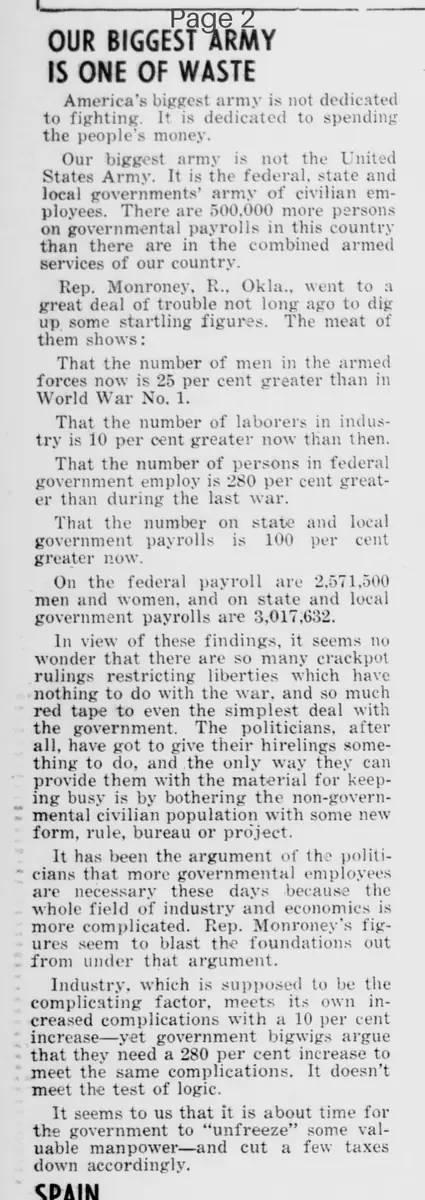
OUR BIGGEST ARMY
IS ONE OF WASTE
America's biggest army is not dedicated to fighting. It is dedicated to spending the people's money.
Our biggest army is not the United States Army. It is the federal, state and local governments' army of civilian employees. There are 500,000 more persons on governmental payrolls in this country than there are in the combined armed services of our country.
Rep. Monroney, R., Okla., went to a great deal of trouble not long ago to dig up some startling figures. The meat of them shows:
That the number of men in the armed forces now is 25 per cent greater than in World War No. 1.
That the number of laborers in industry is 10 per cent greater now than then.
That the number of persons in federal government employ is 280 per cent greater than during the last war.
That the number on state and local government payrolls is 100 per cent greater now.
On the federal payroll are 2,571,500 men and women, and on state and local government payrolls are 3,017,632.
In view of these findings, it seems no wonder that there are so many crackpot rulings restricting liberties which have nothing to do with the war, and so much red tape to even the simplest deal with the government. The politicians, after all, have got to give their hirelings something to do, and the only way they can provide them with the material for keeping busy is by bothering the non-governmental civilian population with some new form, rule, bureau or project.
It has been the argument of the politicians that more governmental employees are necessary these days because the whole field of industry and economics is more complicated. Rep. Monroney's figures seem to blast the foundations out from under that argument.
Industry, which is supposed to be the complicating factor, meets its own increased complications with a 10 per cent increase—yet government bigwigs argue that they need a 280 per cent increase to meet the same complications. It doesn't meet the test of logic.
It seems to us that it is about time for the government to "unfreeze" some valuable manpower—and cut a few taxes down accordingly.
IS ONE OF WASTE
America's biggest army is not dedicated to fighting. It is dedicated to spending the people's money.
Our biggest army is not the United States Army. It is the federal, state and local governments' army of civilian employees. There are 500,000 more persons on governmental payrolls in this country than there are in the combined armed services of our country.
Rep. Monroney, R., Okla., went to a great deal of trouble not long ago to dig up some startling figures. The meat of them shows:
That the number of men in the armed forces now is 25 per cent greater than in World War No. 1.
That the number of laborers in industry is 10 per cent greater now than then.
That the number of persons in federal government employ is 280 per cent greater than during the last war.
That the number on state and local government payrolls is 100 per cent greater now.
On the federal payroll are 2,571,500 men and women, and on state and local government payrolls are 3,017,632.
In view of these findings, it seems no wonder that there are so many crackpot rulings restricting liberties which have nothing to do with the war, and so much red tape to even the simplest deal with the government. The politicians, after all, have got to give their hirelings something to do, and the only way they can provide them with the material for keeping busy is by bothering the non-governmental civilian population with some new form, rule, bureau or project.
It has been the argument of the politicians that more governmental employees are necessary these days because the whole field of industry and economics is more complicated. Rep. Monroney's figures seem to blast the foundations out from under that argument.
Industry, which is supposed to be the complicating factor, meets its own increased complications with a 10 per cent increase—yet government bigwigs argue that they need a 280 per cent increase to meet the same complications. It doesn't meet the test of logic.
It seems to us that it is about time for the government to "unfreeze" some valuable manpower—and cut a few taxes down accordingly.
What sub-type of article is it?
Economic Policy
Taxation
What keywords are associated?
Government Waste
Bureaucracy
Federal Payroll
Civilian Employees
Wartime Spending
Tax Cuts
What entities or persons were involved?
Rep. Monroney
United States Army
Federal Government
State And Local Governments
Editorial Details
Primary Topic
Excessive Government Employment And Waste
Stance / Tone
Critical Of Government Bureaucracy
Key Figures
Rep. Monroney
United States Army
Federal Government
State And Local Governments
Key Arguments
America's Biggest Army Is Civilian Government Employees Spending Money
500,000 More Government Employees Than In Armed Services
Federal Employees 280% Greater Than In World War I
State And Local Employees 100% Greater Than In World War I
Industry Laborers Only 10% Greater Than In World War I
Excess Employees Lead To Unnecessary Rules And Red Tape
Politicians Justify More Employees Due To Complexity, But Figures Contradict
Government Should Reduce Employees And Cut Taxes