Thank you for visiting SNEWPapers!
Sign up free
The Home Journal
Winchester, Franklin County, Tennessee
What is this article about?
A letter to the editor of the Home Journal details the medical and moral dangers of chronic alcoholism, citing authorities like Flint and Wood, and quotes biblical warnings from Solomon to urge readers to abstain or seek help from alcohol addiction.
Merged-components note: Continuation of the letter to the editor on chronic alcoholism across multiple components.
Clipping
OCR Quality
Full Text
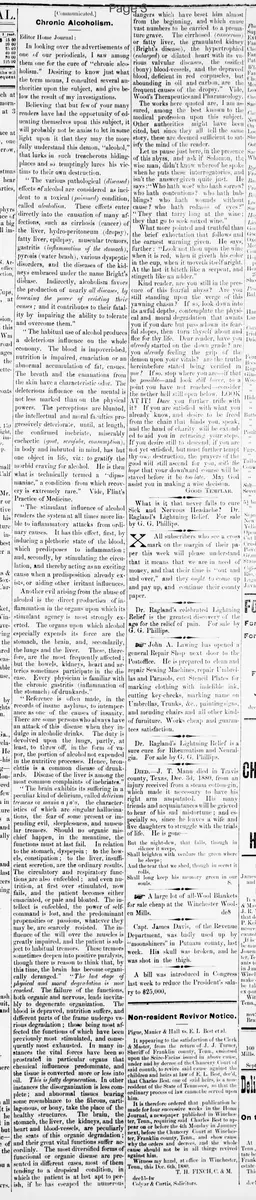
Editor Home Journal:
In looking over the advertisements of one of our periodicals, I saw among them one for the cure of "chronic alcoholism." Desiring to know just what the term means, I consulted several authorities upon the subject, and give below the result of my investigations. Believing that but few of your many readers have had the opportunity of educating themselves upon this subject, it will probably not be amiss to let in some light upon it that they may the more fully understand this demon, "alcohol," that lurks in such treacherous hiding places and so temptingly lures his victims to their own destruction.
"The various pathological (diseased) effects of alcohol are considered as incident to a toxical (poisoned) condition, called alcoholism. These effects enter directly into the causation of many affections, such as cirrhosis (cancer) of the liver, hydro-peritoneum (dropsy), fatty liver, epilepsy, muscular tremors, gastritis (inflammation of the stomach), pyrosis (water brash), various dyspeptic disorders, and the diseases of the kidneys embraced under the name Bright's disease. Indirectly, alcoholism favors the production of nearly all diseases, by lessening the power resisting their causes; and it contributes to their fatality by impairing the ability to tolerate and overcome them.
"The habitual use of alcohol produces a deleterious influence on the whole economy. The blood is impoverished, nutrition is impaired, emaciation or an abnormal accumulation of fat, ensues. The breath and the emanations from the skin have a characteristic odor. The deleterious influence on the mental is not less marked than on the physical powers. The perceptions are blunted, the intellectual and moral faculties progressively deteriorate, until, at length, the confirmed inebriate, miserably cachectic (gout, scrofula, consumption), in body and imbruted in mind, has but one object in life, viz: to gratify the morbid craving for alcohol. He is then what is technically termed a "dipsomaniac," a condition from which recovery is extremely rare."
Vide, Flint's Practice of Medicine.
Another evil arising from the abuse of alcohol is the direct production of inflammation in the organs upon which its stimulant agency is most strongly exerted. The organs upon which alcohol especially expends its force are the stomach, the brain, and, secondarily, the lungs and the liver. These, therefore, are the most frequently affected; but the bowels, kidneys, heart and arteries sometimes participate in the disease. Every physician is familiar with the chronic gastritis (inflammation of the stomach) of drunkards.
"Reference is often made, in the records of insane asylums, to intemperance as one of the causes of insanity. There are some persons who always have an attack of this disease when they indulge in alcoholic drinks. The duty is devolved upon the lungs, partly, at least, to throw off, in the form of vapor, the portion of alcohol not expended in the nutritive processes. Hence, bronchitis is a common disease of drunkards. Disease of the liver is among the most common complaints of inebriates."
"The brain exhibits its suffering in a peculiar kind of delirium, called delirium tremens or mania a potu, the characteristics of which are singular hallucinations, the fear of some present or impending evil, sleeplessness, and muscular tremors. Should no organic mischief happen, in the meantime, the functions must at last fail. In relation to the stomach, dyspepsia; to the bowels, constipation; to the liver, insufficient secretion, are the ordinary results. The circulatory and respiratory functions are also enfeebled; and even nutrition, at first over stimulated, now fails, and the patient becomes either emaciated, or pale and bloated. The intellect is enfeebled, the power of self command is lost, and the predominant propensities or passions, whatever they may be, are scarcely resisted. The influence of the will over the muscles is greatly impaired, and the patient is subject to habitual tremors. These tremors sometimes deepen into positive paralysis, though there is reason to think that, by this time, the brain has become organically deranged."
"The last stage of physical and moral degradation is now reached. The failure of the functions, both organic and nervous, leads inevitably to degenerate organization. The blood is depraved, nutrition suffers, and different parts of the frame undergo various degradation; those being most affected the functions of which have been previously most stimulated, and consequently most exhausted. In many instances the vital forces have been so prostrated in particular organs that chemical influences predominate, and the tissue is converted more or less into oil. This is fatty degeneration. In other instances the disorganization is less complete; and abnormal tissues bearing some resemblance to the fibrous, cartilaginous, or bony, take the place of the healthy structures. The brain, the stomach, the liver, the kidneys, and the heart and blood-vessels, are peculiarly the seats of this organic degradation; and their great vital functions suffer accordingly. "The most diversified forms of functional or organic disease are presented in different cases, most of them tending to a dropsical condition, in which the patient is at last apt to perish, if he has escaped the numerous
dangers which have beset him almost from the beginning, and which cause vast numbers to be carried to a premature grave. The cirrhosed (cancerous or fatty) liver, the granulated kidney (Bright's disease), the hypertrophied (enlarged) or dilated heart with its various valvular diseases, the ossified (bony) blood-vessels, and the depraved blood, deficient in red corpuscles, but abounding in oil and carbon, are the frequent causes of the dropsy."
Vide, Wood's Therapeutics and Pharmacology.
The works here quoted are, I am assured, among the best known to the medical profession upon this subject. Other authorities might have been cited, but since they all tell the same story, these are deemed sufficient to satisfy the mind of the reader.
Let us pause just here, in the presence of this abyss, and ask if Solomon, the wise man, didn't know whereof he spoke when he puts these interrogatories, and isn't the answer given quite just. He says: "Who hath woe? who hath sorrow? who hath contentions? who hath babblings? who hath wounds without cause? who hath redness of eyes?"
"They that tarry long at the wine; they that go to seek mixed wine."
What more pointed and truthful than the brief exhortation that follows and the earnest warning given. He says, further: "Look not thou upon the wine when it is red, when it giveth his color in the cup, when it moveth itself aright. At the last it biteth like a serpent, and stingeth like an adder."
Kind reader, are you still in the presence of this fearful abyss? Are you still standing upon the verge of this yawning chasm? If so, look down into its awful depths, contemplate the physical and moral degradation that awaits you if you dare but pass adown its fearful slopes, then turn thyself about and flee for thy life. Dear reader, have you already started on the down grade? are you already feeling the grip of the demon upon your vitals? are the truths hereinbefore stated being verified in you? If so, stop where you are-if that be possible-and look still lower, to a point you have not reached-consider the nether hell still open below. LOOK AT IT! Dare you further trifle with it? If you are satisfied with what you already know, and desire to be freed from the chain that binds you, speak and the hand of charity will be extended to aid you in retracing your steps. If you desire still to descend, if you are not yet satisfied, but must further tempt thy own destruction, the prayers of the good will still ascend for you, with the hope that your downward course will be stayed before it be too late. May God assist you in making a wise decision.
GOOD-TEMPLAR.
What sub-type of article is it?
What themes does it cover?
What keywords are associated?
What entities or persons were involved?
Letter to Editor Details
Author
Good Templar.
Recipient
Editor Home Journal
Main Argument
chronic alcoholism causes severe physical and mental diseases, as detailed in medical texts, and leads to moral degradation; readers should avoid alcohol or seek help to escape its destructive path, supported by biblical warnings.
Notable Details