Thank you for visiting SNEWPapers!
Sign up free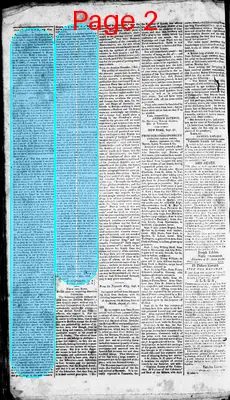
Alexandria Gazette, Commercial And Political
Alexandria, Virginia
What is this article about?
An 1803 unratified convention between US and Britain aimed to clarify eastern boundaries, including assigning Moose Island to the US, but President Jefferson declined to submit it for ratification amid ongoing territorial disputes.
Clipping
OCR Quality
Full Text
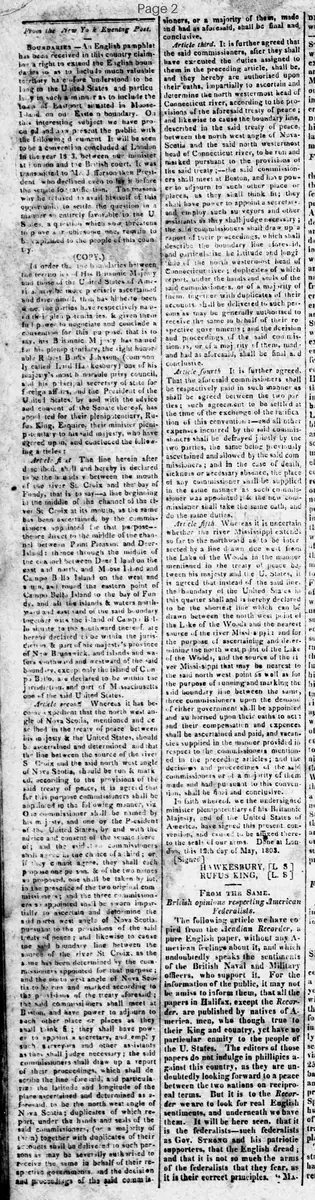
An English pamphlet has been received in this country claiming a right to extend the English boundaries so as to include much valuable territory heretofore understood to belong to the United States and particularly in such a manner as to include the town of Eastport situated in Moose Island on our eastern boundary. On this interesting subject we have procured and now present the public with the following document. It will be seen to be a convention concluded at London in the year 1803 between our minister at London and the British court. It was transmitted to Mr. Jefferson then President who declined even to lay it before the senate for ratification. The reasons why he refused to avail himself of this opportunity to settle the question in a manner so entirely favorable to the United States, a question which now threatens to prove a rubiesome one, remain to be explained to the people of this country.
(COPY.)
In order that the boundaries between the territories of his Britannic Majesty and those of the United States of America may be more precisely ascertained and determined than has hitherto been done, the parties have respectively named their plenipotentiaries and given them full power to negotiate and conclude a convention for this purpose. That is to say, his Britannic Majesty has named for his plenipotentiary the right honorable Robert Banks Jenkinson (commonly called Lord Hawkesbury) one of his majesty's most honorable privy council, and his principal secretary of state for foreign affairs, and the President of the United States, by and with the advice and consent of the Senate thereof, has appointed for their plenipotentiary Rufus King, Esquire, their minister plenipotentiary to his said majesty, who have agreed upon and concluded the following articles:
Article first. The line hereinafter described shall and hereby is declared to be the true boundary between the mouth of the river St. Croix and the bay of Fundy, that is to say—a line beginning in the middle of the channel of the river St. Croix at its mouth, as the same has been ascertained by the Commissioners appointed for that purpose—thence direct to the middle of the channel between Point Pleasant and Deer Island: thence through the middle of the channel between Deer Island on the east and north, and Moose Island and Campobello Island on the west and north, and round the eastern point of Campobello Island to the bay of Fundy, and all the islands and waters northward and eastward of the said boundary together with the island of Campobello situated to the southward thereof, are hereby declared to be within the jurisdiction and part of his majesty's province of New Brunswick, and islands and waters southward and westward of the said boundary, except only the island of Campobello, are declared to be within the jurisdiction and part of Massachusetts one of the said United States.
Article second. Whereas it has become expedient that the north west angle of Nova Scotia, mentioned and described in the treaty of peace between his majesty and the United States, should be ascertained and determined and that the line between the source of the river St. Croix and the said north west angle of Nova Scotia should be run and marked according to the provisions of the said treaty of peace, it is agreed that for this purpose commissioners shall be appointed in the following manner, viz: One commissioner shall be named by his majesty, and one by the President of the United States, by and with the advice and consent of the senate thereof; and the said two commissioners shall agree in the choice of a third; or, if they cannot agree, they shall each propose one person, and of the two names so proposed, one shall be taken by lot, in the presence of the two original commissioners; and the three commissioners appointed shall be sworn impartially to ascertain and determine the said north west angle of Nova Scotia, pursuant to the provisions of the said treaty of peace; and likewise to cause the said boundary line between the source of the river St. Croix, as the same has been determined by the commissioners appointed for that purpose, and the north west angle of Nova Scotia to be run and marked according to the provisions of the treaty aforesaid; the said commissioners shall meet at Boston, and have power to adjourn to such other place or places as they shall think fit; they shall have power to appoint a secretary, and employ such surveyors and other assistants as they shall judge necessary; the said commissioners shall draw up a report of their proceedings, which shall describe the line aforesaid, and particularize the latitude and longitude of the place ascertained and determined as aforesaid, to be the north west angle of Nova Scotia; duplicates of which report, under the hands and seals of the said commissioners, (or a majority of them) together with duplicates of their accounts shall be delivered to such persons as may be severally authorized to receive the same in behalf of their respective governments. And the decision and proceedings of the said commissioners, or a majority of them, made and had as aforesaid, shall be final and conclusive.
Article third. It is further agreed that the said commissioners, after they shall have executed the duties assigned to them in the preceding article, shall be, and they hereby are authorized upon their oaths, impartially to ascertain and determine the north westermost head of Connecticut river, according to the provisions of the aforesaid treaty of peace; and likewise to cause the boundary line, described in the said treaty of peace, between the north west angle of Nova Scotia and the said north westermost head of Connecticut river, to be run and marked pursuant to the provisions of the said treaty;—the said commissioners shall meet at Boston, and have power to adjourn to such other place or places, as they shall think fit; they shall have power to appoint a secretary, and employ such surveyors and other assistants as they shall judge necessary; the said commissioners shall draw up a report of their proceedings, which shall describe the boundary line aforesaid, and particularize the latitude and longitude of the north westermost head of Connecticut river; duplicates of which report, under the hands and seals of the said commissioners, or of a majority of them, together with duplicates of their accounts, shall be delivered to such persons as may be generally authorized to receive the same on behalf of their respective governments; and the decision and proceedings of the said commissioners, or of a majority of them, made and had as aforesaid, shall be final and conclusive.
Article fourth. It is further agreed, that the aforesaid commissioners shall be respectively paid in such manner as shall be agreed between the two parties; such agreement to be settled at the time of the exchange of the ratification of this convention:—and all other expenses incurred by the said commissioners shall be defrayed jointly by the two parties, the same being previously ascertained and allowed by the said commissioners; and in the case of death sickness or necessary absence, the place of any commissioner shall be supplied in the same manner as such commissioner was appointed; and the new commissioner shall take the same oath, and do the same duties.
Article fifth. Whereas it is uncertain whether the river Mississippi extends so far to the northward as to be intersected by a line drawn due west from the Lake of the Woods in the manner mentioned in the treaty of peace between his majesty and the U. States, it is agreed that instead of the said line, the boundary of the United States in this quarter shall and is hereby declared to be the shortest line which can be drawn between the north west point of the Lake of the Woods and the nearest source of the river Mississippi: and for the purpose of ascertaining and determining the north west point of the Lake of the Woods, and the source of the river Mississippi that may be nearest to the said north west point as well as for the purpose of running and marking the said boundary line between the same, three commissioners upon the demand of either government shall be appointed and authorized upon their oaths to act: and their compensation and expenses shall be ascertained and paid, and vacancies supplied in the manner provided in respect to the commissioners mentioned in the preceding articles; and the decisions and proceedings of the said commissioners or of a majority of them made and had pursuant to this convention, shall be final and conclusive.
In witness whereof we the undersigned minister plenipotentiary of his Britannic Majesty, and of the United States of America, have signed this present convention, and caused to be affixed thereto the seals of our arms. Done at London, this 13th day of May, 1803.
[Signed]
HAWKESBURY. [L. S.]
RUFUS KING,
[L. S.]
What sub-type of article is it?
What themes does it cover?
What keywords are associated?
What entities or persons were involved?
Where did it happen?
Story Details
Key Persons
Location
London; Eastern Boundary Of The United States; River St. Croix; Bay Of Fundy; Moose Island
Event Date
1803 05 13
Story Details
An unratified 1803 convention in London between Rufus King for the US and Lord Hawkesbury for Britain to precisely define boundaries from the St. Croix River to the Bay of Fundy, assigning most islands including Moose Island to the US, and provisions for commissioners to determine other boundaries like the northwest angle of Nova Scotia and the Mississippi source; President Jefferson declined to submit it to the Senate despite its favorability to the US.