Thank you for visiting SNEWPapers!
Sign up free
Story
November 10, 1949
The Potters Herald
East Liverpool, Columbiana County, Ohio
What is this article about?
In Cleveland, Brotherhood of Railroad Trainmen President W. P. Kennedy calls for united labor action against Wall Street's deflationary policies and anti-union efforts promoted in a McGraw-Hill ad seeking to ban industry-wide bargaining.
Clipping
OCR Quality
95%
Excellent
Full Text
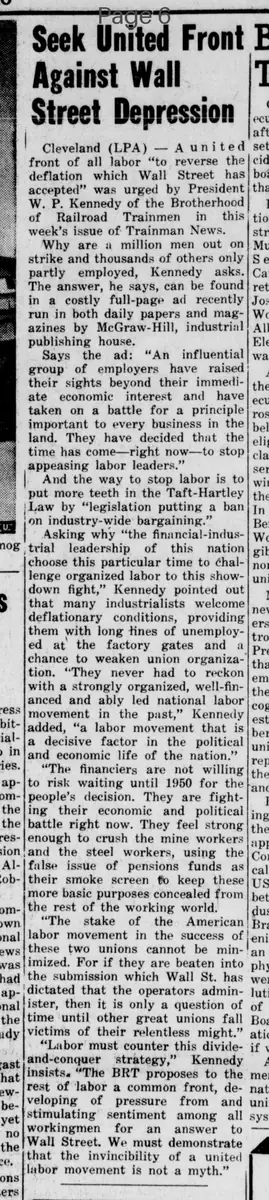
Seek United Front Against Wall Street Depression
Cleveland (LPA)—A united front of all labor "to reverse the deflation which Wall Street has accepted" was urged by President W. P. Kennedy of the Brotherhood of Railroad Trainmen in this week's issue of Trainman News.
Why are a million men out on strike and thousands of others only partly employed, Kennedy asks. The answer, he says, can be found in a costly full-page ad recently run in both daily papers and magazines by McGraw-Hill, industrial publishing house.
Says the ad: "An influential group of employers have raised their sights beyond their immediate economic interest and have taken on a battle for a principle important to every business in the land. They have decided that the time has come—right now—to stop appeasing labor leaders."
And the way to stop labor is to put more teeth in the Taft-Hartley Law by "legislation putting a ban on industry-wide bargaining."
Asking why "the financial-industrial leadership of this nation choose this particular time to challenge organized labor to this show-down fight," Kennedy pointed out that many industrialists welcome deflationary conditions, providing them with long lines of unemployed at the factory gates and a chance to weaken union organization. "They never had to reckon with a strongly organized, well-financed and ably led national labor movement in the past," Kennedy added. "a labor movement that is a decisive factor in the political and economic life of the nation."
"The financiers are not willing to risk waiting until 1950 for the people's decision. They are fighting their economic and political battle right now. They feel strong enough to crush the mine workers and the steel workers, using the false issue of pensions funds as their smoke screen to keep these more basic purposes concealed from the rest of the working world.
"The stake of the American labor movement in the success of these two unions cannot be minimized. For if they are beaten into the submission which Wall St. has dictated that the operators administer, then it is only a question of time until other great unions fall victims of their relentless might."
"Labor must counter this divide-and-conquer strategy," Kennedy insists. The BRT proposes to the rest of labor a common front, developing of pressure from and stimulating sentiment among all workingmen for an answer to Wall Street. We must demonstrate that the invincibility of a united labor movement is not a myth."
Cleveland (LPA)—A united front of all labor "to reverse the deflation which Wall Street has accepted" was urged by President W. P. Kennedy of the Brotherhood of Railroad Trainmen in this week's issue of Trainman News.
Why are a million men out on strike and thousands of others only partly employed, Kennedy asks. The answer, he says, can be found in a costly full-page ad recently run in both daily papers and magazines by McGraw-Hill, industrial publishing house.
Says the ad: "An influential group of employers have raised their sights beyond their immediate economic interest and have taken on a battle for a principle important to every business in the land. They have decided that the time has come—right now—to stop appeasing labor leaders."
And the way to stop labor is to put more teeth in the Taft-Hartley Law by "legislation putting a ban on industry-wide bargaining."
Asking why "the financial-industrial leadership of this nation choose this particular time to challenge organized labor to this show-down fight," Kennedy pointed out that many industrialists welcome deflationary conditions, providing them with long lines of unemployed at the factory gates and a chance to weaken union organization. "They never had to reckon with a strongly organized, well-financed and ably led national labor movement in the past," Kennedy added. "a labor movement that is a decisive factor in the political and economic life of the nation."
"The financiers are not willing to risk waiting until 1950 for the people's decision. They are fighting their economic and political battle right now. They feel strong enough to crush the mine workers and the steel workers, using the false issue of pensions funds as their smoke screen to keep these more basic purposes concealed from the rest of the working world.
"The stake of the American labor movement in the success of these two unions cannot be minimized. For if they are beaten into the submission which Wall St. has dictated that the operators administer, then it is only a question of time until other great unions fall victims of their relentless might."
"Labor must counter this divide-and-conquer strategy," Kennedy insists. The BRT proposes to the rest of labor a common front, developing of pressure from and stimulating sentiment among all workingmen for an answer to Wall Street. We must demonstrate that the invincibility of a united labor movement is not a myth."
What sub-type of article is it?
Historical Event
What themes does it cover?
Justice
Survival
Moral Virtue
What keywords are associated?
Labor Unity
Wall Street Deflation
Anti Union Ad
Taft Hartley
Railroad Trainmen
United Front
What entities or persons were involved?
W. P. Kennedy
Where did it happen?
Cleveland
Story Details
Key Persons
W. P. Kennedy
Location
Cleveland
Story Details
President W. P. Kennedy urges a united labor front to reverse Wall Street's deflation, criticizing a McGraw-Hill ad advocating bans on industry-wide bargaining and stronger Taft-Hartley enforcement to weaken unions.