Thank you for visiting SNEWPapers!
Sign up free
The Daily Cincinnati Republican, And Commercial Register
Cincinnati, Hamilton County, Ohio
What is this article about?
David Crouse, a major stockholder and director of the Bank of Chillicothe, publicly discloses being ousted from the board on January 5, 1835, through a secret circular by President Thomas James that manipulated proxies from distant stockholders due to Crouse's opposition to the Bank of the United States and support for the Jackson administration.
Clipping
OCR Quality
Full Text
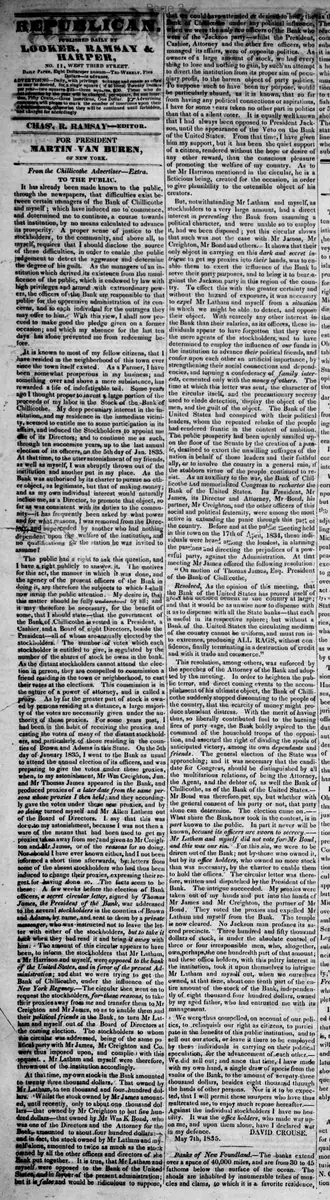
TO THE PUBLIC.
It has already been made known to the public, through the newspapers, that difficulties exist between certain managers of the Bank of Chillicothe and myself: which have induced me to commence, and determined me to continue, a course towards that institution, by no means calculated to advance its prosperity. A proper sense of justice to the stockholders, to the community, and above all, to myself, requires that I should disclose the source of these difficulties, in order to enable the public judgement to detect the aggressor and determine the degree of his guilt. As the managers of an institution which derived its existence from the munificence of the public, which is endowed by law with high privileges and armed with extraordinary powers, the officers of the Bank are responsible to that public for the oppressive administration of its concerns, and to each individual for the outrages they may offer to him. With this view, I shall now proceed to make good the pledge given on a former occasion; and which my absence for the last ten days has alone prevented me from redeeming before.
It is known to most of my fellow citizens, that I have resided in the neighborhood of this town ever since the town itself existed. As a Farmer, I have been somewhat prosperous in my business; and something over and above a mere subsistence, has rewarded a life of indefatigable toil. Some years ago I thought proper to invest a large portion of the proceeds of my labor in the Stock of the Bank of Chillicothe. My deep pecuniary interest in the institution, and my residence in the immediate vicinity, seemed to entitle me to some participation in its affairs, and induced the Stockholders to appoint me one of its Directors; and to continue me as such, through ten successive years, up to the last annual election of its officers, on the 5th day of Jan. 1835. At that time, to the utter astonishment of my friends, as well as myself, I was abruptly thrown out of the institution and another put in my place. As the Bank was authorised by its charter to pursue no other object, as legitimate, but that of making money; and as my own individual interest would naturally incline me, as a Director, to promote that object, so far as was consistent with its duties to the community—it has frequently been asked by what power and for what reasons, I was removed from the Directory and superceded by another who had nothing dependent upon the welfare of the institution, and no qualifications for the station he was invited to assume?
The public had a right to ask this question, and I have a right publicly to answer it. The motives for this act, the manner in which it was done, and the agency of the present officers of the Bank in doing it, are therefore the subjects to which I shall now invite the public attention. My desire is, that this matter should be fully understood by all; and it may therefore be necessary, for the benefit of some, that I should state that the government of the Bank of Chillicothe is vested in a President, a Cashier, and a Board of eight Directors, beside the President—all of whom are annually elected by the stockholders. The number of votes which each stockholder is entitled to give, is regulated by the number of the shares of stock he owns in the bank. As the distant stockholders cannot attend the election in person, they are compelled to commission a friend residing in the town or neighborhood, to cast their votes at the elections. This commission is in the nature of a power of attorney, and is called a proxy. As by far the greater part of stock is owned by persons residing at a distance, a large majority of the votes are necessarily given under the authority of these proxies. For some years past, I had been in the habit of receiving the proxies and casting the votes of many of the distant stockholders, and particularly of those residing in the counties of Brown and Adams in this State. On the 5th day of January 1835, I went to the Bank as usual to attend the annual election of its officers, and was preparing to give the votes under these proxies, when, to my astonishment, Mr Wm Creighton, Jun. and Mr Thomas James appeared in the Bank, and produced proxies of a later date from the same persons whose proxies I then held; and they accordingly gave the votes under these new proxies, and by so doing turned myself and Mr Allen Lathem out of the Board of Directors. I say that this was done to my astonishment, because I was not then aware of the means that had been used to get my proxies taken away from me; and given to Mr Creighton and Mr James, or of the reasons for so doing. Nor should I have ever known either, had I not been informed a short time afterwards, by letters from some of the absent stockholders who had thus been induced to change their proxies, expressing their regret for having done so. The facts seem to be these: A few weeks before the election of Bank officers, a secret circular letter, signed by Thomas James, the President of the Bank, was addressed to the several stockholders in the counties of Brown and Adams, by name, and sent to them by a private messenger, who was instructed not to leave the letter with either of the stockholders, but to take it back when they had read it and bring it away with him: The amount of this circular appears to have been, to inform the stockholders that Mr Latham, a Mr Harrison and myself, were opposed to the bank of the United States, and in favor of the present Administration; and that we were trying to get the Bank of Chillicothe, under the influence of the New York Regency. The circular then went on to request the stockholders, for these reasons, to take their proxies away from me and transfer them to Mr Creighton and Mr James, so as to enable them and their political friends in the Bank, to turn Mr Latham and myself out of the Board of Directors at the coming election. The stockholders to whom this circular was addressed, being of the same political party with Mr James, Mr Creighton and Co. were thus imposed upon, and complied with this request. Mr Latham and myself were therefore, thrown out of the institution accordingly.
At that time, my own stock in the Bank amounted to twenty three thousand dollars: That owned by Mr Latham, to ten thousand and four hundred dollars. Whilst the stock owned by Mr James amounted, until recently, only to about one thousand dollars—that owned by Mr Creighton to but five hundred dollars—that owned by Mr Wm K Bond, who was one of the Directors and the Attorney for the Bank, amounted to about four hundred dollars: and in fact, the stock owned by Mr Latham and myself alone, amounted to twice as much as the stock owned by all the other officers and directors of the Bank put together. It is true, that Mr Latham and myself were opposed to the Bank of the United States and in favor of the present administration; but it is false and would be ridiculous to suppose, that we could have attempted or desired to bring the Bank of Chillicothe under any political influence, when we were the only two officers of the Bank who were of the Jackson party—whilst the President, Cashier, Attorney and the other five officers, who managed its affairs, were of opposite politics. As owners of a large amount of stock, we had every thing to lose and nothing to gain, by such an attempt but it has been, the quiet support of promoting the welfare of my country. As to the Mr Harrison mentioned in the circular, he is a fictitious being, created for the occasion, in order to give plausibility to the ostensible object of his creators.
But, notwithstanding Mr Latham and myself, as stockholders to a very large amount, had a direct interest in preventing the Bank from assuming a political character, and were unable so to employ it, had we been disposed; yet this circular shows that such was not the case with Mr James, Mr Creighton, Mr Bond and others. It shows that their only object in carrying on this dark and secret intrigue to get my proxies into their hands, was to enable them to exert the influence of the Bank to serve their party purposes, and to bring it to bear against the Jackson party in this region of the country. To effect this with the greater certainty and without the hazard of exposure, it was necessary to expel Mr Latham and myself from a situation in which we might be able to detect, and oppose their object. With scarcely any other interest in the Bank than their salaries, as its officers, these individuals appear to have forgotten that they were the mere agents of the stockholders, and to have determined to employ the influence of our funds in the institution to advance their political friends, and confer upon each other an artificial importance, by strengthening their social connections and dependencies, and forming a confederacy of family interests, cemented only with the money of others. The time at which this letter was sent, the character of the circular itself, and the precautionary secrecy used to elude detection, display the object of the men, and the guilt of the object. The Bank of the United States had conspired with their political leaders, whom the repeated rebuke of the people had rendered frantic in the contest of ambition. The public prosperity had been openly assailed upon the floor of the Senate by the creation of a panic, destined to extort the unwilling suffrages of the nation in behalf of those leaders and their faithful ally, or to involve the country in a general ruin, if the stubborn virtue of the people continued to resist. As an auxiliary to the war, the Bank of Chillicothe had memorialized Congress to recharter the Bank of the United States. Its President, Mr James, its Director and Attorney, Mr Bond, his partner, Mr Creighton, and the other officers of this social and political fraternity, were among the most active in extending the panic through this part of the country. Before and at the public meeting held in this town on the 17th of April, 1834, these individuals were heard among the loudest, in alarming the passions and directing the prejudices of a powerful party, against the Administration. At that meeting Mr James offered the following resolution:
On motion of Thomas James, Esq. President of the Bank of Chillicothe,
Resolved, As the opinion of this meeting, that the Bank of the United States has proved itself of great and decided benefit in the country at large; and that it would be as unwise now to dispense with it as to dispense with all the State banks—that each is useful in its respective sphere; but without a Bank of the United States the circulating medium of the country cannot be uniform, and must run into extremes, producing ALL RAGS, without confidence, finally terminating in a destruction of credit and with it trade and commerce.
This resolution, among others, was enforced by the speeches of the Attorney of the Bank and adopted by the meeting. In order to heighten the public terror, and direct coming events to the accomplishment of his ultimate object, the Bank of Chillicothe suddenly stopped discounting to the people of the country, that the scarcity of money might produce abundant distress. With the merit of having thus, so liberally contributed fuel to the burning fires of party rage, the Bank boldly aspired to the command of the household troops of the opposition, and asserted the right of dividing the spoils of anticipated victory, among its own dependants and friends. The general election of the State was approaching; and it was necessary that the candidate for Congress, should be distinguished by all the multifarious relations, of being the Attorney, the Agent, and the debtor of, as well the Bank of Chillicothe, as of the Bank of the United States. Mr Bond was therefore put up, but whether with the general consent of his party or not, that party alone can determine. The election came on. What share the Bank now took in the contest, is in part known to the public. In part it never will be known, because its officers are sworn to secrecy. Mr Latham and myself did not vote for Mr Bond and this was our sin. For this sin, we were to be driven out of the Bank; not by those who owned it, but by its office holders, who owned no more stock than was necessary, by the charter to enable them to hold the offices. The circular letter was therefore, written and dispatched by the President of the Bank. The intrigue succeeded. My proxies were taken out of my hands and put into the hands of Mr James and Mr Creighton, the partner of Mr Bond. They voted the proxies and expelled Mr Latham and myself from the Bank. The temple is now cleared. No Jackson man profanes its sacred precincts. Three hundred and fifty thousand dollars of stock, is under the absolute control of three or four irresponsible men, who, altogether, own, perhaps, the one hundredth part of that amount; and these office holders, with this paltry interest in the institution, took it upon themselves to intrigue Mr Latham and myself out, when we ourselves owned, at that time, about one tenth part of the entire amount of the stock of the Bank, independently of eight thousand four hundred dollars, owned by my aged father, who had entrusted me with its management.
We were thus compelled, on account of our politics, to relinquish our right as citizens, to participate in the benefits of this public institution, and to sell out our stock, or leave it there to be employed by these individuals in carrying on their political speculation, for the advancement of each other. We did sell out; and since that time, I have made with my own hand, a single draw of specie from the vaults of the Bank, to the amount of seventy-three thousand dollars, besides eight thousand through the hands of other persons. Nor is it to be expected, that I will permit these usurpers who have thus maltreated me, to enjoy much repose hereafter. Against the individual stockholders I have no hostility. It was the office holders, who made war upon me, and upon them alone, have I declared war in my defence.
DAVID CROUSE.
May 7th, 1835.
What sub-type of article is it?
What themes does it cover?
What keywords are associated?
What entities or persons were involved?
Where did it happen?
Story Details
Key Persons
Location
Chillicothe, Ohio; Counties Of Brown And Adams
Event Date
January 5, 1835; May 7, 1835
Story Details
David Crouse, a prosperous farmer and major stockholder in the Bank of Chillicothe, served as a director for ten years until ousted on January 5, 1835, via a secret circular letter by President Thomas James that deceived distant stockholders into transferring proxies to James and Creighton due to Crouse's and Latham's Jacksonian politics opposing the Bank of the United States. Crouse sold his stock and vows to oppose the bank's managers.