Thank you for visiting SNEWPapers!
Sign up free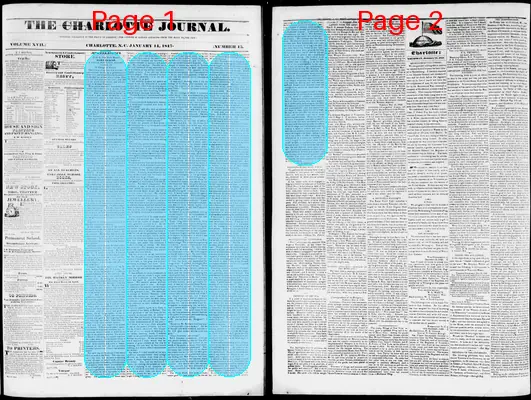
Literary
January 14, 1847
The Charlotte Journal
Charlotte, Mecklenburg County, North Carolina
What is this article about?
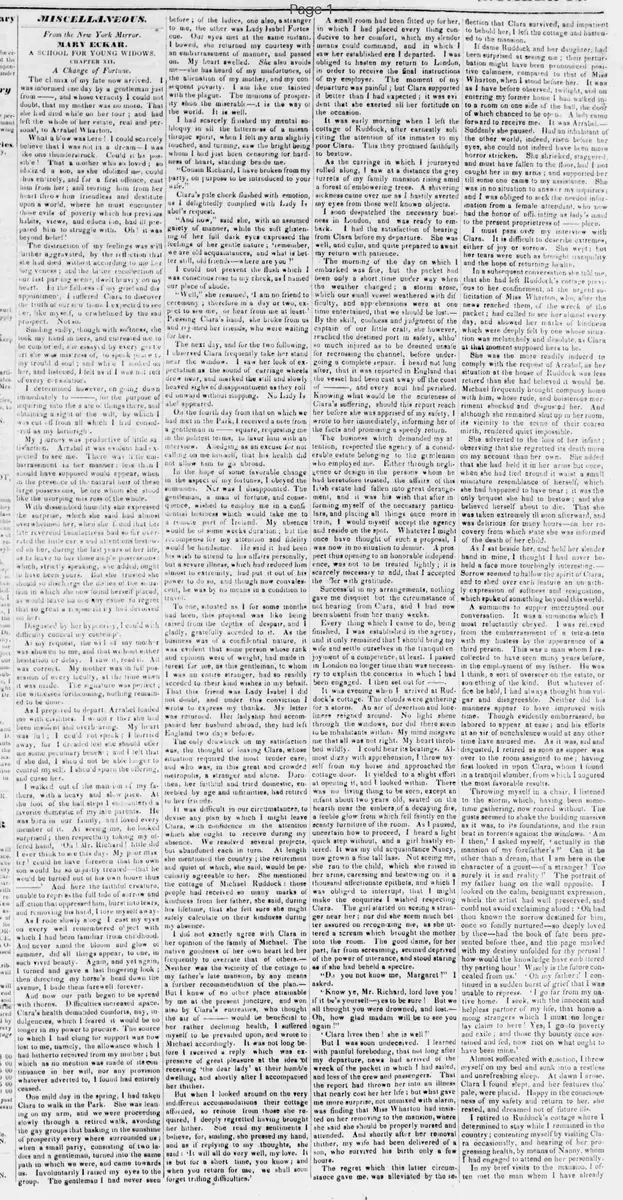
In this chapter, protagonist Richard learns of his mother's death and disinheritance to Arabella Wharton, plunging him and wife Clara into poverty. Supported by Lady Isabel, he takes a job in Ireland. Upon return, he finds Clara had given birth to a son who died shortly after, and they depart the family estate for London.
Merged-components note: Merged serialized literary story continuation across pages.
Clippings
1 of 2
OCR Quality
88%
Good
Full Text
MISCELLANEOUS.
From the New York Mirror.
MARY ECKARD.
A SCHOOL FOR YOUNG WIDOWS
CHAPTER XII.
A Change of Fortune.
The climax of my fate now arrived. I was informed one day by a gentleman just from ----, and whose veracity I could not doubt, that my mother was no more. That she had died while on her tour; and had left the whole of her estate, real and personal, to Arrabel Wharton.
What a blow was here! I could scarcely believe that I was not in a dream—I was like one thunderstruck. Could it be possible! That a mother who so loved; so idolized a son, as she idolized me, could thus entirely, and for a first offence, cast him from her; and tearing him from her heart thron him friendless and destitute upon a world, where he must encounter those evils of poverty which his previous habits, views, and education, had ill prepared him to struggle with. Oh! it was beyond belief!
The distraction of my feelings was still further aggravated, by the reflection that she had died without according to me her forgiveness; and the bitter recollection of our last parting scene, dwelt heavily on my heart. In the fullness of my grief and disappointment, I suffered Clara to discover the truth of our situation. I expected to see her, like myself, overwhelmed by the sad prospect. Not so.
Smiling sadly, though with softness, she took my hand in hers, and entreated me to be comforted, she essayed by every gentle art she was mistress of, to speak peace to my troubled soul; and while I looked on her, and listened, I felt as if I was not reft of every consolation.
I determined however, on going down immediately to —, for the purpose of inquiring into the state of things there, and obtaining a sight of the will, by which I was cut off from all which I had considered as my birthright.
My journey was productive of little satisfaction. Arrabel it was evident had expected to see me. There was little embarrassment in her manner: less than I should have supposed would appear, when in the presence of the natural heir of these large possessions, before whom she stood like the usurping mistress of the whole.
With dissembled humility she expressed the surprise, which she said had almost overwhelmed her, when she found that her late reverend benefactress had so far overrated the little cares and attentions bestowed on her, during the last years of her life, as to leave to her those ample possessions: which, strictly speaking, she added, ought to have been yours. But she trusted she should so discharge the duties of the station in which she now found herself placed, as would leave to no one any cause to regret that so great a responsibility had devolved on her.
Disgusted by her hypocrisy, I could with difficulty conceal my contempt.
At my request, the will of my mother was shown to me, and that without either hesitation or delay. I saw it, read it. All was correct. My mother was in full possession of every faculty, at the time when it was made. The signature was perfect; the witnesses unexceptionable, nothing remained to be done.
As I prepared to depart, Arrabel loaded me with civilities. I would rather she had been insolent and overbearing. My heart was full; I could not speak; I turned away, for I dreaded lest she should offer me some pecuniary benefit; and I felt that if she did, I should not be able longer to control myself. I should spurn the offering, and curse her.
I walked out of the mansion of my fathers, with a heavy and slow pace. At the foot of the hall steps I encountered a favorite domestic of my late parents. He was born in our family, and loved every member of it. At seeing me, he looked surprised; then respectfully taking my offered hand, 'Oh! Mr. Richard! Little did I ever think to see this day. My poor master! could he have foreseen that his own son would be so unjustly treated—that he would be turned out of his own house thus—' And here the faithful creature, unable to repress the full tide of sorrow and affection that oppressed him, burst into tears, and removing his hand, I tore myself away.
As I rode slowly along I cast my eyes on every well remembered object with which I had been familiar from childhood. And never amid the bloom and glow of summer, did all things appear, to one, in such vivid beauty. Again, and yet again, I turned and gave a last lingering look; then directing my horse's head down the avenue, I bade them farewell forever.
And now our path began to be spread with thorns. Difficulties increased apace. Clara's health demanded comforts, nay, indulgencies, which I feared it would be no longer in my power to procure. The source to which I had clung for support was now lost to me, namely, the allowance which I had hitherto received from my mother; but which as no mention was made of its continuance in her will, nor any provision whatever adverted to, I found had entirely ceased.
One mild day in the spring, I had taken Clara to walk in the Park. She was leaning on my arm, and we were proceeding slowly through a retired walk, avoiding the gay groups that basking in the sunshine of prosperity every where surrounded us; when a small party, consisting of two ladies and a gentleman, turned into the same path in which we were, and came towards us. Involuntarily I raised my eyes to the group. The gentleman I had never seen before; of the ladies, one also, a stranger to me, the other was Lady Isabel Fortescue. Our eyes met at the same instant. I bowed, she returned my courtesy with an embarrassment of manner, and passed on. My heart swelled. She also avoided me—she has heard of my misfortunes, of the alienation of my mother, and my consequent poverty, I am like one tainted with the plague. The minions of prosperity shun the miserable—it is the way of the world. It is well.
I had scarcely finished my mental soliloquy in all the bitterness of a misanthrope spirit, when I felt my arm slightly touched, and turning, saw the bright being whom I had just been censuring for hardness of heart, standing beside me.
"Cousin Richard, I have broken from my party, on purpose to be introduced to your wife."
Clara's pale cheek flushed with emotion, as I delightedly complied with Lady Isabel's request.
"And now" said she, with an assumed gaiety of manner, while the soft glistening of her full dark eyes expressed the feelings of her gentle nature; "remember, we are old acquaintances, and what is better still, old friends—where are you?"
I could not prevent the flush which I was conscious rose to my cheek, as I named our place of abode.
"Well." she resumed, "I am no friend to ceremony; therefore in a day or two, expect to see me, or hear from me at least." Pressing Clara's hand, she broke from us and rejoined her friends, who were waiting for her.
The next day, and for the two following, I observed Clara frequently take her stand near the window. I saw her look of expectation as the sound of carriage wheels drew near, and marked the still and slowly heaved sighs of disappointment as they rolled onward without stopping. No Lady Isabel appeared.
On the fourth day from that on which we had met in the Park, I received a note from a gentleman in -- square, requesting me in the politest terms, to favor him with an interview. Alleging as an excuse for not calling on me himself, that his health did not allow him to go abroad.
In the hope of some favorable change in the aspect of my fortunes, I obeyed the summons. Nor was I disappointed. The gentleman, a man of fortune, and consequence, wished to employ me in a confidential business which would take me to a remote part of Ireland. My absence would be of some weeks duration; but the recompense for my attention and fidelity would be handsome. He said it had been his wish to attend to his affairs personally, but a severe illness, which had reduced him almost to extremity, had put it out of his power to do so, and though now convalescent, he was by no means in a condition to travel.
To one, situated as I for some months had been, this proposal was like being raised from the depths of despair, and I gladly, gratefully acceded to it. As the business was of a confidential nature, it was evident that some person whose rank and opinion were of weight, had made interest for me, as this gentleman, to whom I was an entire stranger, had so readily acceded to their kind wishes in my behalf. That this friend was Lady Isabel I did not doubt, and under this conviction I wrote to express my thanks. My letter was returned. Her ladyship had accompanied her husband abroad, they had left England two days before.
The only drawback on my satisfaction was, the thought of leaving Clara, whose situation required the most tender care and who was, in this great and crowded metropolis, a stranger and alone. Dora, then, her faithful and tried domestic, enfeebled by age and infirmities, had retired to her friends.
It was difficult in our circumstances, to devise any plan by which I might leave Clara, with confidence in the attention which she ought to receive during my absence. We resolved several projects, but abandoned each in turn. At length she mentioned the country; the retirement and quiet of which, she said, would be peculiarly agreeable to her. She mentioned the cottage of Michael Ruddock: those people had received so many marks of kindness from her father, she said, during his lifetime, that she felt sure she might safely calculate on their kindness during my absence.
I did not exactly agree with Clara in her opinion of the family of Michael. The native goodness of her own heart led her frequently to overrate that of others. Neither was the vicinity of the cottage to my father's late mansion, by any means a further recommendation of the plan. But I knew of no other place attainable by me at the present juncture, and won also by Clara's entreaties, who thought the air of ---- would be beneficial to her rather declining health, I suffered myself to be prevailed upon, and wrote to Michael accordingly. It was not long before I received a reply which was expressive of great pleasure at the idea of receiving 'the dear lady' at their humble dwelling, and shortly after I accompanied her thither.
But when I looked around on the very indifferent accommodations their cottage afforded, so remote from those she required, I deeply regretted having brought her hither. She read my sentiments I believe, for, smiling, she pressed my hand, and as if replying to my thoughts, she said: 'It will all do very well, my love. It is but for a short time, you know; and when you return for me, we shall soon forget trifling difficulties.'
A small room had been fitted up for her in which I had placed every thing conducive to her comfort, which my slender means could command, and in which I saw her established ere I departed. I was obliged to hasten my return to London, in order to receive the final instructions of my employer. The moment of my departure was painful; but Clara supported it better than I had expected; it was evident that she exerted all her fortitude on the occasion.
It was early morning when I left the cottage of Ruddock, after earnestly soliciting the attention of its inmates to my poor Clara. This they promised faithfully to bestow.
As the carriage in which I journeyed rolled along, I saw at a distance the grey turrets of my family mansion rising amid a forest of embowering trees. A shivering sickness came over me as I hastily averted my eyes from those well known objects.
I soon despatched the necessary business in London, and was ready to embark. I had the satisfaction of hearing from Clara before my departure. She was well, and calm, and quite prepared to await my return with patience.
The morning of the day on which I embarked was fine, but the packet had been only a short time under way when the weather changed; a storm arose, which our small vessel weathered with difficulty, and apprehensions were at one time entertained, that we should be lost. By the skill, coolness and judgment of the captain of our little craft, she however, reached the destined port in safety, altho so much injured as to be deemed unsafe for recrossing the channel, before undergoing a complete repair. I heard not long after, that it was reported in England that the vessel had been cast away off the coast of , and every soul had perished.
Knowing what would be the acuteness of Clara's suffering, should this report reach her before she was apprised of my safety, I wrote to her immediately, informing her of the facts and promising a speedy return.
The business which demanded my attention, respected the agency of a considerable estate belonging to the gentleman who employed me. Either through negligence or design in the persons whom he had heretofore trusted, the affairs of this Irish estate had fallen into great derangement, and it was his wish that after informing myself of the necessary particulars, and placing all things once more in train, I would myself accept the agency and reside on the spot. Whatever I might once have thought of such a proposal, I was now in no situation to demur. A prospect thus opening to an honorable independence, was not to be treated lightly; it is scarcely necessary to add, that I accepted the offer with gratitude.
Successful in my arrangements, nothing gave me disquiet but the circumstance of not hearing from Clara. and I had now been absent from her many weeks.
Every thing which I came to do, being finished, I was established in the agency, and it only remained that I should bring my wife and settle ourselves in the tranquil enjoyment of a competence, at least. I passed in London no longer time than was necessary to explain the concerns in which I had been engaged. I then set out for ———.
It was evening when I arrived at Ruddock's cottage. The clouds were gathering for a storm. An air of desertion and lonelines reigned around. No light shone through the windows, nor did there seem to be inhabitants within. My mind misgave me that all was not right. My heart throbbed wildly. I could hear its beatings. Almost dizzy with apprehension, I threw myself from my horse and approached the cottage door. It yielded to a slight effort at opening it, and I looked within. There was no living thing to be seen, except an infant about two years old, seated on the hearth near the embers of a decaying fire, a feeble glow from which fell faintly on the scanty furniture of the room. As I paused, uncertain how to proceed, I heard a light quick step without, and a girl hastily entered. It was my old acquaintance Nancy, now grown a fine tall lass. Not seeing me, she ran to the child, which she raised in her arms, caressing and bestowing on it a thousand affectionate epithets, and which I was obliged to interrupt, that I might make the enquiries I wished respecting Clara. The girl started on seeing a stranger near her; nor did she seem much better assured on recognizing me, as she uttered a scream which brought the mother into the room. The good dame, for her part, far from screaming, seemed deprived of the power of utterance, and stood staring as if she had beheld a spectre.
"Do you not know me, Margaret?" I asked.
"Know ye, Mr. Richard, lord love you if it ben't yourself—yes to be sure! But we all thought you were drowned, and lost.— Oh, how glad madam will be to see you again!"
'Clara lives then—she is well?'
But I was soon undeceived. I learned with painful foreboding, that not long after my departure, news had arrived of the wreck of the packet in which I had sailed, and loss of the crew and passengers. That the report had thrown her into an illness that nearly cost her her life; but what gave me more surprise, not unmixed with alarm, was finding that Miss Wharton had insisted on her removing to the mansion, where she said she should be properly nursed and attended. And shortly after her removal thither, my wife had been delivered of a son, who survived his birth only a few hours.
The regret which this latter circumstance gave me, was alleviated by the re-mentioned, as having been formerly in my father's employ and could not avoid observing a degree of intimacy which appeared to exist between Arabella and himself, and which seemed singular. I mentioned the circumstance one day to Mrs. Ruddock she seemed embarrassed, and evaded giving a reply. Her husband was less fastidious. He declared with an oath, that the overseer and Miss Arabella had been man and wife, or as good, for a long time past: aye, even before the demise of her lady. I desired to know what grounds he had for his suspicions: but in this he did not think proper to gratify me; contenting himself with saying: 'He knew it to be so, and that was enough.' Indeed, I soon discovered that in ceasing to be the heir of one of the largest estates in the country, I had lost much of my consequence in the eyes of the worthy Mr. Ruddock. His manners always unpolished and rude, were now become at times, even brutal, and particularly so, when under the influence of a stimulus, in which he frequently indulged. I no longer wondered, that helpless, sad and lonely as was my poor wife, she had suffered herself to be removed from the cottage to an asylum so much more congenial to her. Ruddock had resigned himself to the society of a set of vicious fellows, and strange reports were in circulation concerning him. Some said he was connected with a band of illicit traders, who were suspected of occasionally harbouring on the coast. His absence from his family were frequent and unaccountable: and any inquiry into the cause of them, threw him into a rage. He had, at the period of my arrival at his house, just returned from one of those mysterious excursions. From my own observation, I supposed him fully capable of all the vices that were attributed to him. His poor wife was sinking under the effects of his ill usage, and his habitation was becoming a scene of poverty and ruin. I saw that my presence was a restraint, from which he longed to be freed; and as it was out of my power to effect anything like reformation in a subject so hardened in vice, I longed for the period when Clara would be able to commence her journey. It came at last: I took her from that mansion she was destined never again to enter. A cool and ceremonious leave-taking passed between Arabella and myself; and my laboring chest seemed lightened, and I breathed free, when out of my paternal enclosures, we found ourselves on the road to the metropolis.
(To be continued.)
From the New York Mirror.
MARY ECKARD.
A SCHOOL FOR YOUNG WIDOWS
CHAPTER XII.
A Change of Fortune.
The climax of my fate now arrived. I was informed one day by a gentleman just from ----, and whose veracity I could not doubt, that my mother was no more. That she had died while on her tour; and had left the whole of her estate, real and personal, to Arrabel Wharton.
What a blow was here! I could scarcely believe that I was not in a dream—I was like one thunderstruck. Could it be possible! That a mother who so loved; so idolized a son, as she idolized me, could thus entirely, and for a first offence, cast him from her; and tearing him from her heart thron him friendless and destitute upon a world, where he must encounter those evils of poverty which his previous habits, views, and education, had ill prepared him to struggle with. Oh! it was beyond belief!
The distraction of my feelings was still further aggravated, by the reflection that she had died without according to me her forgiveness; and the bitter recollection of our last parting scene, dwelt heavily on my heart. In the fullness of my grief and disappointment, I suffered Clara to discover the truth of our situation. I expected to see her, like myself, overwhelmed by the sad prospect. Not so.
Smiling sadly, though with softness, she took my hand in hers, and entreated me to be comforted, she essayed by every gentle art she was mistress of, to speak peace to my troubled soul; and while I looked on her, and listened, I felt as if I was not reft of every consolation.
I determined however, on going down immediately to —, for the purpose of inquiring into the state of things there, and obtaining a sight of the will, by which I was cut off from all which I had considered as my birthright.
My journey was productive of little satisfaction. Arrabel it was evident had expected to see me. There was little embarrassment in her manner: less than I should have supposed would appear, when in the presence of the natural heir of these large possessions, before whom she stood like the usurping mistress of the whole.
With dissembled humility she expressed the surprise, which she said had almost overwhelmed her, when she found that her late reverend benefactress had so far overrated the little cares and attentions bestowed on her, during the last years of her life, as to leave to her those ample possessions: which, strictly speaking, she added, ought to have been yours. But she trusted she should so discharge the duties of the station in which she now found herself placed, as would leave to no one any cause to regret that so great a responsibility had devolved on her.
Disgusted by her hypocrisy, I could with difficulty conceal my contempt.
At my request, the will of my mother was shown to me, and that without either hesitation or delay. I saw it, read it. All was correct. My mother was in full possession of every faculty, at the time when it was made. The signature was perfect; the witnesses unexceptionable, nothing remained to be done.
As I prepared to depart, Arrabel loaded me with civilities. I would rather she had been insolent and overbearing. My heart was full; I could not speak; I turned away, for I dreaded lest she should offer me some pecuniary benefit; and I felt that if she did, I should not be able longer to control myself. I should spurn the offering, and curse her.
I walked out of the mansion of my fathers, with a heavy and slow pace. At the foot of the hall steps I encountered a favorite domestic of my late parents. He was born in our family, and loved every member of it. At seeing me, he looked surprised; then respectfully taking my offered hand, 'Oh! Mr. Richard! Little did I ever think to see this day. My poor master! could he have foreseen that his own son would be so unjustly treated—that he would be turned out of his own house thus—' And here the faithful creature, unable to repress the full tide of sorrow and affection that oppressed him, burst into tears, and removing his hand, I tore myself away.
As I rode slowly along I cast my eyes on every well remembered object with which I had been familiar from childhood. And never amid the bloom and glow of summer, did all things appear, to one, in such vivid beauty. Again, and yet again, I turned and gave a last lingering look; then directing my horse's head down the avenue, I bade them farewell forever.
And now our path began to be spread with thorns. Difficulties increased apace. Clara's health demanded comforts, nay, indulgencies, which I feared it would be no longer in my power to procure. The source to which I had clung for support was now lost to me, namely, the allowance which I had hitherto received from my mother; but which as no mention was made of its continuance in her will, nor any provision whatever adverted to, I found had entirely ceased.
One mild day in the spring, I had taken Clara to walk in the Park. She was leaning on my arm, and we were proceeding slowly through a retired walk, avoiding the gay groups that basking in the sunshine of prosperity every where surrounded us; when a small party, consisting of two ladies and a gentleman, turned into the same path in which we were, and came towards us. Involuntarily I raised my eyes to the group. The gentleman I had never seen before; of the ladies, one also, a stranger to me, the other was Lady Isabel Fortescue. Our eyes met at the same instant. I bowed, she returned my courtesy with an embarrassment of manner, and passed on. My heart swelled. She also avoided me—she has heard of my misfortunes, of the alienation of my mother, and my consequent poverty, I am like one tainted with the plague. The minions of prosperity shun the miserable—it is the way of the world. It is well.
I had scarcely finished my mental soliloquy in all the bitterness of a misanthrope spirit, when I felt my arm slightly touched, and turning, saw the bright being whom I had just been censuring for hardness of heart, standing beside me.
"Cousin Richard, I have broken from my party, on purpose to be introduced to your wife."
Clara's pale cheek flushed with emotion, as I delightedly complied with Lady Isabel's request.
"And now" said she, with an assumed gaiety of manner, while the soft glistening of her full dark eyes expressed the feelings of her gentle nature; "remember, we are old acquaintances, and what is better still, old friends—where are you?"
I could not prevent the flush which I was conscious rose to my cheek, as I named our place of abode.
"Well." she resumed, "I am no friend to ceremony; therefore in a day or two, expect to see me, or hear from me at least." Pressing Clara's hand, she broke from us and rejoined her friends, who were waiting for her.
The next day, and for the two following, I observed Clara frequently take her stand near the window. I saw her look of expectation as the sound of carriage wheels drew near, and marked the still and slowly heaved sighs of disappointment as they rolled onward without stopping. No Lady Isabel appeared.
On the fourth day from that on which we had met in the Park, I received a note from a gentleman in -- square, requesting me in the politest terms, to favor him with an interview. Alleging as an excuse for not calling on me himself, that his health did not allow him to go abroad.
In the hope of some favorable change in the aspect of my fortunes, I obeyed the summons. Nor was I disappointed. The gentleman, a man of fortune, and consequence, wished to employ me in a confidential business which would take me to a remote part of Ireland. My absence would be of some weeks duration; but the recompense for my attention and fidelity would be handsome. He said it had been his wish to attend to his affairs personally, but a severe illness, which had reduced him almost to extremity, had put it out of his power to do so, and though now convalescent, he was by no means in a condition to travel.
To one, situated as I for some months had been, this proposal was like being raised from the depths of despair, and I gladly, gratefully acceded to it. As the business was of a confidential nature, it was evident that some person whose rank and opinion were of weight, had made interest for me, as this gentleman, to whom I was an entire stranger, had so readily acceded to their kind wishes in my behalf. That this friend was Lady Isabel I did not doubt, and under this conviction I wrote to express my thanks. My letter was returned. Her ladyship had accompanied her husband abroad, they had left England two days before.
The only drawback on my satisfaction was, the thought of leaving Clara, whose situation required the most tender care and who was, in this great and crowded metropolis, a stranger and alone. Dora, then, her faithful and tried domestic, enfeebled by age and infirmities, had retired to her friends.
It was difficult in our circumstances, to devise any plan by which I might leave Clara, with confidence in the attention which she ought to receive during my absence. We resolved several projects, but abandoned each in turn. At length she mentioned the country; the retirement and quiet of which, she said, would be peculiarly agreeable to her. She mentioned the cottage of Michael Ruddock: those people had received so many marks of kindness from her father, she said, during his lifetime, that she felt sure she might safely calculate on their kindness during my absence.
I did not exactly agree with Clara in her opinion of the family of Michael. The native goodness of her own heart led her frequently to overrate that of others. Neither was the vicinity of the cottage to my father's late mansion, by any means a further recommendation of the plan. But I knew of no other place attainable by me at the present juncture, and won also by Clara's entreaties, who thought the air of ---- would be beneficial to her rather declining health, I suffered myself to be prevailed upon, and wrote to Michael accordingly. It was not long before I received a reply which was expressive of great pleasure at the idea of receiving 'the dear lady' at their humble dwelling, and shortly after I accompanied her thither.
But when I looked around on the very indifferent accommodations their cottage afforded, so remote from those she required, I deeply regretted having brought her hither. She read my sentiments I believe, for, smiling, she pressed my hand, and as if replying to my thoughts, she said: 'It will all do very well, my love. It is but for a short time, you know; and when you return for me, we shall soon forget trifling difficulties.'
A small room had been fitted up for her in which I had placed every thing conducive to her comfort, which my slender means could command, and in which I saw her established ere I departed. I was obliged to hasten my return to London, in order to receive the final instructions of my employer. The moment of my departure was painful; but Clara supported it better than I had expected; it was evident that she exerted all her fortitude on the occasion.
It was early morning when I left the cottage of Ruddock, after earnestly soliciting the attention of its inmates to my poor Clara. This they promised faithfully to bestow.
As the carriage in which I journeyed rolled along, I saw at a distance the grey turrets of my family mansion rising amid a forest of embowering trees. A shivering sickness came over me as I hastily averted my eyes from those well known objects.
I soon despatched the necessary business in London, and was ready to embark. I had the satisfaction of hearing from Clara before my departure. She was well, and calm, and quite prepared to await my return with patience.
The morning of the day on which I embarked was fine, but the packet had been only a short time under way when the weather changed; a storm arose, which our small vessel weathered with difficulty, and apprehensions were at one time entertained, that we should be lost. By the skill, coolness and judgment of the captain of our little craft, she however, reached the destined port in safety, altho so much injured as to be deemed unsafe for recrossing the channel, before undergoing a complete repair. I heard not long after, that it was reported in England that the vessel had been cast away off the coast of , and every soul had perished.
Knowing what would be the acuteness of Clara's suffering, should this report reach her before she was apprised of my safety, I wrote to her immediately, informing her of the facts and promising a speedy return.
The business which demanded my attention, respected the agency of a considerable estate belonging to the gentleman who employed me. Either through negligence or design in the persons whom he had heretofore trusted, the affairs of this Irish estate had fallen into great derangement, and it was his wish that after informing myself of the necessary particulars, and placing all things once more in train, I would myself accept the agency and reside on the spot. Whatever I might once have thought of such a proposal, I was now in no situation to demur. A prospect thus opening to an honorable independence, was not to be treated lightly; it is scarcely necessary to add, that I accepted the offer with gratitude.
Successful in my arrangements, nothing gave me disquiet but the circumstance of not hearing from Clara. and I had now been absent from her many weeks.
Every thing which I came to do, being finished, I was established in the agency, and it only remained that I should bring my wife and settle ourselves in the tranquil enjoyment of a competence, at least. I passed in London no longer time than was necessary to explain the concerns in which I had been engaged. I then set out for ———.
It was evening when I arrived at Ruddock's cottage. The clouds were gathering for a storm. An air of desertion and lonelines reigned around. No light shone through the windows, nor did there seem to be inhabitants within. My mind misgave me that all was not right. My heart throbbed wildly. I could hear its beatings. Almost dizzy with apprehension, I threw myself from my horse and approached the cottage door. It yielded to a slight effort at opening it, and I looked within. There was no living thing to be seen, except an infant about two years old, seated on the hearth near the embers of a decaying fire, a feeble glow from which fell faintly on the scanty furniture of the room. As I paused, uncertain how to proceed, I heard a light quick step without, and a girl hastily entered. It was my old acquaintance Nancy, now grown a fine tall lass. Not seeing me, she ran to the child, which she raised in her arms, caressing and bestowing on it a thousand affectionate epithets, and which I was obliged to interrupt, that I might make the enquiries I wished respecting Clara. The girl started on seeing a stranger near her; nor did she seem much better assured on recognizing me, as she uttered a scream which brought the mother into the room. The good dame, for her part, far from screaming, seemed deprived of the power of utterance, and stood staring as if she had beheld a spectre.
"Do you not know me, Margaret?" I asked.
"Know ye, Mr. Richard, lord love you if it ben't yourself—yes to be sure! But we all thought you were drowned, and lost.— Oh, how glad madam will be to see you again!"
'Clara lives then—she is well?'
But I was soon undeceived. I learned with painful foreboding, that not long after my departure, news had arrived of the wreck of the packet in which I had sailed, and loss of the crew and passengers. That the report had thrown her into an illness that nearly cost her her life; but what gave me more surprise, not unmixed with alarm, was finding that Miss Wharton had insisted on her removing to the mansion, where she said she should be properly nursed and attended. And shortly after her removal thither, my wife had been delivered of a son, who survived his birth only a few hours.
The regret which this latter circumstance gave me, was alleviated by the re-mentioned, as having been formerly in my father's employ and could not avoid observing a degree of intimacy which appeared to exist between Arabella and himself, and which seemed singular. I mentioned the circumstance one day to Mrs. Ruddock she seemed embarrassed, and evaded giving a reply. Her husband was less fastidious. He declared with an oath, that the overseer and Miss Arabella had been man and wife, or as good, for a long time past: aye, even before the demise of her lady. I desired to know what grounds he had for his suspicions: but in this he did not think proper to gratify me; contenting himself with saying: 'He knew it to be so, and that was enough.' Indeed, I soon discovered that in ceasing to be the heir of one of the largest estates in the country, I had lost much of my consequence in the eyes of the worthy Mr. Ruddock. His manners always unpolished and rude, were now become at times, even brutal, and particularly so, when under the influence of a stimulus, in which he frequently indulged. I no longer wondered, that helpless, sad and lonely as was my poor wife, she had suffered herself to be removed from the cottage to an asylum so much more congenial to her. Ruddock had resigned himself to the society of a set of vicious fellows, and strange reports were in circulation concerning him. Some said he was connected with a band of illicit traders, who were suspected of occasionally harbouring on the coast. His absence from his family were frequent and unaccountable: and any inquiry into the cause of them, threw him into a rage. He had, at the period of my arrival at his house, just returned from one of those mysterious excursions. From my own observation, I supposed him fully capable of all the vices that were attributed to him. His poor wife was sinking under the effects of his ill usage, and his habitation was becoming a scene of poverty and ruin. I saw that my presence was a restraint, from which he longed to be freed; and as it was out of my power to effect anything like reformation in a subject so hardened in vice, I longed for the period when Clara would be able to commence her journey. It came at last: I took her from that mansion she was destined never again to enter. A cool and ceremonious leave-taking passed between Arabella and myself; and my laboring chest seemed lightened, and I breathed free, when out of my paternal enclosures, we found ourselves on the road to the metropolis.
(To be continued.)
What sub-type of article is it?
Prose Fiction
What themes does it cover?
Death Mortality
Friendship
Social Manners
What keywords are associated?
Disinheritance
Poverty
Family Estate
Friendship
Inheritance
Misfortune
Social Class
What entities or persons were involved?
From The New York Mirror
Literary Details
Title
A School For Young Widows Chapter Xii. A Change Of Fortune.
Author
From The New York Mirror
Key Lines
What A Blow Was Here! I Could Scarcely Believe That I Was Not In A Dream—I Was Like One Thunderstruck.
"Cousin Richard, I Have Broken From My Party, On Purpose To Be Introduced To Your Wife."
The Regret Which This Latter Circumstance Gave Me, Was Alleviated By The Re Mentioned, As Having Been Formerly In My Father's Employ...