Thank you for visiting SNEWPapers!
Sign up free
Editorial
June 8, 1803
The National Intelligencer And Washington Advertiser
Washington, District Of Columbia
What is this article about?
An editorial refuting claims that President Jefferson and his administration are hostile to New England's religious interests, defending Jefferson's piety and commitment to religious freedom via the 1786 Virginia Statute for Religious Freedom.
Clipping
OCR Quality
96%
Excellent
Full Text
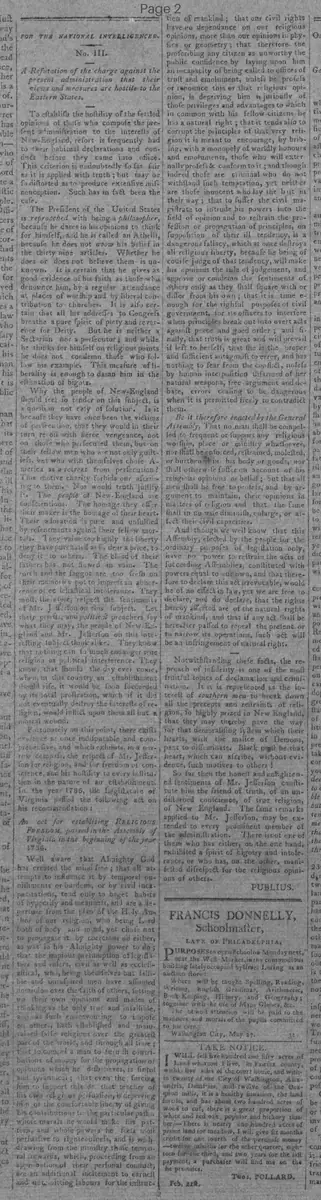
FOR THE NATIONAL INTELLIGENCER.
No. III.
A Refutation of the charge against the present administration that their views and measures are hostile to the Eastern States.
To establish the hostility of the settled opinions of those who compose the present administration to the interests of New-England, resort is frequently had to their habitual declarations and conduct before they came into office. This criterion is undoubtedly so far fair as it is applied with truth; but may be so distorted as to produce extensive misconception. Such has in fact been the case.
The President of the United States is reproached with being a philosopher, because he dares in his opinions to think for himself, and he is called an Atheist, because he does not avow his belief in the thirty nine articles. Whether he does or does not believe them is unknown. It is certain that he gives as good evidence of his faith as those who denounce him, by a regular attendance at places of worship and by liberal contribution to churches. It is also certain that all his addresses to Congress breathe a pure spirit of piety and reverence for Deity. But he is neither a Sectarian nor a persecutor; and while he thinks for himself on religious points he does not condemn those who follow his example. This measure of liberality is enough to damn him in the estimation of bigots.
Why the people of New-England should feel so tender on this subject, is a question not easy of solution. Is it because they have once been the victims of persecution, that they would in their turn recoil with fierce vengeance, not on those who persecuted them, but on their fellow men who are not only guiltless, but who with themselves chose America as a retreat from persecution? Thus motive charity forbids our ascribing to them. Nor would truth justify it. The people of New-England are conscientious. The homage they offer their maker is the homage of their heart. Their adoration is pure and unsullied by resentments against their fellow mortals. They value too highly the liberty they have purchased at so dear a price, to deny it to others. The blood of their fathers has not flowed in vain. The torch and the faggot are too fresh on their memories not to impress an abhorrence of ecclesiastical intolerance. They must, therefore, respect the sentiments of Mr. Jefferson on this subject. Let their priests, and political preachers say what they may, the people of New-England and Mr. Jefferson on this interesting subject think alike. They know that nothing can so much endanger true religion as political interference. They know that should the day ever come, when, in this country an establishment should rise, it would be soon succeeded by its total prostration, which if it did not eventually destroy the interests of religion, would inflict upon them all but a mortal wound.
Fortunately on this point, there exists evidence at once indisputable and comprehensive, and which exhibits, in a narrow compass, the respect of Mr. Jefferson for religion, and for freedom of conscience, and his hostility to every institution in the nature of an establishment. In the year 1786, the Legislature of Virginia passed the following act on his recommendation:
An act for establishing Religious Freedom, passed in the Assembly of Virginia in the beginning of the year 1786.
Well aware that Almighty God hath created the mind free; that all attempts to influence it by temporal punishments or burthens, or by civil incapacitations, tend only to beget habits of hypocrisy and meanness, and are a departure from the plan of the holy author of our religion, who being Lord both of body and mind, yet chose not to propagate it by coercions on either, as was in his Almighty power to do; that the impious presumption of legislators and rulers, civil as well as ecclesiastical, who, being themselves but fallible and uninspired men, have assumed dominion over the faith of others, setting up their own opinions and modes of thinking as the only true and infallible, and as such endeavoring to impose them on others, hath established and maintained false religions over the greatest part of the world, and through all time; that to compel a man to furnish contributions of money for the propagation of opinions which he disbelieves, is sinful and tyrannical; that even the forcing him to support this or that teacher of his own religious persuasion, is depriving him of the comfortable liberty of giving his contributions to the particular pastor whose morals he would make his pattern, and whose powers he feels most persuasive to righteousness, and is withdrawing from the ministry those temporal rewards, which, proceeding from an approbation of their personal conduct, are an additional incitement to earnest and unfeigned labours for the instruction of mankind: that our civil rights have no dependence on our religious opinions, more than our opinions in physics or geometry; that therefore the proscribing any citizen as unworthy the public confidence by laying upon him an incapacity of being called to offices of trust and emolument, unless he profess or renounce this or that religious opinion, is depriving him injuriously of those privileges and advantages to which in common with his fellow citizens he has a natural right; that it tends also to corrupt the principles of that very religion it is meant to encourage, by bribing, with a monopoly of worldly honours and emoluments, those who will externally profess and conform to it; and though indeed those are criminal who do not withstand such temptation, yet neither are those innocent who lay the bait in their way; that to suffer the civil magistrate to intrude his powers into the field of opinion and to restrain the profession or propagation of principles, on supposition of their ill tendency, is a dangerous fallacy, which at once destroys all religious liberty, because he being of course judge of that tendency, will make his opinions the rule of judgment, and approve or condemn the sentiments of others only as they shall square with or differ from his own: that it is time enough for the rightful purposes of civil government, for its officers to interfere when principles break out into overt acts against peace and good order; and finally, that truth is great and will prevail if left to herself, that she is the proper and sufficient antagonist to error, and has nothing to fear from the conflict, unless by human interposition disarmed of her natural weapons, free argument and debate, errors ceasing to be dangerous when it is permitted freely to contradict them.
Be it therefore enacted by the General Assembly, That no man shall be compelled to frequent or support any religious worship, place, or ministry whatsoever, nor shall he be enforced, restrained, molested, or burthened in his body or goods, nor shall otherwise suffer on account of his religious opinions or belief; but that all men shall be free to profess, and by argument to maintain, their opinions in matters of religion, and that the same shall in no wise diminish, enlarge, or affect their civil capacities.
And though we well know that this Assembly, elected by the people for the ordinary purposes of legislation only, have no power to restrain the acts of succeeding Assemblies, constituted with powers equal to our own, and that therefore to declare this act irrevocable, would be of no effect in law; yet we are free to declare, and do declare, that the rights hereby asserted are of the natural rights of mankind, and that if any act shall be hereafter passed to repeal the present or to narrow its operation, such act will be an infringement of natural right.
Notwithstanding these facts, the reproach of infidelity is one of the most fruitful topics of declamation and crimination. It is as represented as the interest of southern men to break down all the precepts and restraints of religion, so highly prized in New England, that they may thereby pave the way for that demoralizing system which their hearts, with the malice of Demons, pant to disseminate. Black must be that heart, which can ascribe, without evidence, such motives to others!
So far then the honest and enlightened sentiments of Mr. Jefferson constitute him the friend of truth, of an undisturbed conscience, of true religion, of New England. The same remarks applied to Mr. Jefferson, may be extended to every prominent member of the administration. There is not one of them who has either, on the one hand, exhibited a spirit of bigotry and intolerance, or who has, on the other, manifested disrespect for the religious opinions of others.
PUBLIUS.
No. III.
A Refutation of the charge against the present administration that their views and measures are hostile to the Eastern States.
To establish the hostility of the settled opinions of those who compose the present administration to the interests of New-England, resort is frequently had to their habitual declarations and conduct before they came into office. This criterion is undoubtedly so far fair as it is applied with truth; but may be so distorted as to produce extensive misconception. Such has in fact been the case.
The President of the United States is reproached with being a philosopher, because he dares in his opinions to think for himself, and he is called an Atheist, because he does not avow his belief in the thirty nine articles. Whether he does or does not believe them is unknown. It is certain that he gives as good evidence of his faith as those who denounce him, by a regular attendance at places of worship and by liberal contribution to churches. It is also certain that all his addresses to Congress breathe a pure spirit of piety and reverence for Deity. But he is neither a Sectarian nor a persecutor; and while he thinks for himself on religious points he does not condemn those who follow his example. This measure of liberality is enough to damn him in the estimation of bigots.
Why the people of New-England should feel so tender on this subject, is a question not easy of solution. Is it because they have once been the victims of persecution, that they would in their turn recoil with fierce vengeance, not on those who persecuted them, but on their fellow men who are not only guiltless, but who with themselves chose America as a retreat from persecution? Thus motive charity forbids our ascribing to them. Nor would truth justify it. The people of New-England are conscientious. The homage they offer their maker is the homage of their heart. Their adoration is pure and unsullied by resentments against their fellow mortals. They value too highly the liberty they have purchased at so dear a price, to deny it to others. The blood of their fathers has not flowed in vain. The torch and the faggot are too fresh on their memories not to impress an abhorrence of ecclesiastical intolerance. They must, therefore, respect the sentiments of Mr. Jefferson on this subject. Let their priests, and political preachers say what they may, the people of New-England and Mr. Jefferson on this interesting subject think alike. They know that nothing can so much endanger true religion as political interference. They know that should the day ever come, when, in this country an establishment should rise, it would be soon succeeded by its total prostration, which if it did not eventually destroy the interests of religion, would inflict upon them all but a mortal wound.
Fortunately on this point, there exists evidence at once indisputable and comprehensive, and which exhibits, in a narrow compass, the respect of Mr. Jefferson for religion, and for freedom of conscience, and his hostility to every institution in the nature of an establishment. In the year 1786, the Legislature of Virginia passed the following act on his recommendation:
An act for establishing Religious Freedom, passed in the Assembly of Virginia in the beginning of the year 1786.
Well aware that Almighty God hath created the mind free; that all attempts to influence it by temporal punishments or burthens, or by civil incapacitations, tend only to beget habits of hypocrisy and meanness, and are a departure from the plan of the holy author of our religion, who being Lord both of body and mind, yet chose not to propagate it by coercions on either, as was in his Almighty power to do; that the impious presumption of legislators and rulers, civil as well as ecclesiastical, who, being themselves but fallible and uninspired men, have assumed dominion over the faith of others, setting up their own opinions and modes of thinking as the only true and infallible, and as such endeavoring to impose them on others, hath established and maintained false religions over the greatest part of the world, and through all time; that to compel a man to furnish contributions of money for the propagation of opinions which he disbelieves, is sinful and tyrannical; that even the forcing him to support this or that teacher of his own religious persuasion, is depriving him of the comfortable liberty of giving his contributions to the particular pastor whose morals he would make his pattern, and whose powers he feels most persuasive to righteousness, and is withdrawing from the ministry those temporal rewards, which, proceeding from an approbation of their personal conduct, are an additional incitement to earnest and unfeigned labours for the instruction of mankind: that our civil rights have no dependence on our religious opinions, more than our opinions in physics or geometry; that therefore the proscribing any citizen as unworthy the public confidence by laying upon him an incapacity of being called to offices of trust and emolument, unless he profess or renounce this or that religious opinion, is depriving him injuriously of those privileges and advantages to which in common with his fellow citizens he has a natural right; that it tends also to corrupt the principles of that very religion it is meant to encourage, by bribing, with a monopoly of worldly honours and emoluments, those who will externally profess and conform to it; and though indeed those are criminal who do not withstand such temptation, yet neither are those innocent who lay the bait in their way; that to suffer the civil magistrate to intrude his powers into the field of opinion and to restrain the profession or propagation of principles, on supposition of their ill tendency, is a dangerous fallacy, which at once destroys all religious liberty, because he being of course judge of that tendency, will make his opinions the rule of judgment, and approve or condemn the sentiments of others only as they shall square with or differ from his own: that it is time enough for the rightful purposes of civil government, for its officers to interfere when principles break out into overt acts against peace and good order; and finally, that truth is great and will prevail if left to herself, that she is the proper and sufficient antagonist to error, and has nothing to fear from the conflict, unless by human interposition disarmed of her natural weapons, free argument and debate, errors ceasing to be dangerous when it is permitted freely to contradict them.
Be it therefore enacted by the General Assembly, That no man shall be compelled to frequent or support any religious worship, place, or ministry whatsoever, nor shall he be enforced, restrained, molested, or burthened in his body or goods, nor shall otherwise suffer on account of his religious opinions or belief; but that all men shall be free to profess, and by argument to maintain, their opinions in matters of religion, and that the same shall in no wise diminish, enlarge, or affect their civil capacities.
And though we well know that this Assembly, elected by the people for the ordinary purposes of legislation only, have no power to restrain the acts of succeeding Assemblies, constituted with powers equal to our own, and that therefore to declare this act irrevocable, would be of no effect in law; yet we are free to declare, and do declare, that the rights hereby asserted are of the natural rights of mankind, and that if any act shall be hereafter passed to repeal the present or to narrow its operation, such act will be an infringement of natural right.
Notwithstanding these facts, the reproach of infidelity is one of the most fruitful topics of declamation and crimination. It is as represented as the interest of southern men to break down all the precepts and restraints of religion, so highly prized in New England, that they may thereby pave the way for that demoralizing system which their hearts, with the malice of Demons, pant to disseminate. Black must be that heart, which can ascribe, without evidence, such motives to others!
So far then the honest and enlightened sentiments of Mr. Jefferson constitute him the friend of truth, of an undisturbed conscience, of true religion, of New England. The same remarks applied to Mr. Jefferson, may be extended to every prominent member of the administration. There is not one of them who has either, on the one hand, exhibited a spirit of bigotry and intolerance, or who has, on the other, manifested disrespect for the religious opinions of others.
PUBLIUS.
What sub-type of article is it?
Moral Or Religious
Constitutional
Partisan Politics
What keywords are associated?
Religious Freedom
Jefferson Piety
New England
Atheism Charges
Virginia Statute
Church Establishment
Political Preachers
Freedom Of Conscience
What entities or persons were involved?
Mr. Jefferson
Present Administration
People Of New England
Publius
Editorial Details
Primary Topic
Refutation Of Charges Against Jefferson's Administration For Hostility To New England's Religious Interests
Stance / Tone
Strongly Defensive Of Jefferson And Religious Liberty, Critical Of Bigotry And Political Interference In Religion
Key Figures
Mr. Jefferson
Present Administration
People Of New England
Publius
Key Arguments
Jefferson's Personal Piety Shown Through Church Attendance And Contributions
Jefferson's Addresses To Congress Reflect Reverence For Deity
Jefferson Promotes Religious Liberty, Not Sectarianism Or Persecution
New Englanders Value Religious Freedom Due To Their History Of Persecution
Political Interference Endangers True Religion
Virginia Statute Of 1786 Demonstrates Jefferson's Commitment To Freedom Of Conscience
No Compulsion In Religious Worship Or Support
Civil Rights Independent Of Religious Opinions
Truth Prevails Through Free Argument, Not Coercion
Charges Of Infidelity Against Southern Men Are Baseless And Malicious