Thank you for visiting SNEWPapers!
Sign up free
Editorial
September 8, 1861
Daily National Democrat
Marysville, Yuba County, California
What is this article about?
Edward Everett argues in the New York Ledger that during the Civil War, Union authorities should restrict secessionist newspapers in the North that aid the Confederacy, as full press freedom in wartime enables treason, unlike the South's suppression of dissent. He emphasizes balancing civil liberties with military necessity under constitutional limits.
Clipping
OCR Quality
95%
Excellent
Full Text
Daily National Democrat.
Edward Everett on Secession Newspapers in the North.
From the New York Ledger.
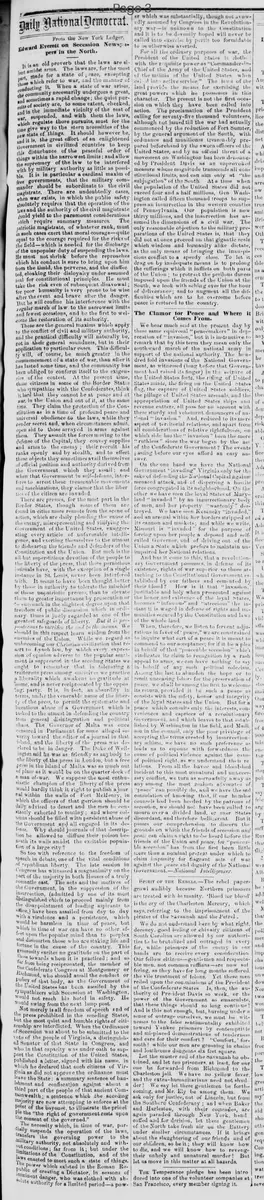
It is an old proverb that the laws are silent amidst arms. The laws are, for the most part, those which refer to war, and the manner of making state peace, excepting when the community necessarily undergoes a great and sometimes rapid change, the pursuits of society are, to some extent, checked, and in the immediate vicinity of the seat of war, suspended, and with them the laws which regulate those pursuits must, for a time, give way to the stern necessities of the contest, and it is the great effort of an enlightened state of things to confine this disturbance of the peaceful order of countries within the narrowest limits, and allow the supremacy of the law to be interfered with by military authority as little as possible. It is in particular a cardinal maxim of free governments that the military commander should be subordinate to the civil magistrate. There are undoubtedly cases when war exists, in which the public safety absolutely requires that the operation of the laws and the authority of the civil magistrate should yield to the paramount considerations which require summary measures. The patriotic magistrate, of whatever rank, must in such cases exert that moral courage—quite equal to the courage required for the risks of the field—which is needed for the discharge of the unpopular duty of suspending the laws. He must not shrink before the reproaches which his conduct is sure to bring upon him from the timid, the perverse, and the disaffected, cloaking their disloyalty under assumed zeal for constitutional principles. He must take the risk even of subsequent disavowal; for poor humanity is very prone to be wise after the event and brave after the danger. But he will confine his interference with the regular march of law to the narrowest limits and fewest occasions, and be the first to welcome the restoration of its authority. These are the general maxims which apply to the conflict of civil and military authority, and the practical difficulty will naturally be, not in their general soundness, but in their application to particular cases. This difficulty will, of course, be much greater in the commencement of a state of war, than after it has lasted some time, and the community has been obliged to conform itself to the exigencies of the contest. At the present time, those citizens in some of the Border States who sympathize with the Confederates, think it hard that they cannot be at peace and at war, in the Union and out of it, at the same time. They claim the protection of the Constitution as in a time of profound peace and universal obedience to the laws, while they render secret and, when circumstances admit, open aid to those arrayed in arms against them. They assault the forces moving to the defense of the Capital, they convey supplies and arms to the enemy; their recruit his ranks openly and by stealth, and to effect these objects they sometimes avail themselves of official position and authority derived from the Government which they assail; and when that Government in self-defense, interferes to arrest these treasonable movements and machinations, they clamor that the liberties of the citizen are invaded. There are presses, for the most part in the Border States, though some of them are found in cities more remote from the scene of action, which are daily pleading the cause of the enemy, misrepresenting and vilifying the Government of the United States, exaggerating every article of unfavorable intelligence, and exerting themselves to the utmost to dishearten the friends and defenders of the Constitution and the Union. But such is the almost superstitious devotion of the people to the liberty of the press, that these pernicious journals have, with the exception of a single instance in St. Louis, never been interfered with. It seems to have been thought better by those in authority to tolerate the mischief of these unpatriotic presses, than to elevate them to greater importance by prosecution or to encroach in the slightest degree upon that freedom of public discussion which in ordinary times is justly regarded as one of the greatest safeguards of liberty. But it is preposterous to sacrifice the end to the means. We should in this respect learn wisdom from the enemies of the Union. While we regard as unbecoming our Christian civilization that resort to Lynch law, by which every expression of opinion adverse to the popular sentiment is suppressed in the seceding States, we ought to remember that in tolerating a traitorous press among ourselves we practice a liberality which awakens no gratitude at home, and is never reciprocated by the opposing party. It is, in fact, an absurdity in terms, under the venerable name of the liberty of the press, to permit the systematic and licentious abuse of a Government which is tasked to the utmost in defending the country from general disintegration and political chaos. The Governor of Malta was once censured in Parliament for some alleged severity toward the editor of a journal in that island, and the liberty of the press was declared to be in danger. The Duke of Wellington said he was as friendly as anybody to the liberty of the press in London, but a free press in the Island of Malta was as much out of place as it would be on the quarter deck of a man-of-war. We suppose the most enthusiastic champion of the liberty of the press would hardly think it right to publish a journal within the walls of Fort McHenry, in which the officers of that garrison should be daily advised to desert and the men be constantly exhorted to mutiny; and whose columns should be filled with persistent abuse of the Government and all engaged in its defense. Why should journals of that description be allowed to diffuse their poison beneath its walls amidst the excitable population of a large city? So too with reference to the freedom of speech in debate, one of the vital conditions of republican liberty. The late session in Congress has witnessed a magnanimity on the part of the majority in both Houses of a truly romantic cast. The acts and the motives of the Government in the suppression of the insurrection (admitted by one of its most distinguished chiefs to proceed mainly from the disappointment of leading aspirants to office) have been assailed from day to day with a virulence and a persistence, which would be harmless in time of peace, but which in time of war can have no other effect upon the popular mind than to perplex and dishearten those who are staking life and fortune in the cause of the country. This generosity excites no gratitude on the part of those towards whom it is practiced; and so far from being reciprocated, the member of the Richmond Confederate Congress who should assail at Montgomery the conduct and policy of that body as the Government of the United States has been assailed at Washington, would not reach his hotel in safety. He would swing from the next lamp post. Not merely is all freedom of speech and of the press prohibited in the seceding States, but the most quiet and humble rights of citizenship are interdicted. When the Ordinance of Secession was about to be submitted to the vote of the people of Virginia, a distinguished Senator of that State in Congress, and who in that capacity was under oath to support the Constitution of the United States, published a letter, signed with his name, in which he declared that such citizens of Virginia as did not approve the ordinance must leave the State: a summary sentence of banishment and confiscation against about a third part of the people of that ancient Commonwealth; a sentence which the seceding majority are now attempting to enforce at the point of the bayonet, to illustrate the principle that "the right of government rests upon the consent of the governed." The necessity which, in time of war, partially suspends the operation of the laws, transfers the governing power to the military authority not absolutely and without conditions, but far from it, but under the limitations of the Constitution and of the laws. The power which to meet such exigencies existed in the state of things in the Roman republic of creating a Dictator in seasons of imminent danger who was clothed with absolute authority for a limited period—a power which was substantially, though not avowedly assumed by Congress in the Revolutionary war—is unknown to the Constitution, and it is to be devoutly hoped will never be called into exercise by perils too formidable to be otherwise averted. For all the ordinary purposes of war, the President of the United States is clothed with the requisite power as "Commander-in-Chief of the Army of the United States, and of the militia of the United States, when called into active service." The laws of the land provide the means for exercising the great powers which he possesses in this character. The present is not the first occasion on which they have been called into action. The proclamation of the President calling for seventy-five thousand volunteers, although not issued till the war had actually commenced by the reduction of Fort Sumter, by the general armament of the South, with ordinance and munitions treasonably prepared beforehand by the sworn officers of the United States, and by an official threat of a movement on Washington, has been denounced by President Davis as an unprovoked measure whose magnitude transcends all constitutional limits, and can aim only at "the subjugation" of the South. At a time when the population of the United States did not exceed four and a half millions, Gen. Washington called fifteen thousand troops to suppress an insurrection in the western counties of Pennsylvania. Our population is now thirty millions, and the insurrection has assumed the dimensions of a civil war. The only reasonable objection to the military preparations of the United States is, that they did not at once proceed on that gigantic scale which wisdom and humanity alike dictate as the only means of bringing the inauspicious conflict to a speedy close. To let it drag on by inadequate means is to prolong the sufferings which it inflicts on both parts of the Union; to protract the perilous duress imposed upon the friends of the Union at the South, who look with aching eyes for the hour of deliverance; and to augment all the difficulties which are to be overcome before peace is restored to the country.
Edward Everett on Secession Newspapers in the North.
From the New York Ledger.
It is an old proverb that the laws are silent amidst arms. The laws are, for the most part, those which refer to war, and the manner of making state peace, excepting when the community necessarily undergoes a great and sometimes rapid change, the pursuits of society are, to some extent, checked, and in the immediate vicinity of the seat of war, suspended, and with them the laws which regulate those pursuits must, for a time, give way to the stern necessities of the contest, and it is the great effort of an enlightened state of things to confine this disturbance of the peaceful order of countries within the narrowest limits, and allow the supremacy of the law to be interfered with by military authority as little as possible. It is in particular a cardinal maxim of free governments that the military commander should be subordinate to the civil magistrate. There are undoubtedly cases when war exists, in which the public safety absolutely requires that the operation of the laws and the authority of the civil magistrate should yield to the paramount considerations which require summary measures. The patriotic magistrate, of whatever rank, must in such cases exert that moral courage—quite equal to the courage required for the risks of the field—which is needed for the discharge of the unpopular duty of suspending the laws. He must not shrink before the reproaches which his conduct is sure to bring upon him from the timid, the perverse, and the disaffected, cloaking their disloyalty under assumed zeal for constitutional principles. He must take the risk even of subsequent disavowal; for poor humanity is very prone to be wise after the event and brave after the danger. But he will confine his interference with the regular march of law to the narrowest limits and fewest occasions, and be the first to welcome the restoration of its authority. These are the general maxims which apply to the conflict of civil and military authority, and the practical difficulty will naturally be, not in their general soundness, but in their application to particular cases. This difficulty will, of course, be much greater in the commencement of a state of war, than after it has lasted some time, and the community has been obliged to conform itself to the exigencies of the contest. At the present time, those citizens in some of the Border States who sympathize with the Confederates, think it hard that they cannot be at peace and at war, in the Union and out of it, at the same time. They claim the protection of the Constitution as in a time of profound peace and universal obedience to the laws, while they render secret and, when circumstances admit, open aid to those arrayed in arms against them. They assault the forces moving to the defense of the Capital, they convey supplies and arms to the enemy; their recruit his ranks openly and by stealth, and to effect these objects they sometimes avail themselves of official position and authority derived from the Government which they assail; and when that Government in self-defense, interferes to arrest these treasonable movements and machinations, they clamor that the liberties of the citizen are invaded. There are presses, for the most part in the Border States, though some of them are found in cities more remote from the scene of action, which are daily pleading the cause of the enemy, misrepresenting and vilifying the Government of the United States, exaggerating every article of unfavorable intelligence, and exerting themselves to the utmost to dishearten the friends and defenders of the Constitution and the Union. But such is the almost superstitious devotion of the people to the liberty of the press, that these pernicious journals have, with the exception of a single instance in St. Louis, never been interfered with. It seems to have been thought better by those in authority to tolerate the mischief of these unpatriotic presses, than to elevate them to greater importance by prosecution or to encroach in the slightest degree upon that freedom of public discussion which in ordinary times is justly regarded as one of the greatest safeguards of liberty. But it is preposterous to sacrifice the end to the means. We should in this respect learn wisdom from the enemies of the Union. While we regard as unbecoming our Christian civilization that resort to Lynch law, by which every expression of opinion adverse to the popular sentiment is suppressed in the seceding States, we ought to remember that in tolerating a traitorous press among ourselves we practice a liberality which awakens no gratitude at home, and is never reciprocated by the opposing party. It is, in fact, an absurdity in terms, under the venerable name of the liberty of the press, to permit the systematic and licentious abuse of a Government which is tasked to the utmost in defending the country from general disintegration and political chaos. The Governor of Malta was once censured in Parliament for some alleged severity toward the editor of a journal in that island, and the liberty of the press was declared to be in danger. The Duke of Wellington said he was as friendly as anybody to the liberty of the press in London, but a free press in the Island of Malta was as much out of place as it would be on the quarter deck of a man-of-war. We suppose the most enthusiastic champion of the liberty of the press would hardly think it right to publish a journal within the walls of Fort McHenry, in which the officers of that garrison should be daily advised to desert and the men be constantly exhorted to mutiny; and whose columns should be filled with persistent abuse of the Government and all engaged in its defense. Why should journals of that description be allowed to diffuse their poison beneath its walls amidst the excitable population of a large city? So too with reference to the freedom of speech in debate, one of the vital conditions of republican liberty. The late session in Congress has witnessed a magnanimity on the part of the majority in both Houses of a truly romantic cast. The acts and the motives of the Government in the suppression of the insurrection (admitted by one of its most distinguished chiefs to proceed mainly from the disappointment of leading aspirants to office) have been assailed from day to day with a virulence and a persistence, which would be harmless in time of peace, but which in time of war can have no other effect upon the popular mind than to perplex and dishearten those who are staking life and fortune in the cause of the country. This generosity excites no gratitude on the part of those towards whom it is practiced; and so far from being reciprocated, the member of the Richmond Confederate Congress who should assail at Montgomery the conduct and policy of that body as the Government of the United States has been assailed at Washington, would not reach his hotel in safety. He would swing from the next lamp post. Not merely is all freedom of speech and of the press prohibited in the seceding States, but the most quiet and humble rights of citizenship are interdicted. When the Ordinance of Secession was about to be submitted to the vote of the people of Virginia, a distinguished Senator of that State in Congress, and who in that capacity was under oath to support the Constitution of the United States, published a letter, signed with his name, in which he declared that such citizens of Virginia as did not approve the ordinance must leave the State: a summary sentence of banishment and confiscation against about a third part of the people of that ancient Commonwealth; a sentence which the seceding majority are now attempting to enforce at the point of the bayonet, to illustrate the principle that "the right of government rests upon the consent of the governed." The necessity which, in time of war, partially suspends the operation of the laws, transfers the governing power to the military authority not absolutely and without conditions, but far from it, but under the limitations of the Constitution and of the laws. The power which to meet such exigencies existed in the state of things in the Roman republic of creating a Dictator in seasons of imminent danger who was clothed with absolute authority for a limited period—a power which was substantially, though not avowedly assumed by Congress in the Revolutionary war—is unknown to the Constitution, and it is to be devoutly hoped will never be called into exercise by perils too formidable to be otherwise averted. For all the ordinary purposes of war, the President of the United States is clothed with the requisite power as "Commander-in-Chief of the Army of the United States, and of the militia of the United States, when called into active service." The laws of the land provide the means for exercising the great powers which he possesses in this character. The present is not the first occasion on which they have been called into action. The proclamation of the President calling for seventy-five thousand volunteers, although not issued till the war had actually commenced by the reduction of Fort Sumter, by the general armament of the South, with ordinance and munitions treasonably prepared beforehand by the sworn officers of the United States, and by an official threat of a movement on Washington, has been denounced by President Davis as an unprovoked measure whose magnitude transcends all constitutional limits, and can aim only at "the subjugation" of the South. At a time when the population of the United States did not exceed four and a half millions, Gen. Washington called fifteen thousand troops to suppress an insurrection in the western counties of Pennsylvania. Our population is now thirty millions, and the insurrection has assumed the dimensions of a civil war. The only reasonable objection to the military preparations of the United States is, that they did not at once proceed on that gigantic scale which wisdom and humanity alike dictate as the only means of bringing the inauspicious conflict to a speedy close. To let it drag on by inadequate means is to prolong the sufferings which it inflicts on both parts of the Union; to protract the perilous duress imposed upon the friends of the Union at the South, who look with aching eyes for the hour of deliverance; and to augment all the difficulties which are to be overcome before peace is restored to the country.
What sub-type of article is it?
Press Freedom
War Or Peace
Constitutional
What keywords are associated?
Press Freedom
Civil War
Secession Newspapers
Traitorous Press
Union Defense
Constitutional Limits
Military Authority
What entities or persons were involved?
Edward Everett
Confederates
United States Government
President Lincoln
President Davis
Duke Of Wellington
Gen. Washington
Editorial Details
Primary Topic
Restrictions On Secessionist Newspapers During Civil War
Stance / Tone
Pro Union Advocacy For Limiting Traitorous Press In Wartime
Key Figures
Edward Everett
Confederates
United States Government
President Lincoln
President Davis
Duke Of Wellington
Gen. Washington
Key Arguments
Laws Are Silent In War, Requiring Suspension For Public Safety
Military Authority Must Subordinate To Civil Magistrate Except In Necessity
Border State Sympathizers Aid Enemy While Claiming Constitutional Protections
Secessionist Presses In North Vilify Union And Should Face Interference
Tolerating Traitorous Press Sacrifices Ends To Means, Unlike South's Suppression
Freedom Of Speech In Congress Harms War Effort Without Reciprocation
President's Powers As Commander In Chief Are Constitutional For War
Military Preparations Should Be Scaled Up To End War Quickly