Thank you for visiting SNEWPapers!
Sign up free
Daily National Intelligencer
Washington, District Of Columbia
What is this article about?
Seamen on the Tyne and Wear rivers in England, numbering about 10,000, have formed a combination demanding higher wages and more crew stipulations, imposing an embargo on ships for three weeks, with orderly processions and patrols to maintain discipline.
Clipping
OCR Quality
Full Text
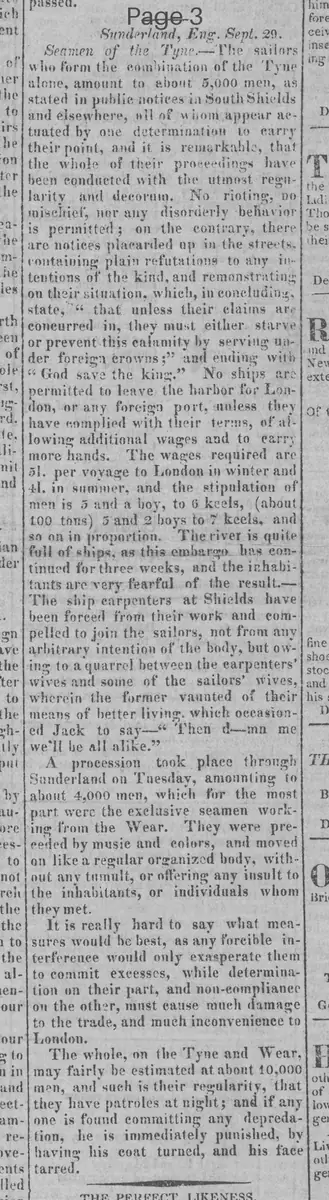
Seamen of the Tyne. -- The sailors who form the combination of the Tyne alone, amount to about 5,000 men, as stated in public notices in South Shields and elsewhere, all of whom appear actuated by one determination to carry their point, and it is remarkable, that the whole of their proceedings have been conducted with the utmost regularity and decorum. No rioting, no mischief, nor any disorderly behavior is permitted; on the contrary, there are notices placarded up in the streets, containing plain refutations to any intentions of the kind, and remonstrating on their situation, which, in concluding, state, "that unless their claims are concurred in, they must either starve or prevent this calamity by serving under foreign crowns;" and ending with "God save the king." No ships are permitted to leave the harbor for London, or any foreign port, unless they have complied with their terms, of allowing additional wages and to carry more hands. The wages required are 5l. per voyage to London in winter and 4l. in summer, and the stipulation of men is 5 and a boy, to 6 keels, (about 100 tons) 5 and 2 boys to 7 keels, and so on in proportion. The river is quite full of ships, as this embargo has continued for three weeks, and the inhabitants are very fearful of the result. -- The ship carpenters at Shields have been forced from their work and compelled to join the sailors, not from any arbitrary intention of the body, but owing to a quarrel between the carpenters' wives and some of the sailors' wives, wherein the former vaunted of their means of better living, which occasioned Jack to say -- Then d--n me we'll be all alike.
A procession took place through Sunderland on Tuesday, amounting to about 4,000 men, which for the most part were the exclusive seamen working from the Wear. They were preceded by music and colors, and moved on like a regular organized body, without any tumult, or offering any insult to the inhabitants, or individuals whom they met.
It is really hard to say what measures would be best, as any forcible interference would only exasperate them to commit excesses, while determination on their part, and non-compliance on the other, must cause much damage to the trade, and much inconvenience to London.
The whole, on the Tyne and Wear, may fairly be estimated at about 10,000 men, and such is their regularity, that they have patrols at night; and if any one is found committing any depredation, he is immediately punished, by having his coat turned, and his face tarred.
What sub-type of article is it?
What keywords are associated?
Where did it happen?
Foreign News Details
Primary Location
Sunderland, Eng.
Event Date
Sept. 29.
Outcome
embargo on ships for three weeks, causing damage to trade and inconvenience to london; no reported casualties or excesses.
Event Details
About 5,000 seamen on the Tyne and 4,000 on the Wear have combined to demand higher wages (5l. winter, 4l. summer to London) and specific crew stipulations per tonnage; they prevent ships from leaving harbors without compliance, conduct orderly processions and patrols, and have forced ship carpenters to join after a dispute.