Thank you for visiting SNEWPapers!
Sign up free
The National Intelligencer And Washington Advertiser
Washington, District Of Columbia
What is this article about?
In May 1809, Napoleon's French army approaches Vienna, meets initial resistance from Archduke Maximilian, but the city's population largely welcomes them. After bombardment and crossing the Danube, Vienna surrenders on May 13 with favorable capitulation terms for inhabitants.
Clipping
OCR Quality
Full Text
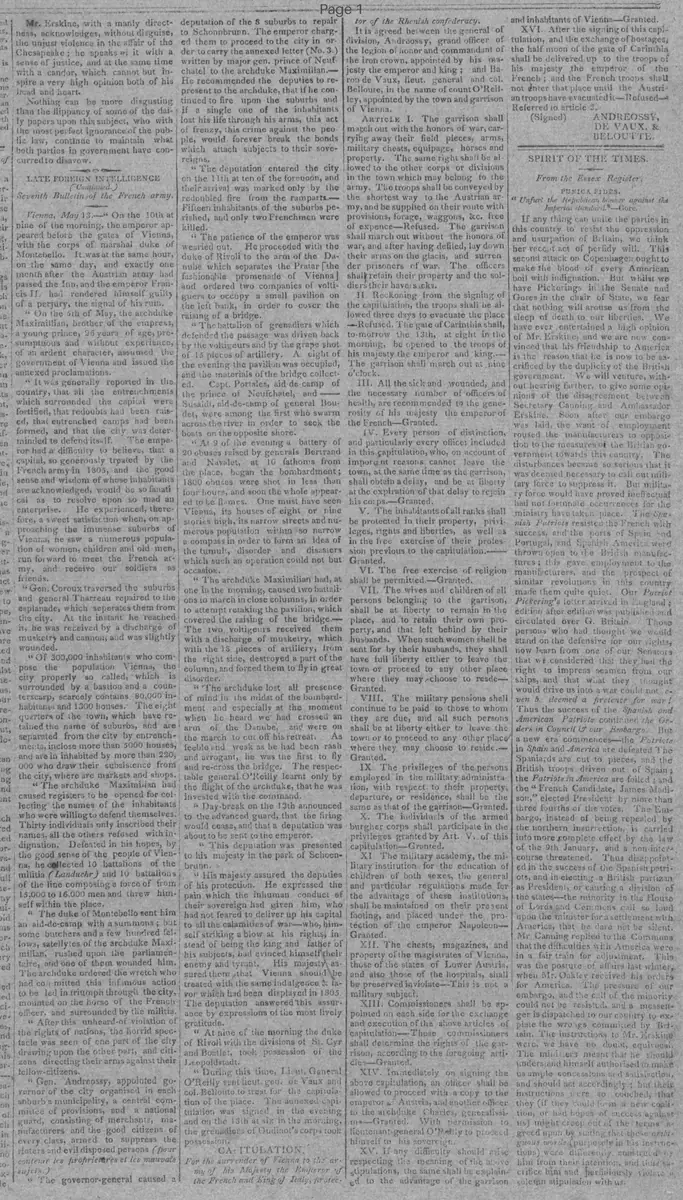
Seventh Bulletin of the French army.
Vienna, May 13. - On the 10th at nine in the morning, the emperor appeared before the gates of Vienna, with the corps of marshal duke of Montebello. It was at the same hour, on the same day, and exactly one month after the Austrian army had passed the Inn, and the emperor Francis II. had rendered himself guilty of a perjury, the signal of his ruin.
On the 5th of May, the archduke Maximilian, brother of the empress, a young prince, 26 years of age, presumptuous and without experience, of an ardent character, assumed the government of Vienna and issued the annexed proclamations.
It was generally reported in the country, that all the entrenchments which surrounded the capital were fortified, that redoubts had been raised, that entrenched camps had been formed, and that the city was determined to defend itself. The emperor had a difficulty to believe, that a capital, so generously treated by the French army in 1805, and the good sense and wisdom of whose inhabitants are acknowledged, would be so fanatical as to resolve upon so mad an enterprise. He experienced, therefore, a sweet satisfaction when, on approaching the immense suburbs of Vienna, he saw a numerous population of women, children and old men, run forward to meet the French army, and receive our soldiers as friends.
Gen. Curoux traversed the suburbs and general Tharreau repaired to the esplanade, which separates them from the city. At the instant he reached it, he was received by a discharge of musketry and cannon, and was slightly wounded.
Of 300,000 inhabitants who compose the population of Vienna, the city properly so called, which is surrounded by a bastion and a counterscarp, scarcely contains 80,000 inhabitants and 1300 houses. The eight quarters of the town, which have retained the name of suburbs, and are separated from the city by entrenchments, inclose more than 5000 houses, and are inhabited by more than 220,000 who draw their subsistence from the city, where are markets and shops.
The archduke Maximilian had caused registers to be opened for collecting the names of the inhabitants who were willing to defend themselves. Thirty individuals only inscribed their names, all the others refused with indignation. Defeated in his hopes, by the good sense of the people of Vienna, he collected 10 battalions of the militia (Landwehr) and 10 battalions of the line composing a force of from 15,000 to 16,000 men and threw himself within the place.
The duke of Montebello sent him an aide-de-camp with a summons; but some butchers and a few hundred fellows, satellites of the archduke Maximilian, rushed upon the parlementaire, and one of them wounded him. The archduke ordered the wretch who had committed this infamous action to be led in triumph through the city, mounted on the horse of the French officer, and surrounded by the militia.
After this unheard-of violation of the rights of nations, the horrid spectacle was seen of one part of the city drawing upon the other part, and citizens directing their arms against their fellow-citizens.
Gen. Andreossy, appointed governor of the city organised in each suburb a municipality, a central committee of provisions, and a national guard, consisting of merchants, manufacturers and the good citizens of every class, armed to suppress the rioters and evil disposed persons (pour contenir les proprietaires et les mauvais sujets.)
The governor-general caused a deputation of the 8 suburbs to repair to Schoenbrunn. The emperor charged them to proceed to the city in order to carry the annexed letter (No. 3.) written by major gen. prince of Neufchatel to the archduke Maximilian. He recommended the deputies to represent to the archduke, that if he continued to fire upon the suburbs and if a single one of the inhabitants lost his life through his arms, this act of frenzy, this crime against the people, would forever break the bonds which attach subjects to their sovereigns.
The deputation entered the city on the 11th at ten of the forenoon, and their arrival was marked only by the redoubled fire from the ramparts. Fifteen inhabitants of the suburbs perished, and only two Frenchmen were killed.
The patience of the emperor was wearied out. He proceeded with the duke of Rivoli to the arm of the Danube which separates the Prater (the fashionable promenade of Vienna) and ordered two companies of voltigeurs to occupy a small pavilion on the left bank, in order to cover the raising of a bridge.
The battalion of grenadiers which defended the passage was driven back by the voltigeurs and by the grape shot of 15 pieces of artillery. At eight of the evening the pavilion was occupied, and the materials of the bridge collected. Capt. Portales, aide-de-camp of the prince of Neufchatel, and - Susaidt, aide-de-camp of general Boudet, were among the first who swam across the river in order to seek the boats on the opposite shore.
At 9 of the evening a battery of 20 howitzers raised by generals Bertrand and Navalet, at 10 fathoms from the place, began the bombardment; 1800 howitzers were shot in less than four hours, and soon the whole appeared to be in flames. One must have seen Vienna, its houses of eight or nine stories high, its narrow streets and numerous population within so narrow a compass in order to form an idea of the tumult, disorder and disasters which such an operation could not but occasion.
The archduke Maximilian had, at one in the morning, caused two battalions to march in close columns, in order to attempt retaking the pavilion, which covered the raising of the bridge. The two voltigeurs received them with a discharge of musketry, which with the 13 pieces of artillery, from the right side, destroyed a part of the column, and forced them to fly in great disorder.
The archduke lost all presence of mind in the midst of the bombardment and especially at the moment when he heard we had crossed an arm of the Danube, and were on the march to cut off his retreat. As feeble and weak as he had been rash and arrogant, he was the first to fly and re-cross the bridge. The respectable general O'Reilly learnt only by the flight of the archduke, that he was invested with the command.
Day-break on the 13th announced to the advanced guard, that the firing would cease, and that a deputation was about to be sent to the emperor.
This deputation was presented to his majesty in the park of Schoenbrunn.
His majesty assured the deputies of his protection. He expressed the pain which the inhuman conduct of their sovereign had given him, who had not feared to deliver up his capital to all the calamities of war—who, himself striking a blow at his rights, instead of being the king and father of his subjects, had evinced himself their enemy and tyrant. His majesty assured them that Vienna should be treated with the same indulgence & favor which had been displayed in 1805. The deputation answered this assurance by expressions of the most lively gratitude.
At nine of the morning the duke of Rivoli with the divisions of St. Cyr and Beulet, took possession of the Leopoldstadt.
During this time, Lieut. General O'Reilly sent lieut. gen. de Vaux and col. Belloute to treat on the capitulation of the place. The annexed capitulation was signed in the evening and on the 13th at six in the morning, the grenadiers of Oudinot's corps took possession.
4
CAPITULATION.
For the surrender of Vienna to the army of his Majesty the Emperor of the French and King of Italy, protector of the Rhenish confederacy.
It is agreed between the general of division, Andreossy, grand officer of the legion of honor and commandant of the iron crown, appointed by his majesty the emperor and king ; and Baron de Vaux, lieut. general and col. Belloute, in the name of count O'Reilly, appointed by the town and garrison of Vienna.
ARTICLE I. The garrison shall march out with the honors of war, carrying away their field pieces, arms, military chests, equipage, horses and property. The same right shall be allowed to the other corps or divisions in the town which may belong to the army. The troops shall be conveyed by the shortest way to the Austrian army, and be supplied on their route with provisions, forage, waggons, &c. free of expence—Refused. The garrison shall march out without the honors of war, and after having defiled, lay down their arms on the glacis, and surrender prisoners of war. The officers shall retain their property and the soldiers their knapsacks.
II. Reckoning from the signing of the capitulation, the troops shall be allowed three days to evacuate the place—Refused. The gate of Carinthia shall, to-morrow the 13th, at eight in the morning, be opened to the troops of his majesty the emperor and king. The garrison shall march out at nine o'clock.
III. All the sick and wounded, and the necessary number of officers of health, are recommended to the generosity of his majesty the emperor of the French—Granted.
IV. Every person of distinction, and particularly every officer included in this capitulation, who, on account of important reasons cannot leave the town, at the same time as the garrison, shall obtain a delay, and be at liberty at the expiration of that delay to rejoin his corps—Granted.
V. The inhabitants of all ranks shall be protected in their property, privileges, rights and liberties, as well as in the free exercise of their profession previous to the capitulation—Granted.
VI. The free exercise of religion shall be permitted—Granted.
VII. The wives and children of all persons belonging to the garrison, shall be at liberty to remain in the place, and to retain their own property, and that left behind by their husbands. When such women shall be sent for by their husbands, they shall have full liberty either to leave the town or proceed to any other place where they may choose to reside—Granted.
VIII. The military pensions shall continue to be paid to those to whom they are due, and all such persons shall be at liberty either to leave the town or to proceed to any other place where they may choose to reside—Granted.
IX. The privileges of the persons employed in the military administration, with respect to their property, departure, or residence, shall be the same as that of the garrison—Granted.
X. The individuals of the armed burgher corps shall participate in the privileges granted by Art. V. of this capitulation—Granted.
XI. The military academy, the military institution for the education of children of both sexes, the general and particular regulations made for the advantage of these institutions, shall be maintained on their present footing, and placed under the protection of the emperor Napoleon—Granted.
XII. The chests, magazines, and property of the magistrates of Vienna, those of the states of Lower Austria, and also those of the hospitals, shall be preserved inviolate—This is not a military subject.
XIII. Commissioners shall be appointed on each side for the exchange and execution of the above articles of capitulation—These commissioners shall determine the rights of the garrison, according to the foregoing articles—Granted.
XIV. Immediately on signing the above capitulation, an officer shall be allowed to proceed with a copy to the emperor of Austria, and another officer to the archduke Charles, generalissimo—Granted. With permission to lieutenant-general O'Reilly to proceed himself to his sovereign.
XV. If any difficulty should arise respecting the meaning of the above stipulations, the same shall be explained to the advantage of the garrison and inhabitants of Vienna—Granted.
XVI. After the signing of this capitulation, and the exchange of hostages, the half moon of the gate of Carinthia shall be delivered up to the troops of his majesty the emperor of the French ; and the French troops shall not enter that place until the Austrian troops have evacuated it—Refused. Referred to article 2.
(Signed)
ANDREOSSY
DE VAUX. &
BELOUTTE.
What sub-type of article is it?
What keywords are associated?
What entities or persons were involved?
Where did it happen?
Foreign News Details
Primary Location
Vienna
Event Date
May 5 13, 1809
Key Persons
Outcome
vienna surrenders; garrison becomes prisoners of war without honors; 15 suburb inhabitants and 2 frenchmen killed; favorable terms for civilians, property, and institutions protected.
Event Details
French army under Napoleon arrives at Vienna on May 10; minimal civilian resistance despite Archduke Maximilian's efforts; French cross Danube, bombard city; Archduke flees; city capitulates on May 13 with terms signed by Andreossy and O'Reilly's representatives.