Thank you for visiting SNEWPapers!
Sign up free
The Liberator
Boston, Suffolk County, Massachusetts
What is this article about?
Thomas S. Grimke's letter to South Carolinians, dated December 1, 1832, published in the Charleston Courier on the 14th ultimo, denounces the Nullification Ordinance as tyrannical, predicts federal military and naval enforcement, and warns of inevitable defeat and ruin for the state.
Clipping
OCR Quality
Full Text
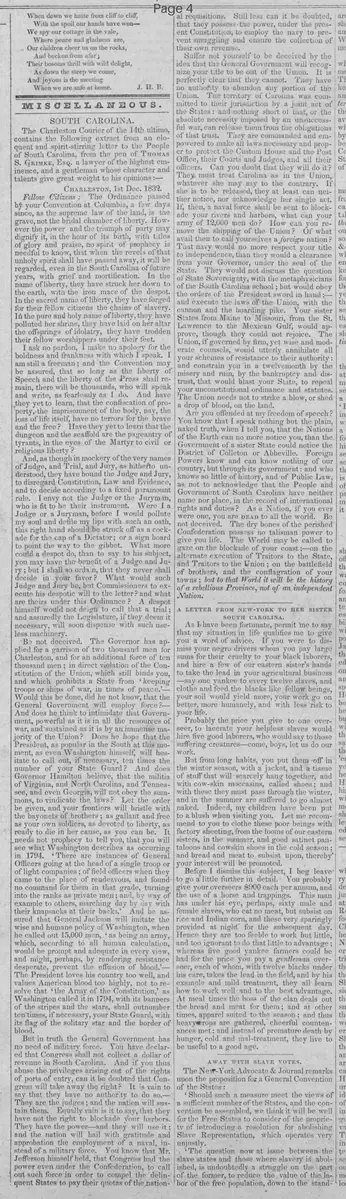
The Charleston Courier of the 14th ultimo. contains the following extract from an eloquent and spirit-stirring letter to the People of South Carolina, from the pen of Thomas S. Grimke, Esq. a lawyer of the highest eminence, and a gentleman whose character and talents give great weight to his opinions:
CHARLESTON, 1st Dec. 1832.
Fellow Citizens: The Ordinance passed by your Convention at Columbia, a few days since, as the supreme law of the land, is the grave, not the bridal chamber of liberty. However the power and the triumph of party may dignify it, in the hour of its birth, with titles of glory and praise, no spirit of prophecy is needful to know, that when the revels of that unholy spirit shall have passed away, it will be regarded, even in the South Carolina of future years, with grief and mortification. In the name of liberty, they have struck her down to the earth, with the iron mace of the despot. In the sacred name of liberty, they have forged for their fellow citizens the chains of slavery. In the pure and holy name of liberty, they have polluted her shrine, they have laid on her altar the offsprings of idolatry, they have trodden their fellow worshippers under their feet.
I ask no pardon, I make no apology for the boldness and frankness with which I speak. I am still a freeman; and the Convention may be assured, that so long as the liberty of Speech and the liberty of the Press shall remain, there will be thousands, who will speak and write, as fearlessly as I do. And have they yet to learn, that the confiscation of property, the imprisonment of the body, nay, the loss of life itself, have no terrors for the brave and the free? Have they yet to learn that the dungeon and the scaffold are the pageantry of tyrants, in the eyes of the Martyr to civil or religious liberty?
And, as though in mockery of the very names of Judge, and Trial, and Jury, as hitherto understood, they have bound the Judge and Jury, to disregard Constitution, Law and Evidence, and to decide according to a fixed paramount rule. I envy not the Judge or the Juryman, who is fit to be their instrument. Were I a Judge or a Juryman, before I would pollute my soul and defile my lips with such an oath, this right hand should be struck off as a cockade for the cap of a Dictator; or a sign board to point the way to the gibbet. What more could a despot do, than to say to his subject, you may have the benefit of a Judge and Jury; but I shall so ordain, that they never shall decide in your favor? What would such Judge and Jury be, but Commissioners to execute his despotic will to the letter? and what are theirs under this Ordinance? A despot himself would not deign to call that a trial: and assuredly the Legislature, if they deem it necessary, will soon dispense with such useless machinery.
Be not deceived. The Governor has applied for a garrison of two thousand men for Charleston, and for an additional force of ten thousand men; in direct violation of the Constitution of the Union, which still binds you, and which prohibits a State from 'keeping troops or ships of war, in times of peace.' Would this be done, did he not know, that the General Government will employ force?— And does he think to intimidate that Government, powerful as it is in all the resources of war, and sustained as it is by an immense majority of the Union? Does he hope that the President, as popular in the South at this moment, as even Washington himself, will hesitate to call out, if necessary, ten times the number of your State Guard? And does Governor Hamilton believe, that the militia of Virginia, and North Carolina, and Tennessee, and even Georgia, will not obey the summons, to vindicate the laws? Let the order be given, and your frontiers will bristle with the bayonets of brothers; as gallant and free as your own soldiers, as devoted to liberty, as ready to die in her cause, as you can be. It needs not prophecy to tell you, that you will see what Washington describes as occurring in 1794. 'There are instances of General Officers going at the head of a single troop or of light companies; of field officers when they came to the place of rendezvous, and found no command for them in that grade, turning into the ranks as private men; and, by way of example to others, marching day by day with their knapsacks at their backs.' And be assured that General Jackson will imitate the wise and humane policy of Washington, when he called out 15,000 men, 'as being an army, which, according to all human calculation, would be prompt and adequate in every view, and might, perhaps, by rendering resistance desperate, prevent the effusion of blood.' The President loves his country too well, and values American blood too highly, not to resolve that 'the Army of the Constitution,' as Washington called it in 1794, with its banners of the stripes and the stars, shall outnumber ten times, if necessary, your State Guard, with its flag of the solitary star and the border of blood.
But in truth the General Government has no need of military force. You have declared that Congress shall not collect a dollar of revenue in South Carolina. And if you thus abuse the privileges arising out of the rights of ports of entry, can it be doubted that Congress will take away the right? It is vain to say that they have no authority to do so.— They are the judges; and the nation will sustain them. Equally vain is it to say, that they have not the right to blockade your harbors. They have the power—and they will use it; and the nation will hail with gratitude and approbation the employment of a naval, instead of a military force. You know that Mr. Jefferson himself held, that Congress had the power even under the Confederation, to call out such force in order to compel the delinquent States to pay their quotas of the national requisitions. Still less can it be doubted, that they possess the power, under the present Constitution, to employ the navy to prevent smuggling and ensure the collection of their own revenue.
Suffer not yourself to be deceived by the idea that the General Government will recognize your title to be out of the Union. It is perfectly clear that they cannot. They have no authority to abandon any portion of the Union. The territory of Carolina was committed to their jurisdiction by a joint act of the States: and nothing short of that, or the absolute necessity imposed by an unsuccessful war, can release them from the obligations of that trust. They are commanded and empowered to make all laws necessary and proper to protect the Custom House and the Post Office, their Courts and Judges, and all their officers. Can you doubt that they will do it? They must treat Carolina as in the Union, whatever she may say to the contrary. If she is to be released, they at least can neither notice, nor acknowledge her single act. If, then, a naval force shall be sent to blockade your rivers and harbors, what can your army of 12,000 men do? How can you remove the shipping of the Union? Of what avail then to call yourselves a foreign nation? That navy would no more respect your title to independence, than they would a clearance from your Governor, under the seal of the State. They would not discuss the question of State Sovereignty, with the metaphysicians of the South Carolina school; but would obey the orders of the President sword in hand;— and execute the laws of the Union, with the cannon and the boarding pike. Your sister States from Maine to Missouri, from the St. Lawrence to the Mexican Gulf, would approve, though they could not rejoice. The Union, if governed by firm, yet wise and moderate counsels, would utterly annihilate all your schemes of resistance to their authority: and constrain you in a twelvemonth by the misery and ruin, by the bankruptcy and distrust, that would blast your State, to repeal your unconstitutional ordinance and statutes. The Union needs not to strike a blow, or shed a drop of blood, on the land.
Are you offended at my freedom of speech: You know that I speak nothing but the plain, naked truth, when I tell you, that the Nations of the Earth can no more notice you, than the Government of a sister State could notice the District of Colleton or Abbeville. Foreign Powers know and can know nothing of our country, but through its government: and who knows so little of history, and of Public Law, as not to acknowledge that the People and Government of South Carolina have neither name nor place, in the record of international rights and duties? As a Nation, if you ever were one, you are dead to all the world. Be not deceived. The dry bones of the perished Confederation possess no talisman power to give you life. The World may be called to gaze on the blockade of your coast; on the alternate execution of Traitors to the State, and Traitors to the Union; on the battlefield of brothers, and the conflagration of your towns; but to that World it will be the history of a rebellious Province, not of an independent Nation.
What sub-type of article is it?
What keywords are associated?
What entities or persons were involved?
Where did it happen?
Domestic News Details
Primary Location
South Carolina
Event Date
1st Dec. 1832
Key Persons
Event Details
Thomas S. Grimke writes a letter criticizing the Nullification Ordinance passed by the South Carolina Convention at Columbia as despotic and predicting federal military and naval response including garrison, troops from other states, blockade of harbors, and ultimate coercion to repeal without bloodshed on land.