Thank you for visiting SNEWPapers!
Sign up free
Story
September 19, 1956
Atlanta Daily World
Atlanta, Fulton County, Georgia
What is this article about?
The 54th Weather Reconnaissance Squadron in Guam flies hazardous missions into typhoons using modified B-29s and B-50s to track and measure storms, providing critical data despite extreme turbulence and danger.
Clipping
OCR Quality
98%
Excellent
Full Text
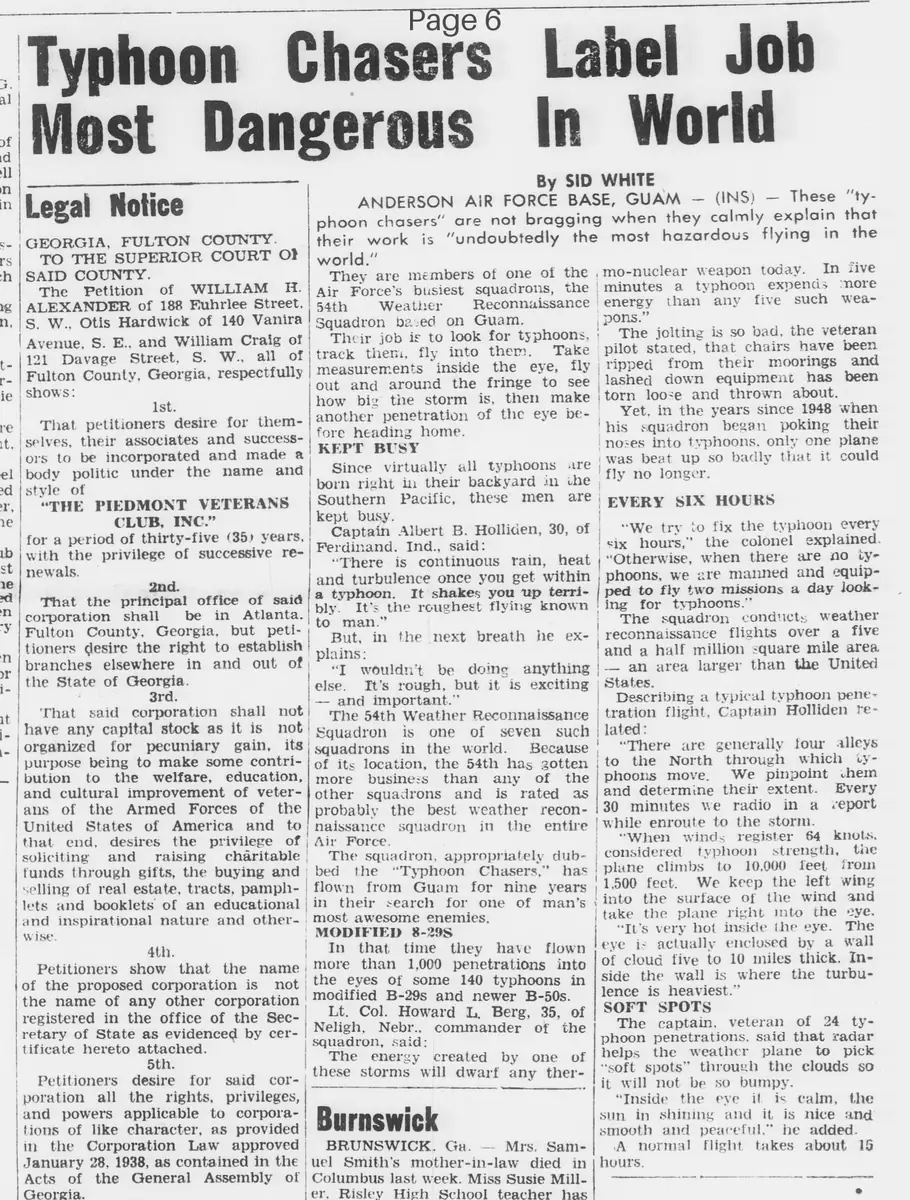
Typhoon Chasers
Most Dangerous
ANDERSON AIR FORCE BASE, GUAM - (INS) - These "typhoon chasers" are not bragging when they calmly explain that their work is "undoubtedly the most hazardous flying in the world."
They are members of one of the Air Force's busiest squadrons, the 54th Weather Reconnaissance Squadron based on Guam.
Their job is to look for typhoons, track them, fly into them. Take measurements inside the eye, fly out and around the fringe to see how big the storm is, then make another penetration of the eye before heading home.
KEPT BUSY
Since virtually all typhoons are born right in their backyard in the Southern Pacific, these men are kept busy.
Captain Albert B. Holliden, 30, of Ferdinand, Ind., said:
"There is continuous rain, heat and turbulence once you get within a typhoon. It shakes you up terribly. It's the roughest flying known to man."
But, in the next breath he explains:
"I wouldn't be doing anything else. It's rough, but it is exciting -- and important."
The 54th Weather Reconnaissance Squadron is one of seven such squadrons in the world. Because of its location, the 54th has gotten more business than any of the other squadrons and is rated as probably the best weather reconnaissance squadron in the entire Air Force.
The squadron, appropriately dubbed the "Typhoon Chasers," has flown from Guam for nine years in their search for one of man's most awesome enemies.
MODIFIED B-29S
In that time they have flown more than 1,000 penetrations into the eyes of some 140 typhoons in modified B-29s and newer B-50s.
Lt. Col. Howard L. Berg, 35, of Neligh, Nebr., commander of the squadron, said:
The energy created by one of these storms will dwarf any thermonuclear weapon today. In five minutes a typhoon expends more energy than any five such weapons.
The jolting is so bad, the veteran pilot stated, that chairs have been ripped from their moorings and lashed down equipment has been torn loose and thrown about.
Yet, in the years since 1948 when his squadron began poking their noses into typhoons, only one plane was beat up so badly that it could fly no longer.
EVERY SIX HOURS
"We try to fix the typhoon every six hours," the colonel explained. "Otherwise, when there are no typhoons, we are manned and equipped to fly two missions a day looking for typhoons."
The squadron conducts weather reconnaissance flights over a five and a half million square mile area an area larger than the United States.
Describing a typical typhoon penetration flight, Captain Holliden related:
"There are generally four alleys to the North through which typhoons move. We pinpoint them and determine their extent. Every 30 minutes we radio in a report while enroute to the storm.
"When winds register 64 knots, considered typhoon strength, the plane climbs to 10,000 feet from 1,500 feet. We keep the left wing into the surface of the wind and take the plane right into the eye.
"It's very hot inside the eye. The eye is actually enclosed by a wall of cloud five to 10 miles thick. Inside the wall is where the turbulence is heaviest."
SOFT SPOTS
The captain, veteran of 24 typhoon penetrations, said that radar helps the weather plane to pick "soft spots" through the clouds so it will not be so bumpy.
"Inside the eye it is calm, the sun is shining and it is nice and smooth and peaceful," he added.
A normal flight takes about 15 hours.
Most Dangerous
ANDERSON AIR FORCE BASE, GUAM - (INS) - These "typhoon chasers" are not bragging when they calmly explain that their work is "undoubtedly the most hazardous flying in the world."
They are members of one of the Air Force's busiest squadrons, the 54th Weather Reconnaissance Squadron based on Guam.
Their job is to look for typhoons, track them, fly into them. Take measurements inside the eye, fly out and around the fringe to see how big the storm is, then make another penetration of the eye before heading home.
KEPT BUSY
Since virtually all typhoons are born right in their backyard in the Southern Pacific, these men are kept busy.
Captain Albert B. Holliden, 30, of Ferdinand, Ind., said:
"There is continuous rain, heat and turbulence once you get within a typhoon. It shakes you up terribly. It's the roughest flying known to man."
But, in the next breath he explains:
"I wouldn't be doing anything else. It's rough, but it is exciting -- and important."
The 54th Weather Reconnaissance Squadron is one of seven such squadrons in the world. Because of its location, the 54th has gotten more business than any of the other squadrons and is rated as probably the best weather reconnaissance squadron in the entire Air Force.
The squadron, appropriately dubbed the "Typhoon Chasers," has flown from Guam for nine years in their search for one of man's most awesome enemies.
MODIFIED B-29S
In that time they have flown more than 1,000 penetrations into the eyes of some 140 typhoons in modified B-29s and newer B-50s.
Lt. Col. Howard L. Berg, 35, of Neligh, Nebr., commander of the squadron, said:
The energy created by one of these storms will dwarf any thermonuclear weapon today. In five minutes a typhoon expends more energy than any five such weapons.
The jolting is so bad, the veteran pilot stated, that chairs have been ripped from their moorings and lashed down equipment has been torn loose and thrown about.
Yet, in the years since 1948 when his squadron began poking their noses into typhoons, only one plane was beat up so badly that it could fly no longer.
EVERY SIX HOURS
"We try to fix the typhoon every six hours," the colonel explained. "Otherwise, when there are no typhoons, we are manned and equipped to fly two missions a day looking for typhoons."
The squadron conducts weather reconnaissance flights over a five and a half million square mile area an area larger than the United States.
Describing a typical typhoon penetration flight, Captain Holliden related:
"There are generally four alleys to the North through which typhoons move. We pinpoint them and determine their extent. Every 30 minutes we radio in a report while enroute to the storm.
"When winds register 64 knots, considered typhoon strength, the plane climbs to 10,000 feet from 1,500 feet. We keep the left wing into the surface of the wind and take the plane right into the eye.
"It's very hot inside the eye. The eye is actually enclosed by a wall of cloud five to 10 miles thick. Inside the wall is where the turbulence is heaviest."
SOFT SPOTS
The captain, veteran of 24 typhoon penetrations, said that radar helps the weather plane to pick "soft spots" through the clouds so it will not be so bumpy.
"Inside the eye it is calm, the sun is shining and it is nice and smooth and peaceful," he added.
A normal flight takes about 15 hours.
What sub-type of article is it?
Military Action
Adventure
Curiosity
What themes does it cover?
Bravery Heroism
Exploration
Triumph
What keywords are associated?
Typhoon Chasers
Weather Reconnaissance
Air Force Squadron
Guam Base
Typhoon Penetrations
B 29 Missions
Storm Tracking
What entities or persons were involved?
Captain Albert B. Holliden
Lt. Col. Howard L. Berg
Where did it happen?
Anderson Air Force Base, Guam; Southern Pacific
Story Details
Key Persons
Captain Albert B. Holliden
Lt. Col. Howard L. Berg
Location
Anderson Air Force Base, Guam; Southern Pacific
Event Date
Since 1948
Story Details
The 54th Weather Reconnaissance Squadron, dubbed Typhoon Chasers, based on Guam, flies modified B-29s and B-50s into typhoons to track and measure them, conducting penetrations into the eye every six hours over a vast area, facing extreme turbulence but with high success and importance in weather reconnaissance.