Thank you for visiting SNEWPapers!
Sign up free
The Recorder, Or, Lady's And Gentleman's Miscellany
Richmond, Virginia
What is this article about?
Critique of federal government's neglect of western frontiers, focusing on the 1794 Nickajack raid by Tennessee militia under Major Ore, who destroyed Cherokee towns allied with Creeks, killing warriors and recovering stolen goods, yet denied payment for crossing Indian boundaries despite preventing larger attacks.
Merged-components note: These components are parts of the same story on 'Nickajack and the Northwestern Frontier', with the first noting 'See page 4th' for continuation; merge across pages as a single logical unit.
Clippings
1 of 2
OCR Quality
Full Text
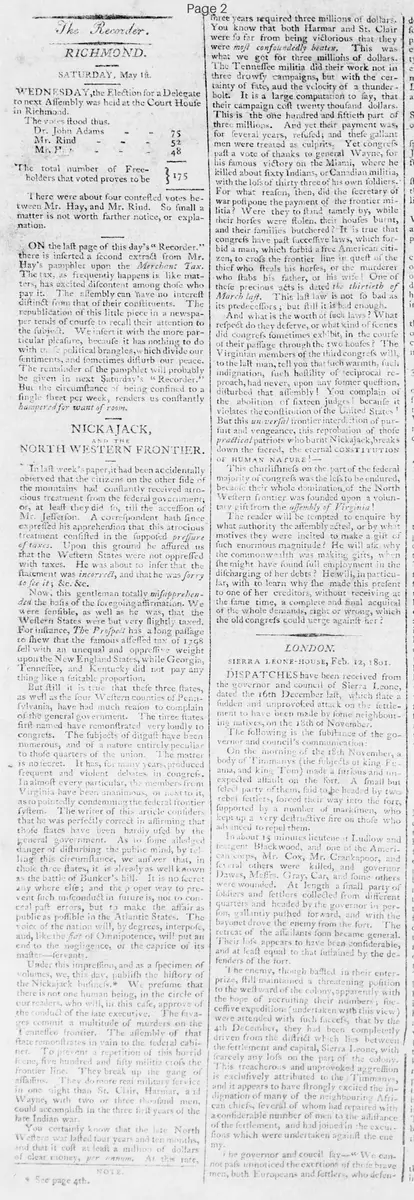
AND THE
NORTH WESTERN FRONTIER.
In last week's paper, it had been accidentally observed that the citizens on the other side of the mountains had constantly received atrocious treatment from the federal government; or, at least they did so, till the accession of Mr. Jefferson. A correspondent hath since expressed his apprehension that this atrocious treatment consisted in the supposed pressure of taxes. Upon this ground he assured us that the Western States were not oppressed with taxes. He was about to infer that the statement was incorrect, and that he was sorry to see it; &c. &c.
Now; this gentleman totally misapprehended the basis of the foregoing affirmation. We were sensible, as well as he was, that the Western States were but very slightly taxed. For instance. The Prospect has a long passage to show that the famous assessed tax of 1798 fell with an unequal and oppressive weight upon the New England States, while Georgia, Tennessee, and Kentucky did not pay any thing like a suitable proportion.
But still it is true that these three states, as well as the four Western counties of Pennsylvania, have had much reason to complain of the general government. The three states first named have remonstrated very loudly to congress. The subjects of disgust have been numerous, and of a nature entirely peculiar to those quarters of the union. The matter is no secret. It has, for many years, produced frequent and violent debates in congress.
In almost every particular, the members from Virginia have been unanimous, or next to it, as to pointedly condemning the federal frontier system. The writer of this article considers that he was perfectly correct in affirming that those states have been hardly used by the general government. As to some alleged danger of disturbing the public mind, by telling this circumstance, we answer that, in those three states, it is already as well known as the battle of Bunker's hill. It is no secret any where else; and the proper way to prevent such misconduct in future is, not to conceal past errors, but to make the affair as public as possible in the Atlantic States. The voice of the nation will, by degrees, interpose, and, like the fiat of Omnipotence, will put an end to the negligence, or the caprice of its master-servants.
Under this impression, and as a Specimen of volumes, we, this day, publish the history of the Nickajack business.* We presume that there is not one human being, in the circle of our readers, who will, in this case, approve of the conduct of the late executive. The savages commit a multitude of murders on the Tennessee frontier. The assembly of that state remonstrates in vain to the federal cabinet. To prevent a repetition of this horrid scene, five hundred and fifty militia cross the frontier line. They break up the gang of assassins. They do more real military service in one night than St. Clair, Harmar, and Wayne, with two or three thousand men, could accomplish in the three first years of the late Indian war.
You certainly know that the late North Western war lasted four years and ten months, and that it cost at least a million of dollars of clear money, per annum. At this rate, three years required three millions of dollars.
You know that both Harmar and St. Clair were so far from being victorious that they were most confoundedly beaten. This was what we got for three millions of dollars.
The Tennessee militia did their work not in three drowsy campaigns, but with the certainty of fate, and the velocity of a thunderbolt. It is a large computation to say, that their campaign cost twenty thousand dollars. This is the one hundred and fiftieth part of three millions. And yet their payment was, for several years, refused: and these gallant men were treated as culprits. Yet congress passed a vote of thanks to general Wayne, for his famous victory on the Miami, where he killed about sixty Indians, or Canadian militia, with the loss of thirty three of his own soldiers.
For what reason, then, did the secretary of war postpone the payment of the frontier militia? Were they to stand tamely by, while their horses were stolen, their houses burnt, and their families butchered? It is true that congress have passed successive laws, which forbid a man, which forbid a free American citizen, to cross the frontier line in quest of the thief who steals his horses, or the murderer who stabs his father, or his wife! One of these precious acts is dated the thirtieth of March last. This last law is not so bad as its predecessors: but still it is bad enough.
And what is the worth of such laws? What respect do they deserve, or what kind of scenes did congress sometimes exhibit, in the course of their passage through the two houses? The Virginian members of the third congress will, to the last man, tell you that such warmth, such indignation, such hostility of reciprocal reproach, had never, upon any former question, disturbed that assembly! You complain of the abolition of sixteen judges! because it violates the constitution of the United States!
But this universal frontier interdiction of pursuit and vengeance, this reprobation of those practical patriots who burnt Nickajack, breaks down the sacred, the eternal CONSTITUTION OF HUMAN NATURE!
This churlishness on the part of the federal majority of congress was the less to be endured, because their whole domination of the North Western frontier was founded upon a voluntary gift from the assembly of Virginia!
The reader will be tempted to enquire by what authority the assembly acted, or by what motives they were incited to make a gift of such enormous magnitude? He will ask why the commonwealth was making gifts, when she might have found full employment in the discharging of her debts? He will, in particular, wish to learn why she made this present to one of her creditors, without receiving at the same time, a complete and final acquittal of the whole demands, right or wrong, which the old congress could urge against her?
NOTE.
See page 4th
EXTRACT FROM THE HISTORY OF THE UNITED STATES FOR 1796.
By land, our interest has been as grossly betrayed as by sea. This appears from the discouragement constantly given to the defence of Indian frontier. On that head, the following narrative will repay a perusal.
On the 10th of November, 1794, President Washington, in his speech to Congress, has these words: "Towards none of the Indian tribes have overtures of friendship been spared. The Creeks, in particular, are covered from encroachment by the interposition of the general government, and that of Georgia." It would have been fortunate for the people of Tennessee, if the general government had covered them from the encroachments of the Creeks.
Respecting the behaviour of the Creeks previous to the delivery of that speech, information for the present work has been derived from two sources, the public newspapers, and a private manuscript communicated by Mr. Andrew Jackson, Representative from the state of Tennessee in the fourth Congress. An examination of these details will assist in ascertaining what sort of friendship the Creeks deserved, and to what side the balance of protection ought to have been inclined.
The account given in the newspapers amounts in substance to what follows. Continual skirmishes had been taking place for a long time. In one of these, on the 9th of August, 1794, lieutenant McClellan, with thirty-seven men, had been attacked on the Cumberland path, eighteen miles from South-West-Point, by above an hundred Creeks. He had four men killed, and four missing. He likewise lost thirty-one horses, with several other articles. A multitude of murders by the Indians are mentioned. Of these, it would be needless here to attempt a catalogue. A letter from Knoxville, dated 22d of September 1794, says, that the general assembly of Tennessee had then been in session for several weeks. They had prepared another memorial to Congress, with a list of the citizens killed, wounded, or taken prisoners by the Creeks and Cherokees, since the 1st of March last; the date of a former statement to Congress. The number was an hundred and twenty-seven, besides which the Indians had stolen four hundred and seventy-four horses. These thefts and murders had been chiefly committed while a party of the Lower Cherokees were at Philadelphia, giving the strongest promises of peace, and while major Seagrove, an agent for Indian affairs, was making assurances of the friendship of the Creeks. The letter concludes with an account of some fresh murders which had, at that moment, been received. They were said to have been committed on the 10th of September current.
Nickajack and Running Water were two of the most populous of the Lower Cherokee towns. They were situated close on the south bank of the Tennessee below a place called the Suck. They were principal crossing-places for the Creeks over the Tennessee, when they wanted to make war on Cumberland and Kentucky. They had co-operated with the warriors of Look-out Mountain and Will's towns, for several years past. They boasted of perfect security from their situation. They were surrounded on three sides by mountains, and protected on the north by the south branch of the Tennessee. They were also formidable by their numbers.
On the 7th of September, major Ore marched from Nashville to attack the savages. He had with him five hundred and fifty militia, of whom an hundred and fifty were from Kentucky. They arrived on the bank of the Tennessee, opposite to Nickajack, and undiscovered, in the dusk of the evening. About eleven o'clock at night, a part of them crossed the river on rafts, and surrounded the town, while another party lay in ambush on the opposite side of the river. The attack began about day break. Many of the savages plunged, according to their custom, into the water, and having got almost to the opposite shore, the militia in reserve rose from their covert and discharged a volley at the fugitives in the river. The victory was complete. Nine squaws and children were taken. About forty or forty-five warriors were killed. Accounts differ about their exact numbers.
As no particular detail is offered about Running Water, but barely that it was destroyed at the same time with Nickajack, it seems probable that they stood very near each other. In these towns two fresh scalps were found: and several others dry, that had been hung up as trophies. Many articles of property were recovered, which the militia knew to have been taken from their owners when killed by the Indians, in the course of the preceding twelve months. Among these were found a number of letters. They had been carried off when the Kentucky mail was robbed and the post murdered. In Nickajack was found a quantity of powder and lead, that had just been received from the Spanish government, as also a commission to Braeth, chief of the town, who was among the slain.
The prisoners confessed that sixty Creek and Cherokee warriors had passed through Nickajack, only nine days before, on their way to make war against the United States. Two nights previous to the destruction of Running Water, a scalp dance was held in it. Among others, John Watts was present; and it was there resolved to carry on the war with additional vigour. This the white people learned from the prisoners. The towns were burnt, and every thing destroyed. Such is the substance of the newspaper account. That received from Mr. Jackson is to the following effect.
Major James Ore was, in the close of August, 1794, ordered by governor Blount to march to the district of Mero, to defend its frontier; and on the 6th of September, he was ordered, by general Robertson to march to the Lower Cherokee towns, and destroy them.
"It is proper for me here to observe," says Mr. Jackson, "that the Indians inhabiting those towns were daily killing our citizens, and our officers, transmitting a roster of the captured, killed, and wounded to the secretary at war: and the answers returned were; not to pursue on any account across the Indian boundary, or carry on any offensive measures against the Indian boundary in the pursuit of depredating parties."
Major Ore obeyed the orders of general Robertson. He marched to Nickajack and Running Water, swept them with the besom of destruction, and killed about thirty warriors. 'It is necessary here to state some facts. The night before major Ore made the attack on Nickajack, the Indians held the scalp dance over two fresh scalps, which they had taken on the frontier. Ore had pursued the track of this party. On the very day that he made the attack, twenty-two Indians fell upon the station of the widow Hays, killed one man, and wounded three; and the evening before, they had burnt captain John Donelson's station. At the time that general Robertson issued the order to Ore, he had information of an intended general attack, contemplated on that frontier. This was well substantiated, and the expedition of Ore was the only circumstance which prevented it, and established peace on the frontier.
The pay of these troops hath been suspended, because they crossed the Indian boundary, although they precisely pursued the orders given by general Robertson. The muster and pay rolls were, in the latter end of the year 1794, deposited with colonel David Henley, agent of the war department at Knoxville. Governor Blount, in 1794, transmitted to Mr. Knox general Robertson's order, authorizing and commanding the expedition? and on the 19th of December of that year, this communication was laid before Congress. Yet though frequent applications have been made at the office of the secretary at war for payment, they have constantly been refused. After a delay of more than two years, Mr. Jackson, in the last session of the fourth Congress, has applied to Mr. Pickering to recover the necessary papers, that he might lay the subject before the House of Representatives. "I am informed by him," says Mr. Jackson, "that he knows nothing of the business." Here the matter stood, on the 22d of February, 1797.
Mr. Jackson further adds that this is not a single instance. In 1794, major Thomas Johnston commanded a party of Tennessee militia, who were ordered to pursue a gang of Indians. The latter had murdered colonel John Montgomery, and the Titsworth family. In the pursuit, they crossed into the Kentucky territory. Colonel Henley gave that reason for suspending their pay. These were the only two parties of Tennessee militia, whose arrears have not been paid up, excepting those comprehended in the approbation act for 1797.
What sub-type of article is it?
What themes does it cover?
What keywords are associated?
What entities or persons were involved?
Where did it happen?
Story Details
Key Persons
Location
Nickajack And Running Water Towns On The Tennessee River, Tennessee Frontier
Event Date
1794, Specifically September 7
Story Details
Tennessee militia under Major Ore, following orders from General Robertson, crossed into Cherokee territory in September 1794 to destroy Nickajack and Running Water towns, killing 30-45 warriors, capturing prisoners, and recovering stolen property, thus preventing a larger Indian attack on the frontier. Despite success and low cost compared to federal campaigns, their pay was withheld for years by the federal government due to violating boundary laws, sparking outrage and congressional debate.