Thank you for visiting SNEWPapers!
Sign up free
Editorial
August 10, 1953
Trainman News
Indianapolis, Marion County, Indiana
What is this article about?
The editorial criticizes the National Association of Manufacturers' proposal for a national sales tax on manufactured goods, arguing it exacerbates inequities and burdens low-income groups, while highlighting hypocrisies in incentives and economic policy under the Eisenhower Administration.
Clipping
OCR Quality
98%
Excellent
Full Text
NAM Incentives
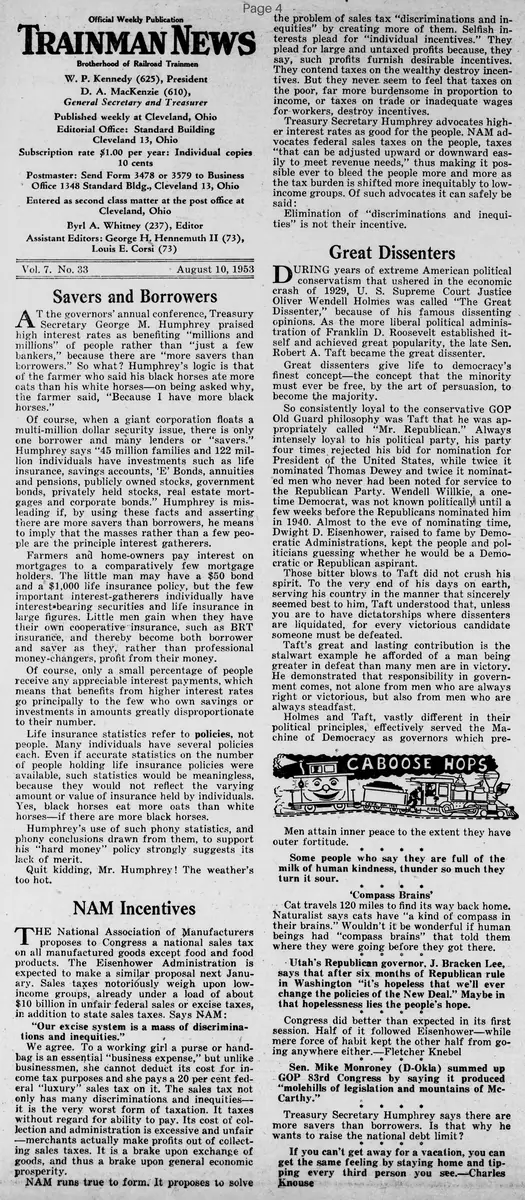
The National Association of Manufacturers proposes to Congress a national sales tax on all manufactured goods except food and food products. The Eisenhower Administration is expected to make a similar proposal next January. Sales taxes notoriously weigh upon low-income groups, already under a load of about $10 billion in unfair federal sales or excise taxes, in addition to state sales taxes. Says NAM:
"Our excise system is a mass of discriminations and inequities."
We agree. To a working girl a purse or handbag is an essential "business expense," but unlike businessmen, she cannot deduct its cost for income tax purposes and she pays a 20 per cent federal "luxury" sales tax on it. The sales tax not only has many discriminations and inequities--it is the very worst form of taxation. It taxes without regard for ability to pay. Its cost of collection and administration is excessive and unfair--merchants actually make profits out of collecting sales taxes. It is a brake upon exchange of goods, and thus a brake upon general economic prosperity.
NAM runs true to form. It proposes to solve the problem of sales tax "discriminations and inequities" by creating more of them. Selfish interests plead for "individual incentives." They plead for large and untaxed profits because, they say, such profits furnish desirable incentives. They contend taxes on the wealthy destroy incentives. But they never seem to feel that taxes on the poor, far more burdensome in proportion to income, or taxes on trade or inadequate wages for workers, destroy incentives.
Treasury Secretary Humphrey advocates higher interest rates as good for the people. NAM advocates federal sales taxes on the people, taxes "that can be adjusted upward or downward easily to meet revenue needs," thus making it possible ever to bleed the people more and more as the tax burden is shifted more inequitably to low-income groups. Of such advocates it can safely be said:
Elimination of "discriminations and inequities" is not their incentive.
The National Association of Manufacturers proposes to Congress a national sales tax on all manufactured goods except food and food products. The Eisenhower Administration is expected to make a similar proposal next January. Sales taxes notoriously weigh upon low-income groups, already under a load of about $10 billion in unfair federal sales or excise taxes, in addition to state sales taxes. Says NAM:
"Our excise system is a mass of discriminations and inequities."
We agree. To a working girl a purse or handbag is an essential "business expense," but unlike businessmen, she cannot deduct its cost for income tax purposes and she pays a 20 per cent federal "luxury" sales tax on it. The sales tax not only has many discriminations and inequities--it is the very worst form of taxation. It taxes without regard for ability to pay. Its cost of collection and administration is excessive and unfair--merchants actually make profits out of collecting sales taxes. It is a brake upon exchange of goods, and thus a brake upon general economic prosperity.
NAM runs true to form. It proposes to solve the problem of sales tax "discriminations and inequities" by creating more of them. Selfish interests plead for "individual incentives." They plead for large and untaxed profits because, they say, such profits furnish desirable incentives. They contend taxes on the wealthy destroy incentives. But they never seem to feel that taxes on the poor, far more burdensome in proportion to income, or taxes on trade or inadequate wages for workers, destroy incentives.
Treasury Secretary Humphrey advocates higher interest rates as good for the people. NAM advocates federal sales taxes on the people, taxes "that can be adjusted upward or downward easily to meet revenue needs," thus making it possible ever to bleed the people more and more as the tax burden is shifted more inequitably to low-income groups. Of such advocates it can safely be said:
Elimination of "discriminations and inequities" is not their incentive.
What sub-type of article is it?
Taxation
Economic Policy
What keywords are associated?
Sales Tax
National Association Of Manufacturers
Tax Inequities
Excise Taxes
Economic Incentives
Low Income Burden
What entities or persons were involved?
National Association Of Manufacturers
Eisenhower Administration
Congress
Treasury Secretary Humphrey
Editorial Details
Primary Topic
Critique Of Nam's Proposed National Sales Tax
Stance / Tone
Strongly Critical Of Sales Taxes And Their Proponents
Key Figures
National Association Of Manufacturers
Eisenhower Administration
Congress
Treasury Secretary Humphrey
Key Arguments
Sales Taxes Disproportionately Burden Low Income Groups
Current Excise System Is Discriminatory And Inequitable
Sales Taxes Are The Worst Form Of Taxation As They Ignore Ability To Pay
Collection Of Sales Taxes Is Costly And Allows Merchants To Profit
Sales Taxes Hinder Economic Prosperity
Nam's Proposal Creates More Discriminations Rather Than Solving Them
Advocates Ignore Incentives Destroyed By Taxes On The Poor
Higher Interest Rates And Sales Taxes Shift Burden To Low Income Groups